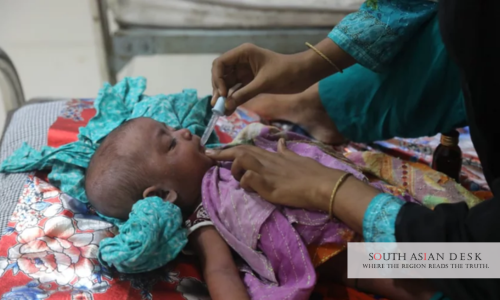
Bangladesh Measles Outbreak: Despite headline vaccination figures exceeding 100 percent, a catastrophic breakdown in vaccine supply and widening immunity gaps have driven Bangladesh’s deadliest measles crisis in a generation.
Bangladesh is in the grip of a severe measles outbreak that has swept across 58 of its 64 districts since early 2026, killing hundreds of children and overwhelming hospitals — even as official records once claimed the country had achieved full vaccination coverage. The crisis, rooted in a combination of inflated statistics, a policy-driven vaccine stockout, and years of accumulated immunity gaps, has exposed how a paper figure of 100 percent can mask a far more fragile reality on the ground.
Bangladesh Measles Outbreak: The Scale of the Crisis
Between mid-March and mid-April 2026 alone, Bangladesh recorded over 19,000 suspected measles cases across 58 of its 64 districts, with at least 166 confirmed deaths. Subsequent figures have risen sharply. Bangladesh’s Directorate General of Health Services (DGHS) reported suspected cases surging to over 56,000, with hospitals across the country severely overwhelmed. According to public health experts and officials, the outbreak has left at least 294 children dead.
The burden has fallen almost entirely on the youngest. Children aged under five years account for 79 percent of reported cases, including those aged under two years at 66 percent and infants aged under nine months at 33 percent. Suspected deaths have been reported mainly among unvaccinated children aged under two years.
The geographic concentration is stark. The highest cumulative burden of suspected cases has been reported in Dhaka with 8,263 cases, Rajshahi with 3,747, Chattogram with 2,514, and Khulna with 1,568. In Dhaka, cases are concentrated in densely populated informal settlements, including Demra, Jatrabari, Kamrangirchar, Korail, Mirpur, and Tejgaon industrial and slum clusters.
What the ‘100%’ Figure Actually Means
The headline statistic — measles-rubella first-dose (MR1) coverage of 100.1 percent in 2023 — was always a narrower measure than it appeared. That figure counted both valid and invalid vaccinations. When disaggregated, MR1 coverage fell to 92.73 percent by 2025, while second-dose (MR2) coverage dropped to 90.78 percent from 98.1 percent in 2023.
Field surveys painted an even bleaker picture. According to Bangladesh’s own Coverage Evaluation Survey conducted in 2023, MR1 coverage had already declined to 86 percent, down from 88.6 percent in 2019, while MR2 coverage had fallen further to 80.7 percent from 89 percent in 2019. As a result, approximately 10 million children remained susceptible for MR1 and 20 million for MR2.
To prevent outbreaks, measles requires population immunity of at least 95 percent. Bangladesh had dipped well below that threshold — yet the administrative figure of 100 percent obscured the gap until the outbreak made it undeniable.
How the Vaccine Supply Collapsed
The immediate catalyst was a policy shift introduced in September 2025, when the then-interim government halted vaccine procurement through UNICEF and moved to an open tender system — a process in which the government invites suppliers to bid and evaluates proposals before placing orders.
UNICEF strongly opposed the change, warning it might disrupt the immunisation system. UNICEF’s representative in Bangladesh, Rana Flowers, said she repeatedly warned health officials against making the switch.
The tender process stalled in bureaucratic delays. Stocks of six types of vaccines, including measles, were exhausted by March 2026. Under the previous programme, a three-month buffer stock had been routinely maintained. The interim government procured vaccines worth approximately Tk 200 crore from UNICEF on credit in late 2025 when shortage reports began to emerge, but this proved insufficient.
The clinical pressure on hospitals became severe. The Infectious Diseases Hospital in Mohakhali, Dhaka, admitted 560 suspected measles cases in the first three months of 2026, compared with 69 suspected cases for the entire preceding year. March 2026 alone accounted for 448 of those admissions.
Structural Immunity Gaps Compounded the Crisis
The stockout was not the only driver. The absence of regular nationwide supplementary measles-rubella campaigns since 2020, combined with routine immunisation gaps, had increased the number of susceptible children and contributed to the current outbreak.
Almost five million children in Bangladesh were not fully immunised in 2025, including 70,000 children with zero doses and more than 400,000 who were under-immunised. UNICEF, WHO, and Gavi, the Vaccine Alliance, had warned of major gaps among children in urban slum settlements and other marginalised communities.
Professor Be-Nazir Ahmed, a public health expert, stated that delayed procurement meant vaccination coverage was not properly maintained, resulting in the outbreak. “If responsibility is to be assigned, it falls on the interim government. Their failure to ensure proper vaccination meant herd immunity or collective protection was not achieved.”
Background
Bangladesh routinely administers two doses of the measles-rubella vaccine to children at nine months and 15 months of age, supplemented by nationwide campaigns every four years to maintain the coverage threshold needed to prevent outbreaks. For years, UNICEF supplied the vaccines, with most funding provided by Gavi, the Vaccine Alliance.
Before the current outbreak, Bangladesh had made substantial progress towards measles elimination. Reported coverage with the first dose of the measles-containing vaccine had increased considerably between 2000 and 2016, and confirmed measles incidence had declined sharply over the same period.
What’s Next
On Sunday, 5 April 2026, following a sharp rise in cases through March, the Bangladesh Ministry of Health and Family Welfare launched an emergency measles-rubella vaccination campaign targeting children aged six months to five years, regardless of prior vaccination status. The campaign began in 30 high-risk upazilas across 18 districts. By 18 April, more than 1,492,000 children had been vaccinated, and on 20 April the campaign was expanded nationwide.
The Government of Bangladesh allocated Tk 604 crore (approximately USD 49.3 million) for emergency vaccine procurement to address current stock gaps. The newly elected government, which took office on 17 February 2026, reinstated vaccine procurement through UNICEF in April and coordinated with WHO and Gavi to secure supplies.
The Bangladesh measles outbreak serves as a sobering reminder that a vaccination coverage figure is only as reliable as the system that produces it — and that when that system falters, the consequences fall hardest on the most vulnerable.
Published in SouthAsianDesk, June 8, 2026
Follow SouthAsianDesk on X, Instagram and Facebook for insights on business and current affairs from across South Asia.