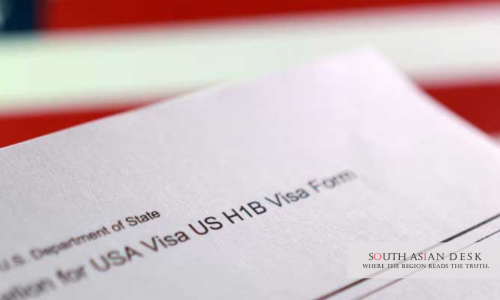
H-1B visa rules came under renewed scrutiny after a US federal judge declared Donald Trump’s $100,000 fee unlawful, delivering a major setback to one of his administration’s most controversial immigration measures.
US District Judge Leo Sorokin in Boston ruled that the $100,000 H-1B fee, imposed through a presidential proclamation, was not a lawful immigration penalty but effectively a tax that had not been authorised by Congress.
The ruling came in a lawsuit filed by 20 Democratic state attorneys general, who challenged the Trump visa fee on the grounds that the executive branch could not impose such a sweeping payment requirement without clear congressional approval.
The decision blocks the administration from implementing the fee through the State Department and US Citizenship and Immigration Services, although the White House is expected to appeal the ruling.
H-1B Visa Fee Challenged As Unauthorised Tax
Judge Sorokin rejected the administration’s argument that the H-1B visa fee was a lawful penalty linked to the president’s power to restrict the entry of certain foreign nationals.
Instead, the court found that the structure and application of the payment made it closer to a tax than a penalty. Under the US constitutional framework, taxation powers generally rest with Congress, not the president acting alone.
The Trump administration had defended the fee as part of a broader US immigration policy designed to protect American workers and discourage companies from relying heavily on skilled foreign workers.
However, the court found that the administration had exceeded its authority by attaching such a large financial condition to new H-1B petitions without congressional approval.
What The $100,000 H-1B Fee Meant For Employers
The $100,000 H-1B fee was introduced in September 2025 through a presidential proclamation titled “Restriction On Entry Of Certain Nonimmigrant Workers.” The measure required many new H-1B petitions to be accompanied by a $100,000 payment.
The H-1B visa allows US employers to hire skilled foreign workers in specialty occupations, including technology, engineering, healthcare, finance and research.
The programme is especially important for US tech companies, universities, hospitals and other employers that rely on high-skilled international talent.
Under the regular H-1B cap, 65,000 visas are available annually, with an additional 20,000 reserved for foreign workers who hold advanced degrees from US institutions.
Before Trump’s proclamation, employers typically paid several thousand dollars in filing and related fees for H-1B petitions, depending on the size and type of employer.
The $100,000 H-1B fee represented a sharp increase and raised concerns that smaller businesses, universities and public institutions would be priced out of hiring overseas talent.
Why The H-1B Visa Ruling Matters
The ruling is significant because it limits how far a president can go in reshaping US immigration policy through executive action alone.
Supporters of the Trump visa fee said it was necessary to curb abuse of the H-1B programme and encourage companies to hire American workers first.
Critics argued that the policy was excessive, legally flawed and harmful to employers that depend on specialised global talent.
For employers, the ruling may ease immediate uncertainty around the cost of hiring skilled foreign workers.
For foreign professionals, especially those seeking work in the US technology sector, it removes one of the biggest financial barriers created by the proclamation, at least for now.
White House Expected To Appeal H-1B Visa Ruling
The White House has defended the policy and said the administration believes the order will be reversed on appeal.
Officials have maintained that the president has broad authority to restrict the entry of foreign nationals when he determines that their entry is not in the national interest.
The legal fight is therefore unlikely to end with Monday’s ruling.
The administration may seek a stay or appeal the decision, while business groups, states and employers are expected to continue challenging the fee and related immigration measures.
For now, the judgment represents a major legal defeat for the Trump administration’s $100,000 H-1B fee and a significant moment in the continuing debate over skilled immigration, foreign workers in the US and the limits of presidential power.
Published in SouthAsianDesk, June 9, 2026
Follow SouthAsianDesk on X, Instagram and Facebook for insights on business and current affairs from across South Asia.