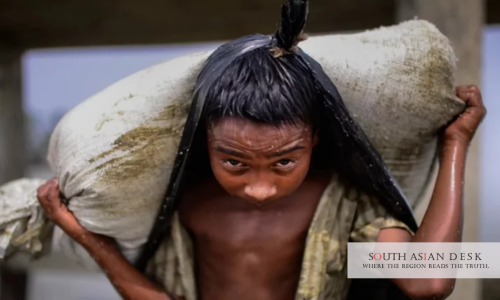
Child labour in Bangladesh is rising at an alarming rate, with one in every eleven children now engaged in work, a sharp deterioration from one in fifteen just six years ago. New data from the Multiple Indicator Cluster Survey (MICS) 2025, released to coincide with the observance of World Day Against Child Labour on 12 June, reveals that nearly 1.2 million additional children have entered the workforce since 2019, pushing the national child labour rate from 6.8 percent to 9.2 percent of all children aged five to seventeen. The findings place Bangladesh sharply at odds with global trends, which have seen child labour decline significantly over the same period.
The MICS survey, which is conducted in accordance with internationally recognised Sustainable Development Goal indicators, defines child labour to include paid and unpaid economic activity, work in family enterprises, agricultural labour, and excessive domestic responsibilities that interfere with a child’s education, health, or overall development. The breadth of the definition is deliberate: it acknowledges that exploitation does not always take the form of a wage relationship, and that millions of children are effectively lost to the labour market without ever appearing on a payroll.
The Scale Of Child Labour In Bangladesh: Key Findings
The headline figure of 9.2 percent conceals significant variation across age groups, gender, and geography. Among children aged five to eleven, approximately eight percent are engaged in labour, a figure that rises to fourteen percent among those aged twelve to fourteen, suggesting that the risk of entering the workforce intensifies sharply at precisely the age when children should be completing their foundational schooling.
The gender gap is also pronounced. Roughly eleven percent of boys are engaged in child labour, compared to seven percent of girls, a disparity that likely reflects the concentration of male child labour in visible sectors such as construction, transport, and agriculture, as opposed to the domestic and household work that affects girls but may go underreported.
Regional patterns reveal further inequalities. Rajshahi recorded the highest rate of child labour in the country at 12.4 percent, followed closely by Rangpur at 11.8 percent, Mymensingh at 10.1 percent, and Khulna at 9.8 percent. The divisions of Barisal, Sylhet, Chittagong, and Dhaka fell below the national average, though even these lower figures represent substantial numbers of working children in absolute terms.
Out-Of-School Children: The Highest-Risk Group
Perhaps the starkest finding in the MICS 2025 data is the relationship between educational exclusion and child labour. Children who are out of school are four times more likely to be engaged in labour than those attending school. The correlation exposes the self-reinforcing nature of the crisis: poverty drives children out of the classroom, and the absence of education in turn traps them in low-wage, exploitative work from which escape becomes progressively harder.
Child rights advocate Abdullah Al Mamun, quoted in reporting on the findings, argued that child labour must be understood as a symptom rather than a root problem, with school dropouts, poverty, and inadequate social protection forming the underlying architecture of the crisis. He emphasised that Bangladesh’s policy response has historically been skewed towards rehabilitation, assisting children already in work, rather than prevention, and called for coordinated action across the ministries responsible for education, social welfare, labour, women and children’s affairs, and local government.
Bangladesh Bucks A Positive Global Trend
The deterioration in Bangladesh’s child labour statistics is particularly striking when set against the global picture. According to estimates published by the Child Protection Global Network and the International Labour Organization (ILO), the number of children engaged in labour worldwide fell by more than 22 million between 2020 and 2024, declining from approximately 160 million to 138 million. Over a longer timeframe, the progress is even more dramatic: in 2000, an estimated 246 million children worldwide were engaged in labour; by 2024, that figure had almost halved.
Bangladesh’s trajectory runs counter to this progress. Child rights advocates and international agencies including UNICEF and the ILO have identified a combination of structural and conjunctural factors as driving the increase: deteriorating economic conditions, inflationary pressures that have eroded household purchasing power, and persistent gaps in social protection coverage that leave vulnerable families with no meaningful safety net when incomes fall.
The Legal Framework And Its Limits
Bangladesh’s Labour Act prohibits the employment of children under fourteen and restricts access to hazardous work for adolescents. On paper, the legal framework is broadly compliant with international standards. In practice, enforcement presents a formidable challenge, particularly in the informal sector, which accounts for the overwhelming majority of child labour, where regulatory monitoring is limited and labour inspectors lack both the resources and the reach to intervene systematically.
The government has recently prepared a draft National Action Plan for 2026–2030, and Finance Minister Amir Khasru Mahmud Chowdhury, in his budget speech, indicated that time-bound measures to address child labour would continue to be implemented. However, international agencies and child protection experts have consistently cautioned that legislative commitments and action plans will not by themselves reverse the trend. Without substantial investment in education access, social safety nets, nutrition programs, and family livelihoods, particularly for the poorest households, the economic pressures that push children into work are unlikely to abate.
A Generational Challenge That Demands Urgent Action
The MICS 2025 findings arrive at a moment when Bangladesh is navigating significant political and economic transition following the upheaval of 2024. The challenge of reversing the child labour surge is, at its core, a challenge of protecting the country’s next generation from a cycle of poverty and educational deprivation that, once embedded, becomes deeply difficult to break.
Al Mamun summarised the imperative with clarity: ensuring that every child remains in school is the single most effective tool available for eradicating child labour. That objective requires not merely good policy design, but sustained investment, institutional coordination, and the political will to enforce standards in sectors of the economy where exploitation has long been regarded as an unremarkable feature of daily life.
For Bangladesh, a country that has in recent decades earned international recognition for progress on development indicators from child mortality to female education, the reversal documented by MICS 2025 represents a serious warning. The question now is whether the warning will translate into action before another generation of children loses the years they cannot recover.
Published in SouthAsianDesk, June 12, 2026
Follow SouthAsianDesk on X, Instagram and Facebook for insights on business and current affairs from across South Asia.