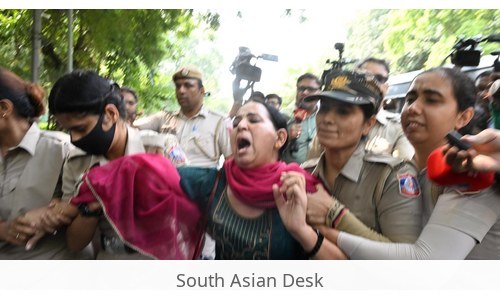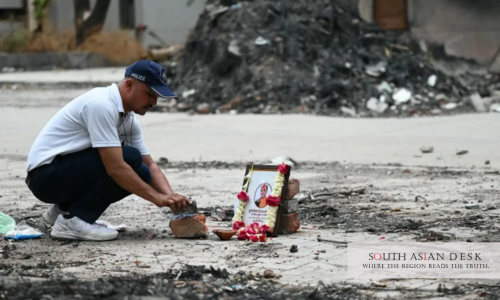
The Air India crash in Ahmedabad claimed 260 lives on 12 June 2025, making it one of the deadliest aviation disasters in South Asian history. Twelve months later, the families of those killed gathered at the crash site on Friday to mark the anniversary — but they did so without the definitive account of what happened they had been waiting for.
India’s Aircraft Accident Investigation Bureau (AAIB) is expected to publish only an interim report in the coming days, rather than the final findings that international aviation rules call for within a year of an accident. For many families, the continued silence from investigators has compounded a year of grief with a year of unanswered questions.
What Happened: The Final Minutes Of Flight AI171
Air India Flight AI171 was a Boeing 787 Dreamliner operating a scheduled service from Ahmedabad’s Sardar Vallabhbhai Patel International Airport to London Gatwick. It departed on the afternoon of 12 June 2025, but never left the city. According to data recorded by the flight tracking service Flightradar24, the aircraft’s final signal was received seconds after takeoff, at 1:38pm local time. The plane had reached an altitude of no more than 625 feet, approximately 190 metres, before losing height and striking the ground outside the airport perimeter.
A mayday alert was transmitted to air traffic control in the moments before all communication ceased. The aircraft came down in Meghani Nagar, a densely populated residential district, striking a medical college hostel that stood directly in its path. The scale of destruction was immediate and catastrophic.
Of the 242 people aboard, 241 were killed. Passengers included 169 Indian nationals and 52 British nationals. A further 19 people on the ground near the crash site also lost their lives, with 67 others sustaining injuries. The total death toll of 260 places the Ahmedabad disaster among the most deadly aviation accidents of the past decade worldwide, and the worst on Indian soil in modern times.
The crash was also an historic first in another sense: it was the world’s first fatal accident involving a Boeing 787 Dreamliner, a widebody jet that had been in commercial service since 2011 and which, until that afternoon in Ahmedabad, had an unblemished safety record.
The Sole Survivor And The Question Of Compensation
Among those aboard Flight AI171, only one person survived: Vishwash Kumar Ramesh, a British national who lost his brother in the disaster. The circumstances of his survival have not been fully disclosed publicly. Ramesh has since been represented in legal proceedings by Sanjiv Patel, who disclosed on the eve of the first anniversary that Air India had paid Ramesh £21,500, approximately $28,800, to support his wife and their five-year-old son. Whether comparable payments have been made to the families of other victims has not been confirmed.
The Investigation: What The Preliminary Report Revealed — And What It Didn’t
India’s AAIB released a 15-page preliminary report one month after the crash, as required under international aviation law. The document disclosed that the fuel supply to the aircraft’s engines had been cut off in the moments before the crash, and reproduced two brief lines of cockpit conversation between the captain and co-pilot referencing the fuel cut-off. Those two sentences immediately ignited a contentious public debate, with some commentators suggesting they pointed towards deliberate pilot action — a theory the Federation of Indian Pilots union has vigorously contested.
The preliminary report did not explain why the fuel switches were turned off, nor did it distinguish between a mechanical fault, a procedural error, and deliberate human action. Critically, it made no safety recommendations to either Boeing or engine manufacturer GE Aerospace, a fact that was widely interpreted as indicating investigators had not, at that early stage, identified any technical fault with the aircraft itself. The absence of any such recommendation has done little to settle the question of cause; it has, if anything, shifted suspicion further towards the flight crew.
The Pilot Suicide Theory: Contested And Unresolved
The suggestion that the captain may have deliberately disabled the aircraft’s fuel supply has been the most inflammatory element of the investigation, and remains unresolved. An early assessment by United States officials, reported by Reuters, indicated that cockpit voice recordings were consistent with the captain having cut the fuel flow. However, the AAIB stated at the time that it was premature to reach any firm conclusions.
The Federation of Indian Pilots has pushed back against this framing, calling on investigators to obtain further technical data from Boeing and Air India to allow for a proper challenge to the pilot suicide hypothesis. The union’s president, Charanvir Randhawa, was notably direct on the eve of the anniversary: releasing an interim report at this stage, he argued, would serve only to generate further speculation rather than provide clarity.
Meanwhile, the captain’s father has filed a petition before India’s Supreme Court seeking an independent inquiry — one that would examine alternative explanations for the crash beyond deliberate pilot action.
Where The Investigation Stands Now
Progress over the past year has been slow. Engine testing was conducted in April 2026, and AAIB officials travelled to France to examine the aircraft’s engine management unit as part of their technical analysis. The engines themselves were sent to the United States for detailed examination. Bloomberg, citing informed sources, reported this week that the final investigation report is expected to be published within three months, once engine analysis is concluded.
Under international civil aviation rules, a final accident report is due within twelve months of a crash where possible, with interim statements required on each anniversary if the investigation continues. The AAIB’s decision to issue only an interim report on Friday means the probe will extend into at least its second year, a delay that international aviation bodies have noted is not unprecedented in complex investigations but which nonetheless leaves families in an extended state of uncertainty.
A Crash With Wider Consequences
The Ahmedabad disaster struck Air India at a difficult moment in its institutional history. The carrier had only recently returned to the Tata Group through privatisation and was mid-way through a substantial fleet and operational overhaul when the crash occurred. The investigation’s inconclusive status, combined with Pakistan’s ongoing airspace ban on Indian carriers and the disruption caused by the US-Israel war on Iran to regional route networks, has complicated the airline’s path to recovery.
For the 260 families who lost loved ones in the wreckage at Meghani Nagar, however, the corporate and geopolitical context is of secondary concern. One year on, their primary demand remains unchanged: a full, transparent, and final account of why Air India Flight AI171 came down, and who or what is responsible for the catastrophe that followed.
Published in SouthAsianDesk, June 13, 2026
Follow SouthAsianDesk on X, Instagram and Facebook for insights on business and current affairs from across South Asia.