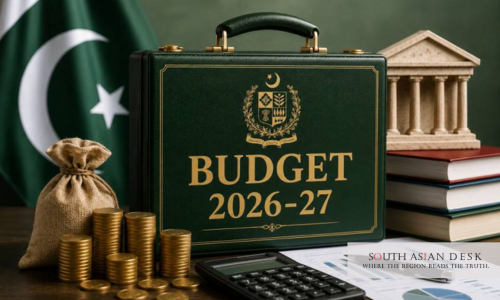
Pakistan’s budget 2026-27, presented to the National Assembly on Friday by Finance Minister Muhammad Aurangzeb, sets total federal spending at Rs 18.771 trillion, approximately $67 billion, and charts a course of continued fiscal austerity under the International Monetary Fund’s Extended Fund Facility while delivering targeted relief to salaried taxpayers and raising defense expenditure to its highest level on record.
The third consecutive budget under the Shehbaz Sharif government reflects an economy that has stabilized from the precipice of sovereign default in 2023 but remains structurally constrained by a debt servicing burden that alone will consume Rs 8.054 trillion, roughly 43 percent of the entire outlay, in the coming fiscal year.
Pakistan Budget 2026-27: Key Fiscal Targets: Growth, Inflation And The IMF Compact
The government is targeting GDP growth of 4 percent in FY2026-27, a modest improvement on the estimated 3.7 percent recorded in the outgoing year. Inflation is projected at 8.2 percent, up from an average of approximately 7 percent in the current fiscal year, a figure that will be watched carefully given that it erodes any nominal gains from the salary and pension increases announced alongside the budget.
Nominal GDP has been projected at Rs 143.604 trillion for the coming year, with per capita income standing at $1,901. Foreign exchange reserves are now sufficient to cover three months of imports, Aurangzeb noted, a meaningful recovery from the dangerously low levels of 2023. Remittances are projected to reach $41 billion by the close of the current fiscal year, with 92 percent now flowing through formal banking channels.
The central fiscal compact with the IMF remains the primary constraint shaping every allocation in the budget. The federal deficit is projected at Rs 7.02 trillion, or 3.6 percent of GDP. After factoring in an expected combined provincial surplus of Rs 1.794 trillion, the consolidated deficit falls to Rs 5.226 trillion. Crucially, the government has committed to a primary surplus, revenues minus all expenditure except debt interest, of Rs 2.828 trillion, equivalent to 2 percent of GDP. This is a key IMF programme condition, and it is the arithmetic ceiling within which every other budget decision has been made.
Defence: Pakistan Budget 2026-27’s Most Politically Significant Allocation
The single most politically significant item in the Pakistan budget 2026-27 is the allocation for defense, which has been raised to over Rs 3 trillion, up from Rs 2.56 trillion in the previous year, itself already a 20 percent increase following the military confrontation with India in 2025. The cumulative effect across two budgets has been to nearly double defense spending in absolute rupee terms within two years.
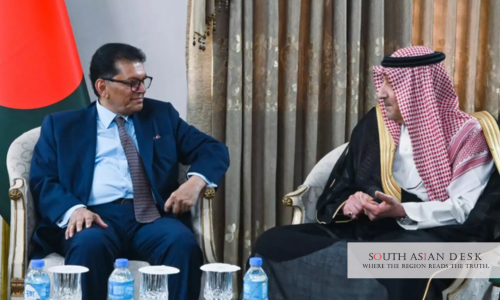
Aurangzeb was explicit about the rationale. “Defense spending has been increased considerably to make the country invincible due to the uncertainty in the region,” he told the National Assembly. He also lauded the armed forces for their role in generating foreign exchange earnings, and described the recently concluded strategic defense agreement between Pakistan and Saudi Arabia as a moment of national pride. Defense expenditure as a share of GDP now stands at 2.1 percent, compared to 2.03 percent in the revised FY26 estimate.
The increase comes at a time of acutely heightened regional tensions. The US-Israeli military campaign against Iran, now in its third month, has disrupted regional logistics, trade flows, and energy price expectations across South Asia, while the unresolved status of the India-Pakistan ceasefire, under international supervision since the May 2025 conflict, has kept security planners in Rawalpindi on a sustained elevated posture.
Revenue: A Demanding FBR Target
On the revenue side, the Federal Board of Revenue has been assigned a tax collection target of Rs 15.26 trillion for FY27, representing an increase of over 8 percent from Rs 14.13 trillion in the current year. After transferring Rs 8,848 billion to provinces under the National Finance Commission Award, the federal government’s net revenue receipts are estimated at Rs 11.751 trillion. Non-tax revenues are projected to exceed Rs 5.34 trillion, drawing substantially on State Bank of Pakistan profit transfers and petroleum levy collections.
To bridge the remaining financing gap, the government plans to raise Rs 4.012 trillion through treasury bills, Pakistan Investment Bonds, and Sukuk instruments. Privatisation proceeds have been estimated at Rs 161 billion, though the track record on privatisation timelines in recent years gives analysts reason to treat that figure with caution.
Relief For Salaried Earners: Tax Cuts And Surcharge Abolition
The most widely anticipated measure for the country’s formal workforce was the revision of income tax slabs for salaried individuals, and the government largely delivered. The Finance Bill proposes reductions across four income bands: the marginal rate on annual salaries between Rs 2.2 million and Rs 3.2 million has been cut from 23 percent to 20 percent; from Rs 3.2 million to Rs 4.1 million, the rate falls from 30 percent to 25 percent; from Rs 4.1 million to Rs 5.6 million, from 35 percent to 29 percent; and from Rs 5.6 million to Rs 7 million, from 35 percent to 32 percent. The 9 percent surcharge previously imposed on salaried taxpayers has been abolished entirely.
The Super Tax on corporate income has also been partially eased. It will be eliminated altogether for six income brackets ranging from Rs 150 million to Rs 5 billion annually; for companies earning more than Rs 5 billion, the rate is proposed to fall from 10 percent to 8 percent, though banks, oil and gas exploration companies, and fertiliser manufacturers remain excluded from the relief.
Government employees will receive a 7 percent salary and pension increase, modest against a projected inflation rate of 8.2 percent, but a figure that reflects the binding constraint imposed by the IMF’s primary surplus requirement. The quarterly stipend under the Benazir Income Support Programme has been raised from Rs 13,000 to Rs 14,500, with BISP’s total allocation climbing to Rs 838 billion, up 17 percent from the previous year.
Development Spending: Infrastructure Prioritised
The federal Public Sector Development Programme has been allocated Rs 1 trillion for FY27, with infrastructure receiving the largest single share at Rs 365 billion. Priority projects include Rs 100 billion for the N-25 expressway connecting Karachi to Chaman, Rs 93 billion for Gwadar port and inter-provincial transport links, and Rs 25 billion for the Karachi-Rohri rail corridor. Higher education and research received Rs 46 billion under the Annual Development Programme, up from Rs 34.9 billion the previous year. Allocations for the health sector stand at Rs 25.1 billion.
Constitutional transfers to smaller administrative units include Rs 146 billion for Azad Jammu and Kashmir, Rs 88 billion for Gilgit-Baltistan, and Rs 95 billion for KP’s merged districts from current expenditure.
The Structural Problem That No Budget Can Fully Solve
The overarching challenge exposed by the Pakistan budget 2026-27 is one that successive governments have acknowledged but not yet resolved. Debt servicing alone, at Rs 8.054 trillion, consumes more than the entire combined allocation for defense, BISP, pensions, subsidies, development spending, and civil government operations. For every rupee collected in FBR taxes, approximately 53 paise goes directly to servicing existing debt before a single rupee reaches a school, hospital, or road.
Aurangzeb has spoken consistently about the importance of broadening the tax base by bringing agriculture, retail, and real estate into the formal revenue net, sectors that have historically enjoyed political protection from meaningful taxation. The FY27 budget takes incremental steps in that direction, but structural reform of Pakistan’s revenue base is a multi-year project, and the budget as presented remains one in which the debt overhang sharply limits the government’s ability to invest in the human capital and physical infrastructure that sustained growth above 4 percent ultimately requires.
Published in SouthAsianDesk, June 13, 2026
Follow SouthAsianDesk on X, Instagram and Facebook for insights on business and current affairs from across South Asia.