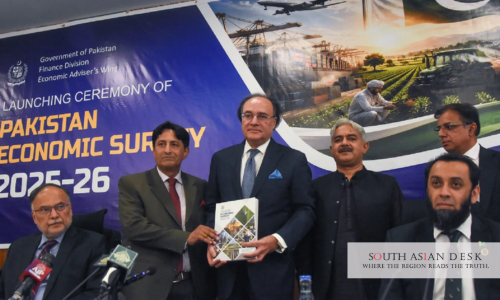
Pakistan GDP growth FY26 was recorded at 3.7 percent, the highest expansion in four years but below the government’s target of 4.2 percent, according to the Pakistan Economic Survey 2025-26 unveiled by Finance Minister Muhammad Aurangzeb on Thursday in Islamabad.
The figure marks an improvement on the 3.18 percent recorded in FY25 and continues a recovery from the contraction of 0.2 percent in FY23 and the 2.6 percent expansion in FY24. Aurangzeb said the shortfall against target was attributable to the ongoing regional conflict in the Middle East, which had disrupted the external environment in the final quarter of the fiscal year. Global growth, he noted, had itself declined to 3.1 percent from 3.7 percent over the same period, providing wider context for Pakistan’s performance.
The economy has reached a historically high nominal size of Rs126.9 trillion, while GDP per capita income has risen to $1,901 from $1,751 the previous year.
The economic survey cited effective macroeconomic management, improved fiscal accounts, large-scale manufacturing growth, agricultural resilience despite the floods of 2025, exchange rate stability, and structural reforms under the IMF Extended Fund Facility program as the principal drivers of the improvement.
Pakistan GDP Growth FY26: Sectoral Performance
Large-scale manufacturing recorded growth of 6.1 percent in FY26, the highest in the last four years, with positive performance in 16 of the sector’s 22 sub-sectors. Aurangzeb described the improvement as broad-based rather than driven by a single industry. Among the year-on-year increases recorded, demand for cement rose 10 percent, fertiliser 17 percent, petroleum 5 percent, automobiles 31 percent, and mobile phones 9 percent. Overall, the manufacturing sector recorded growth of 6.6 percent on the back of this performance.
The services sector, which accounts for close to 58 percent of Pakistan’s GDP, grew by 4.09 percent, also the highest in the past four years. Within services, communication and information services recorded growth of 7.52 percent, again a four-year high, a result Aurangzeb highlighted for its significance to the digital economy.
Agriculture grew by 2.89 percent, up from 1.53 percent the previous year, despite floods that struck in August and September 2025. The crop sub-sector recorded growth of 1.44 percent, while livestock continued to perform positively.
Fiscal Consolidation and Inflation
The fiscal position showed marked improvement. The fiscal deficit narrowed to 0.7 percent of GDP, equivalent to Rs856.4 billion, from 2.6 percent of GDP, or Rs2,970 billion, in the comparable period of the previous year. The primary surplus strengthened to 3.2 percent from 3 percent. Tax revenues increased by 10.1 percent while markup payments fell by 23 percent, widening available fiscal space.
Inflation measured by the consumer price index averaged 6.2 percent over the July to April period of FY26, against 4.7 percent in the same period of the previous year. The sensitive price indicator, however, eased to 4.1 percent from 4.8 percent. The survey acknowledged that inflation had remained broadly stable through the first three quarters before geopolitical tensions in the final quarter introduced renewed pressure. Aurangzeb noted that the policy rate now stands at 11.5 percent, down from 28 percent when the current fiscal consolidation effort began.
The survey’s meta-description, drawn from budget documents, noted that poverty had climbed to 28.9 percent and that April inflation reached 10.9 percent, a reminder that the headline macroeconomic recovery has yet to translate fully into household welfare.
External Sector: Reserves Firm, Food Exports Slide
On the external front, the current account recorded a marginal surplus of $72 million during July to March FY26, compared to a surplus of $1.7 billion in the same period of the previous year. Workers’ remittances rose 8.2 percent to $30.3 billion, remaining, in Aurangzeb’s framing, a structural component of Pakistan’s external balancing position rather than a substitute for export growth.
Exports presented a mixed picture. The food sector recorded a decline of approximately $1.5 billion, with rice exports down by $1.1 billion and sugar exports lower by $403 million. Textile exports, however, increased over the period. Sports goods exports grew 18 percent in the July to May period of FY26, with Aurangzeb noting that the football to be used at the upcoming FIFA World Cup was manufactured in Pakistan. IT exports crossed $3.8 billion, with the government hoping to reach $4.5 billion, while freelancer export earnings were approaching $900 million.
Foreign exchange reserves stood at approximately $17 billion at the time of the press conference, with the minister expressing confidence they would reach $18 billion by the end of June, representing three months of import cover. As of 17 April, total reserves including State Bank holdings of $15.1 billion had reached $20.6 billion.
Capital Markets and Corporate Sector
Pakistan’s equity market performed strongly against global benchmarks during the year. The KSE-100 index gained 18.4 percent over the July to March period of FY26, supported by strong corporate earnings, declining policy and inflation rates, and successful IMF program review tranches. Pakistan Stock Exchange market capitalisation rose from Rs15,237 billion at the end of June 2025 to Rs16,534 billion at the end of March 2026, an increase of 8.5 percent.
Sovereign Sukuk issuances over the July to March period totalled Rs1.86 trillion, with secondary market trading surpassing Rs1.38 trillion. The Securities and Exchange Commission of Pakistan issued 53 certificates of Shariah-compliant securities under the Shariah Governance Regulations, 2023, amounting to Rs229.6 billion.
Some 39,000 new companies were registered in FY26, bringing the total number of registered companies to 300,000. Aurangzeb acknowledged that some foreign businesses had exited the Pakistani market in recent years but said multinational companies in telecoms, energy, IT, digital services, and industrial sectors had either entered the market or expanded their commitments during the year.
Published in SouthAsianDesk, June 14, 2026
Follow SouthAsianDesk on X, Instagram and Facebook for insights on business and current affairs from across South Asia.