

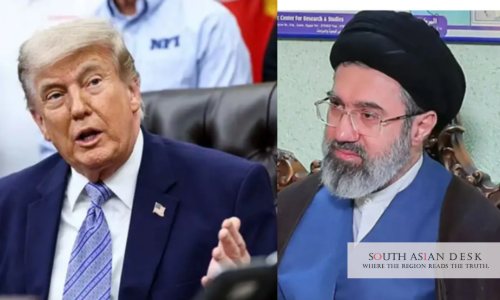
The US Iran peace deal has been announced simultaneously by Pakistani Prime Minister Shehbaz Sharif and US President Donald Trump on Sunday, ending nearly four months of war that began with joint US-Israeli strikes on Iran in late February, with a formal signing ceremony scheduled for Friday, 19 June in Switzerland and the US naval blockade of the Strait of Hormuz ordered to be lifted.
Sharif, whose country served as the primary mediator in negotiations between Washington and Tehran, made the announcement on X in the early hours of Monday morning Pakistani time. “Following intensive talks, we are pleased to announce that the Peace Deal between the United States of America and Islamic Republic of Iran has been REACHED,” he wrote. “Both sides have declared the immediate and permanent termination of military operations on all fronts, including in Lebanon. The official signing ceremony will be on Friday, 19 June in Switzerland. With the agreement now in place, mediators will facilitate a series of meetings this week.”
Trump confirmed the US Iran peace deal on his Truth Social platform shortly after Sharif’s post. “The Deal with the Islamic Republic of Iran is now complete. Congratulations to all!” he wrote, adding that he had authorised the removal of the US naval blockade of the Strait of Hormuz. “Ships of the World, start your engines. Let the oil flow!” Trump said. He subsequently clarified that the strait would physically reopen only after the signing ceremony on Friday, to allow for mine removal operations.
Pakistan’s Central Role in Brokering the US Iran Peace Deal
The announcement places Pakistan at the centre of one of the most consequential diplomatic breakthroughs in decades. Sharif played a personal and sustained role in the mediation effort, holding a 45-minute call with Iranian President Masoud Pezeshkian at a critical early stage of the process, persuading Tehran to participate in peace talks hosted in Islamabad, and serving as a channel between Washington and a government with which the United States has no direct diplomatic relations.
Pakistan’s Army Chief and Chief of Defence Forces, Field Marshal Syed Asim Munir, was also actively engaged at key moments, reportedly speaking directly with Trump during an earlier episode when the United States deferred planned strikes on Iran to allow diplomacy to proceed. US Special Envoy Steve Witkoff conducted indirect exchanges with Iranian Foreign Minister Abbas Araghchi through Pakistani, Qatari, and Turkish intermediaries throughout the negotiating process.
Qatar’s Prime Minister Sheikh Mohammed bin Abdulrahman bin Jassim Al Thani co-mediated alongside Pakistan. Iran’s Deputy Foreign Minister Kazem Gharibabadi confirmed the US Iran peace deal on Iranian state media, saying Tehran’s agreement had come after 14 hours of talks with Qatari mediators.
The achievement adds to a list of high-stakes mediation efforts in Pakistan’s diplomatic history. Pakistan served as the backchannel facilitating the contacts that led to US President Richard Nixon’s 1972 visit to China and the subsequent establishment of diplomatic relations between Washington and Beijing in 1979. Islamabad also played a central role in the 1988 Geneva Accords that produced the Soviet withdrawal from Afghanistan, and more recently in the US-Taliban Doha agreement of 2020 that set the conditions for the withdrawal of NATO forces.
Terms of the Deal
The precise text of the US Iran peace deal was not publicly released on Sunday. According to Sharif’s announcement and subsequent reporting from multiple outlets, the agreement provides for the immediate and permanent termination of military operations on all fronts, including the conflict between Israel and Hezbollah in Lebanon. The US naval blockade of the Strait of Hormuz, in place since 13 April, is to be lifted, and the strait is to be reopened to international shipping following demining operations coordinated around the signing ceremony.
Iran’s nuclear program has not been resolved under the current agreement and will instead be the subject of a 60-day period of additional talks following the deal’s signing. According to a senior US official, Iran agreed as part of the current framework to maintain the nuclear status quo, meaning no further uranium enrichment and no expansion of nuclear facilities, until a final deal on that issue is reached.
Iran’s state television characterised the US Iran peace deal as a product of Tehran having “forced” the United States to accept its terms, reflecting the competing domestic narratives each government will need to manage in the aftermath of the agreement.
Israel, Lebanon, and the Near-Collapse of Negotiations
The deal was confirmed despite a significant late complication. Israel carried out a strike on southern Beirut on Sunday, drawing immediate criticism from both Iran and Trump. Iran’s foreign ministry held the United States responsible for the strike, warning of a “strong response” and saying its military command was with its “finger on the trigger” ready to act against the “enemy’s heart.”
Trump addressed the strike directly in an earlier post on Sunday: “This morning’s attack on Beirut should not have happened, particularly on a special day when we are so close to a Peace Deal with Iran.” The episode underscored a sustained tension between Washington and Jerusalem over the Lebanon dimension of the conflict. Israeli Prime Minister Benjamin Netanyahu has consistently maintained that Israel will retain freedom of military operations in Lebanon regardless of any US-Iran arrangement, while Iran had made a comprehensive ceasefire in Lebanon a core demand throughout negotiations.
That Lebanon is explicitly included in Sharif’s formulation of “all fronts” in the US Iran peace deal is significant, though it remains to be seen whether Israel will accept the terms as they apply to its own operations.
Markets and International Reaction
Financial markets responded immediately to the announcement. US crude oil prices fell nearly 5 percent in the hours following the news, reflecting expectations that the reopening of the Strait of Hormuz will restore a substantial volume of global energy supply that has been effectively absent from world markets since the conflict began. Stock futures rose and Asian-Pacific markets traded higher on Monday morning.
European leaders from the United Kingdom, France, Germany, and Italy issued a joint statement welcoming the US Iran peace deal, calling for swift implementation and urging the urgent reopening of the Strait of Hormuz. French President Emmanuel Macron, preparing to host G7 leaders in Évian-les-Bains, said discussions at the summit would address the long-term reopening of Hormuz and the broader diplomatic opportunity created by the agreement. The United Nations also welcomed the development.
For the South Asian region, the implications are substantial. India, which had been embroiled in a public diplomatic dispute with the United States over the deaths of Indian sailors in US military operations enforcing the Hormuz blockade, stands to benefit from the blockade’s removal and the restoration of normal commercial shipping routes. Pakistan, through its mediating role, has enhanced its standing both in Washington and across the Gulf in a way that carries direct implications for its own economic diplomacy and security relationships. The formal signing on Friday in Geneva will be the next test of whether the framework announced on Sunday holds.
Published in SouthAsianDesk, June 15, 2026
Follow SouthAsianDesk on X, Instagram and Facebook for insights on business and current affairs from across South Asia.
