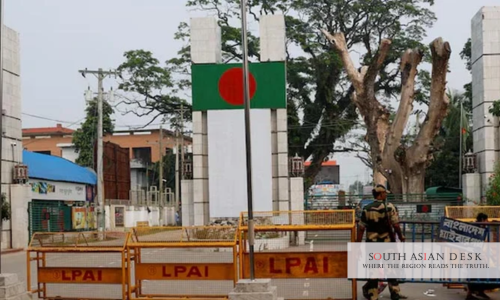
Bangladesh India diplomatic row – Dhaka has called in India’s Deputy High Commissioner to register a formal protest after Prime Minister Tarique Rahman’s policy adviser was stopped and held for questioning for approximately two and a half hours at New Delhi’s Indira Gandhi International Airport, in a development that risks further straining an already fragile bilateral relationship.
The Bangladesh India diplomatic row deepened on Monday, June 15, 2026, as Dhaka formally summoned India’s Deputy High Commissioner Pawan Badhe to register a protest over the treatment of a senior government official at Indira Gandhi International Airport in New Delhi. Bangladesh’s Foreign Minister Khalilur Rahman described the incident as “unexpected and unfortunate,” while Dhaka formally conveyed its concerns to Badhe late on Monday.
Zahed Ur Rahman, who serves as the Prime Minister’s adviser on policy and strategy affairs, was reportedly stopped by immigration authorities on Sunday, June 14, 2026, after arriving in India to attend an official meeting organised by the Ministry of External Affairs. He was questioned for nearly two and a half hours before being cleared to proceed. Despite receiving clearance, Rahman chose not to continue with his scheduled engagements and returned to Bangladesh, according to Bangladesh’s state-run BSS news agency.
Adviser Questioned at Delhi Airport on Official Visit
According to a report by the Bangladeshi daily Prothom Alo, citing diplomatic sources, Rahman had travelled to India to take part in the 28th Meeting of the Committee of Senior Officials of the Indian Ocean Rim Association (IORA). He was not travelling on a diplomatic passport. According to local media reports, he was carrying a regular Bangladeshi passport with a SAARC visa.
Rahman was held for questioning for several hours after his name was flagged during a routine security screening process, according to Bangladesh’s state-run BSS news agency. The report further stated that Rahman, a political commentator known for his criticism of former Bangladeshi Prime Minister Sheikh Hasina and her administration, was travelling to India on an official invitation.
Dhaka Summons Indian Diplomat Over Airport Incident
Bangladesh summoned a senior Indian diplomat posted in Dhaka to protest against the treatment of the adviser, in what has been described as the latest diplomatic row between the neighbours. Bangladesh’s Foreign Minister Khalilur Rahman said Dhaka had conveyed its concerns to Indian Deputy High Commissioner Pawan Badhe during a meeting on Monday. Indian authorities have not publicly commented on the matter, and the country’s foreign ministry has yet to issue an official response.
The absence of any statement from New Delhi means the cause of the security screening that flagged the adviser’s name remains officially unexplained.
Adviser Defends Decision to Return Without Attending Meeting
At a press conference in Dhaka on Tuesday, June 16, 2026, Zahed Ur Rahman publicly addressed his decision to abandon his official engagement and return home. Rahman said he had travelled as a representative of Bangladesh and not in a personal capacity. “I did not go there in a personal capacity. I went as a representative of the state. Therefore, I felt that we needed to make an instant protest against what happened to me there. That is why I decided not to enter India.”
Rahman said his decision was intended to signal that Bangladesh’s current administration should not be viewed in the same way as the previous government. “I felt a message needed to be sent both inside and outside the country that this is not Sheikh Hasina’s government. This is a government with a public mandate.”
At the same time, the adviser sought to temper concerns about lasting damage to ties between the two countries. “We do not want a bad situation with any country under any circumstances. I hope this incident will not affect future relations between the two countries,” he said.
Background: Strained Relations Since the 2024 Uprising
The airport incident occurs at a particularly sensitive moment in Bangladesh India relations. Relations have remained strained since the 2024 uprising that ousted former Prime Minister Sheikh Hasina, who has since remained in India despite repeated requests from Bangladesh for her extradition.
Relations between Bangladesh and India were under severe strain for 18 months in the aftermath of the fall of the Hasina-led Awami League government in August 2024, with mutual suspicions increasing and political, diplomatic, and intelligence relations souring.
Bilateral engagement showed signs of recovery after Tarique Rahman secured a decisive electoral victory. Indian Foreign Minister Subrahmanyam Jaishankar visited Bangladesh in December 2025 to attend the funeral of Tarique Rahman’s mother and former Prime Minister Begum Khaleda Zia, and Indian Prime Minister Narendra Modi was among the first leaders to congratulate Rahman when his party won the election. aol
In April 2026, Indian High Commissioner Pranay Verma paid a courtesy call on Prime Minister Tarique Rahman, with both sides reaffirming their commitment to strengthening bilateral ties across areas including trade, energy, technology, and people-to-people connectivity.
However, the migration dispute has emerged as a fresh source of friction. Bangladesh has alleged that Indian authorities have attempted to push undocumented migrants across the border without following agreed repatriation procedures. Dhaka said border guards had foiled several recent “push-in” attempts and raised the issue during last week’s talks between the Border Guard Bangladesh and India’s Border Security Force in New Delhi. While both sides agreed during the talks to strengthen intelligence sharing and coordinate border patrols, the migrant issue remains a source of friction between the neighbours.
What’s Next
India has yet to respond to Bangladesh’s formal diplomatic protest, and no explanation for the airport questioning has been offered by New Delhi. Diplomatic attention will now focus on whether India issues a formal clarification and whether the two governments can manage this latest incident without undermining the broader reset in relations that has been under way since early 2026.
The resolution of the Hasina extradition request, the handling of cross-border migration disputes, and the establishment of clear diplomatic protocols for official Bangladeshi visitors to India will remain central to determining whether this Bangladesh India diplomatic row marks a temporary setback or a more significant deterioration in ties.
Published in SouthAsianDesk, June 17, 2026
Follow SouthAsianDesk on X, Instagram and Facebook for insights on business and current affairs from across South Asia.