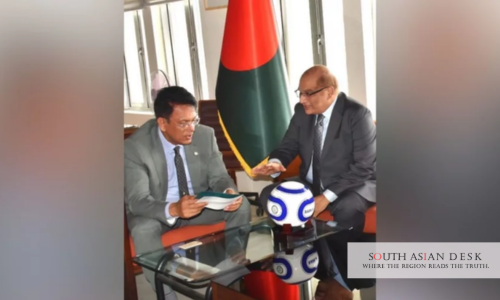
Pakistan-Bangladesh Knowledge Corridor was discussed in Dhaka as Pakistan’s High Commissioner to Bangladesh, Imran Haider, called on Education Minister Dr ANM Ehsanul Hoque Milon to review education cooperation and explore new areas of academic and youth collaboration.
The meeting took place on Sunday, June 21, 2026, and focused on expanding cooperation in education, technical and vocational training, digital learning, physical education and accreditation of educational institutions.
Pakistan-Bangladesh Knowledge Corridor Progress Reviewed
During the meeting, Haider briefed Milon on the progress of the Pakistan-Bangladesh Knowledge Corridor, an initiative aimed at strengthening academic, research and technological links between the two countries.
According to Pakistan’s High Commission in Dhaka, the two sides also discussed the Pakistan Technical Assistance Programme, which offers scholarship opportunities for Bangladeshi students in specialised fields including medicine, pharmacy, engineering, biotechnology, business administration, artificial intelligence, computer science, arts and fashion designing.
The meeting also covered possible exchanges in education, training and sports, indicating that both sides are looking at cooperation beyond university scholarships alone.
Education Cooperation Expands Beyond Scholarships
The Knowledge Corridor has become one of the more visible parts of the recent thaw in Bangladesh-Pakistan engagement.
In May, Milon said the programme could open “a new horizon” in education and research cooperation between the two countries. He said 74 Bangladeshi students were already pursuing higher education in Pakistan under the first phase of the initiative.
Pakistan’s Planning Ministry had earlier said the Knowledge Corridor was proposed to promote academic, research and technological collaboration, including twin-university agreements and student and faculty exchange programmes.
The same statement said 500 scholarships had been allocated for Bangladeshi students, with 75 students already proceeding to Pakistan for higher education.
Footballs Presented For Public Schools
As part of the education and youth engagement discussion, the high commissioner presented the education minister with a football manufactured by Forward Sports, a Sialkot-based Pakistani company.
A total of 1,000 such footballs had earlier been handed over to Bangladesh’s Directorate of Secondary and Higher Education for distribution among public schools.
The gesture was linked to promoting physical education, health and fitness among Bangladeshi youth. The high commissioner also noted Sialkot’s role as a global football manufacturing centre, including its production of match balls used in major international tournaments.
Broader Diplomatic Context
The meeting comes as Dhaka and Islamabad have been holding a series of engagements across education, trade, connectivity, agriculture and health.
In a separate courtesy call on Bangladesh’s Foreign Minister Dr Khalilur Rahman, Haider briefed him on what Pakistan described as positive momentum in bilateral ties, including education and institutional cooperation.
Pakistan and Bangladesh have also discussed wider regional cooperation, people-to-people links and improved connectivity in recent months.
Background
Bangladesh and Pakistan have historically had a complex relationship, but recent diplomatic activity suggests both sides are looking for practical areas of cooperation where progress is easier to build.
Education has emerged as one such area. Scholarships, student exchanges, technical training, university linkages and digital learning offer relatively low-risk avenues for engagement while supporting youth development.
The Knowledge Corridor is therefore being presented not only as an education initiative, but also as a confidence-building platform between the two countries.
What’s Next
The next phase will depend on how quickly scholarship placements, institutional accreditation, student exchanges and technical training partnerships are implemented.
If carried forward, the Pakistan-Bangladesh Knowledge Corridor could expand academic mobility and create new opportunities for Bangladeshi students in specialised disciplines. Both sides are also expected to continue discussions on digital learning, vocational training and physical education cooperation.
Published in SouthAsianDesk, June 22, 2026
Follow SouthAsianDesk on X, Instagram and Facebook for insights on business and current affairs from across South Asia.