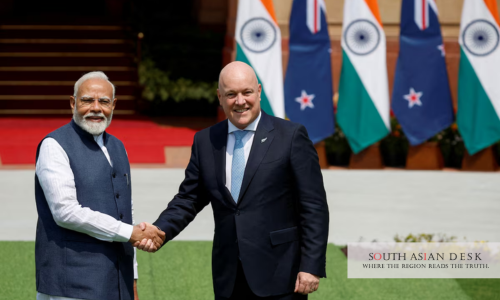
India New Zealand strategic partnership has been announced during Prime Minister Narendra Modi’s visit to Auckland, marking a major diplomatic upgrade as the two countries seek deeper cooperation in trade, defence, maritime security and the Indo-Pacific.
Modi and New Zealand Prime Minister Christopher Luxon elevated bilateral ties during talks on Saturday, describing the partnership as a reflection of shared democratic values, strong people-to-people links and common interests in regional stability. The visit is significant because it is the first by an Indian prime minister to New Zealand in 40 years.
The announcement came as India continues a wider diplomatic push across the Asia-Pacific region. Modi arrived in New Zealand after visits to Indonesia and Australia, where India also sought to strengthen economic, defence and strategic cooperation.
India New Zealand strategic partnership strengthens diplomatic ties
India New Zealand strategic partnership gives the relationship a more formal political and strategic framework after years of relatively modest engagement between the two countries.
The two governments said the new partnership would guide cooperation in trade, defence, maritime security, tourism, culture, sports, agriculture technology, education and people-to-people links. They also announced a Roadmap to 2030 to give ministries and agencies a structured plan for implementation over the next four years.
The upgrade reflects a changing regional environment. India is seeking closer relations with Indo-Pacific partners, while New Zealand is looking to diversify trade and strengthen links with major Asian economies.
For New Delhi, stronger ties with Wellington fit into its Act East policy and broader Indo-Pacific engagement. For New Zealand, India offers a large market, a growing strategic partner and a deeper connection with one of New Zealand’s fastest-growing ethnic communities.
Defence and maritime cooperation move forward
Defence and maritime cooperation were central to the Auckland talks.
India and New Zealand signed a memorandum of arrangement on maritime cooperation between India’s Ministry of Defence and the New Zealand Defence Force. The arrangement is intended to create a framework for dialogue, coordination, information exchange and joint activities in the Indo-Pacific.
The two sides also agreed to establish a Maritime Security Dialogue, which will strengthen coordination on maritime safety, information exchange and regional security. New Zealand has also joined the maritime security pillar of India’s Indo-Pacific Oceans Initiative, with cooperation expected to focus partly on combating illegal, unreported and unregulated fishing.
The governments also concluded an arrangement on mutual logistics support between the Indian Navy and the New Zealand Defence Force. This will facilitate reciprocal logistics support during approved activities and operations.
These steps indicate that India and New Zealand want their relationship to move beyond trade and diaspora ties. Maritime security has become an increasingly important area of cooperation as both countries seek a stable, rules-based Indo-Pacific.
India New Zealand FTA anchors economic agenda
The India New Zealand FTA remains the economic foundation of the renewed partnership. The two countries signed a free trade agreement earlier this year, and both sides now want to use it to expand commerce and market access.
As part of the Auckland outcomes, the two governments set a target to double bilateral trade to NZ$7 billion, or about ₹35,000 crore, by 2030. The target is designed to give the economic relationship a measurable goal at a time when both countries are seeking new trade opportunities.
The free trade agreement is expected to remove tariffs on all Indian goods and 95 percent of New Zealand goods over time. For New Zealand, the agreement offers access to a large and fast-growing consumer market. For India, it provides opportunities in agriculture, food processing, education, technology, tourism and services.
The two sides also announced cooperation in agriculture and dairying, including technical collaboration and knowledge exchange. A Kiwifruit Action Plan will support productivity and the creation of two centres of excellence in Nagaland and Uttarakhand.
Modi Auckland visit highlights people-to-people links
The Modi Auckland visit also placed strong emphasis on people-to-people ties, particularly the Indian community in New Zealand.
Reuters reported that about 292,000 people in New Zealand identified as Indian in the 2023 census, out of a population of about 5.3 million. The Indian community has become an important part of New Zealand’s social, cultural and economic landscape.
Modi was scheduled to address an Indian diaspora event at an Auckland arena later on Saturday. Such events have become a regular feature of his foreign visits and are used to strengthen cultural, political and business connections with overseas Indian communities.
However, the visit also took place against a sensitive domestic backdrop in New Zealand. Reuters reported rising anti-Indian sentiment linked to immigration debates and tensions within New Zealand’s ruling coalition over the free trade agreement. Indian New Zealanders have reported increased racial abuse, while some political figures have pushed for tighter migrant controls.
That context makes the people-to-people dimension important but delicate. Both governments are likely to frame the diaspora as a bridge between the countries, but New Zealand’s domestic debate over migration may continue to shape the political environment around the relationship.
Education, tourism and culture included in wider cooperation
The Auckland visit produced a broad list of agreements beyond defence and trade.
India and New Zealand announced cooperation in tourism, sports, culture, maritime heritage, disaster management, hydrography and education. These areas show that the strategic partnership is intended to be comprehensive rather than limited to security.
The tourism arrangement aims to increase tourist flows and deepen mutual understanding of each country’s culture. The sports action plan will support cooperation in high-performance sport, sports science, sports medicine and athlete development.
The two countries also agreed on cultural cooperation through exchanges in arts, heritage and cultural initiatives. A separate arrangement involving the National Maritime Heritage Complex at Lothal in Gujarat and the New Zealand Maritime Museum will support cooperation on maritime heritage projects.
Education and research were also part of the outcomes. Agreements involving the University of Canterbury and Massey University will support Antarctic research, academic exchange, food technology, entrepreneurship and student mobility.
Counterterrorism and disaster cooperation added to framework
The two governments agreed to establish a Joint Working Group on Counter-Terrorism. The mechanism is intended to strengthen information exchange and coordination against terrorism.
They also signed a memorandum of cooperation between India’s National Disaster Management Authority and New Zealand’s National Emergency Management Agency. The agreement will focus on disaster risk management, earthquake resilience, tsunami preparedness, coastal hazard mitigation, knowledge exchange and capacity building.
This cooperation is practical for both countries. New Zealand has major experience with earthquake response and emergency management, while India faces a wide range of disaster risks, including floods, cyclones, heatwaves, earthquakes and coastal hazards.
Disaster management cooperation gives the partnership a civilian security dimension. It also reflects the broader Indo-Pacific reality that climate shocks, extreme weather and natural disasters are becoming more central to regional planning.
New Zealand joins Global Biofuels Alliance
New Zealand also joined the Global Biofuels Alliance during the visit, adding an energy transition component to the partnership.
The alliance, launched by India and partners, is intended to promote sustainable biofuels and support cleaner energy transitions. New Zealand’s decision to join gives both countries another area for cooperation in climate and energy policy.
The move aligns with the broader theme of linking strategic partnership with economic and environmental priorities. For India, clean energy partnerships are increasingly part of foreign policy. For New Zealand, climate and sustainable agriculture remain important elements of international engagement.
Regional strategy drives deeper engagement
The India New Zealand strategic partnership should be understood within India’s broader regional outreach.
Modi’s tour of Indonesia, Australia and New Zealand reflects India’s effort to build stronger ties across the eastern Indian Ocean and the wider Indo-Pacific. Reuters reported that Indian officials described the focus as shifting towards the eastern maritime zones of the Indian Ocean and Act East engagement.
New Zealand’s location, maritime interests and role in the Pacific give it strategic relevance for India. While New Zealand is not a military heavyweight, it is a stable democracy with strong links to the Pacific, an advanced economy and a growing interest in Indo-Pacific security discussions.
For Wellington, the partnership with India provides an opportunity to broaden its Asian relationships beyond China, Australia and traditional Western partners. It also supports the Luxon government’s push to expand trade access and strengthen New Zealand’s economic diplomacy.
Domestic politics may shape New Zealand response
Although the diplomatic outcome was positive, domestic politics in New Zealand may influence how the partnership develops.
The free trade agreement has already caused tensions within the ruling coalition, according to Reuters. Immigration politics may also complicate the public conversation around India ties, particularly as the Indian-origin population grows and debates over migration remain politically sensitive.
This does not mean the partnership is weak. It means implementation will require careful political management. Trade, migration, education and diaspora issues can generate both opportunity and tension.
New Zealand’s government will need to show that closer relations with India bring practical benefits for businesses, workers, students and regional security. India, meanwhile, will expect the partnership to produce visible gains in trade, mobility, education and strategic cooperation.
Strategic partnership needs practical delivery
India New Zealand strategic partnership gives both countries a stronger diplomatic platform, but its success will depend on implementation.
The Roadmap to 2030 provides a mechanism for follow-up, but outcomes will depend on whether ministries, businesses, universities and defence institutions turn agreements into projects. Trade targets must be supported by market access, logistics, regulatory cooperation and private-sector interest.
The defence and maritime arrangements will also need regular activity to become meaningful. Dialogues, information exchange and logistics support can strengthen cooperation only if they are used consistently.
The same applies to education, culture, tourism and research. These sectors can build long-term people-to-people links, but they require sustained funding, institutional partnerships and policy support.
For now, the Auckland visit marks a significant diplomatic reset. The elevation of ties to a strategic partnership shows that India and New Zealand want a relationship that is wider, more structured and more relevant to the Indo-Pacific.
The challenge now is to ensure that the new framework produces tangible results in trade, security, education, mobility and regional cooperation before 2030.
Published in SouthAsianDesk, July 12, 2026
Follow SouthAsianDesk on X, Instagram and Facebook for insights on business and current affairs from across South Asia.