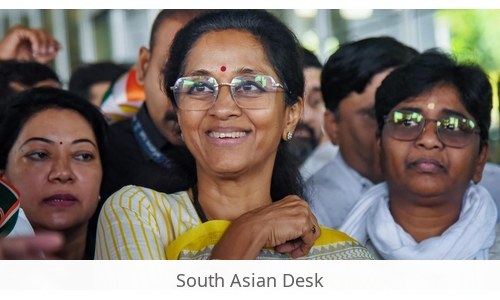
The delimitation controversy has taken center stage in Indian politics as Supriya Sule, a leader of the Nationalist Congress Party (NCP), characterized the ongoing debate as a “storm in a teacup” and denied backing the proposal. Speaking to The Hindu on July 15, 2026, Sule emphasized the necessity for clarity regarding the delimitation process and a proposed 50% increase in legislative seats for all states. However, Indian Express reported that Sule indicated the NCP (SP) would support the delimitation bill but with certain conditions.
Delimitation Controversy: Political Implications
Sule’s remarks have raised questions about the NCP’s strategic positioning amid evolving political dynamics. Her characterization of the delimitation controversy as a “storm in a teacup” suggests a calculated effort to downplay the issue’s significance while signaling potential alignment with the delimitation proposal under specific terms. Analysts note that the proposed 50% increase in seats could reshape electoral representation, though Sule’s conditional support introduces uncertainty about the party’s stance. Reactions from other political entities remain pending, with no immediate statements from rival parties on the matter.
The delimitation process, which involves redrawing electoral boundaries to reflect population changes, has historically been a flashpoint for political contention. The proposed 50% increase in seats, if implemented, would require a comprehensive reassessment of state boundaries and representation, potentially altering the balance of power in state legislatures. This could have far-reaching implications for coalition politics, particularly in states where smaller parties hold critical seats. For instance, in states like Maharashtra, where the NCP has historically played a pivotal role in coalition governments, such a change might necessitate recalibrating alliances or adjusting electoral strategies to accommodate the new seat distribution.
The delimitation controversy is not merely a technical exercise; it is deeply intertwined with the political landscape. In states where the ruling party holds a majority, delimitation can be used to consolidate power by creating constituencies that favor their electoral prospects. Conversely, in states with fragmented political landscapes, delimitation may be seen as a tool to dilute the influence of opposition parties. The NCP’s conditional support for the delimitation bill, as indicated by Sule, suggests that the party is seeking to navigate these complexities while safeguarding its own interests in the evolving political calculus.
Historical Context of Delimitation
Delimitation in India involves redrawing electoral boundaries to reflect population changes, ensuring fair representation in legislative assemblies. Historically, such processes have been contentious, often influencing political alliances and electoral outcomes. For instance, the 2008 delimitation exercise in Jammu and Kashmir sparked debates over regional representation, with critics arguing that the process favored certain communities over others. The current discussions around a 50% seat increase highlight ongoing tensions between equitable representation and political strategy, with Sule’s comments adding another layer to this complex debate.
The 2008 delimitation in Jammu and Kashmir, which adjusted constituency boundaries following the region’s demographic shifts, underscored the sensitivity of the delimitation controversy. Similar controversies have emerged in other states, such as West Bengal and Tamil Nadu, where delimitation exercises have been delayed or contested due to concerns over minority representation. The proposed 50% increase in seats for all states would require a nationwide reassessment of population data, administrative boundaries, and electoral dynamics, a task that could take years to complete. This raises questions about the feasibility of implementing such a sweeping change, particularly given the logistical challenges and potential for further political disputes.
Moreover, the delimitation controversy is not confined to technicalities; it reflects broader political aspirations and fears. In states where the ruling party seeks to entrench its dominance, delimitation can be a strategic tool. However, in states with multi-party dynamics, the process risks alienating smaller parties or minority groups. Sule’s nuanced stance on the delimitation controversy highlights the delicate balance parties must strike between ideological principles and pragmatic political survival.
Follow SouthAsianDesk on X, Instagram and Facebook for insights on business and current affairs from across South Asia.
Sources
- Supriya Sule calls delimitation row a ‘storm in a teacup’, denies backing proposal – thehindu.com
- Amid BJP tie-up buzz, Supriya Sule says NCP (SP) will back delimitation bill, with riders – indianexpress.com
Image: th-i.thgim.com