Watermelon seed smuggling from Nepal to India has emerged as a fast-growing illicit trade along the two countries’ shared frontier, with customs data and a string of police seizures across the Tarai plains pointing to a well-organised network exploiting Nepal’s lenient agricultural import duties. Traders are bringing large volumes of edible watermelon kernels into Nepal under the guise of agricultural seeds, only to move the consignments across the porous Nepal-India open border to meet strong demand in Indian food markets.
Watermelon Seed Smuggling from Nepal to India – Police Seizures Expose Scale of the Trade
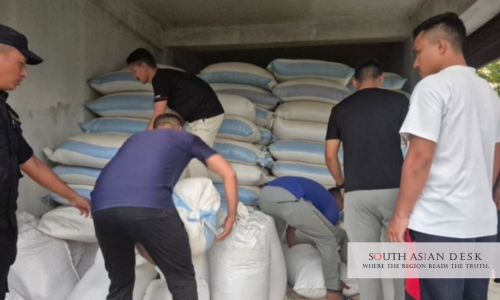
The most recent seizure took place on Sunday evening, when police recovered 948 sacks of watermelon seeds from Bhadrapur Municipality-3 in Jhapa district. Superintendent of Police Basundhara Khadka, who heads the Jhapa District Police Office, said the seeds were found during a raid on two warehouses belonging to local resident Bhimlal Subedi. The operation required a 55-member police team simply to transport the volume of goods recovered, after officers who first arrived at the scene found both storage sites packed to capacity. Investigators believe the seeds had been brought into the country illegally to avoid customs duties, and the consignment has since been handed over to the Bhadrapur Customs Office. Police estimate the market value of the seized stock at as much as Rs1,600 per kilogram.
This is far from an isolated case. On June 11, a confrontation broke out between security personnel and local residents at Bankul Tole in Baudhimai Municipality-7, Rautahat, after police attempted to seize nearly 12,000 kilograms of watermelon seeds hidden in the area ahead of an anticipated shipment to India. Villagers tried to block officers from removing the goods, prompting police to fire six rounds of tear gas to disperse the crowd. Six people, including three security personnel, were injured in the clash.
Further seizures have followed in quick succession across Madhesh Province. Watermelon seeds worth Rs1.5 million were recovered from a warehouse in Malangwa Municipality-2, Sarlahi, on June 18. Four days later, Bara police intercepted 314 sacks being transported from Simraungadh towards Mahottari, while Siraha police had already seized 70 sacks from Bariarpatti in late May. On June 25, the Armed Police Force intercepted 249 sacks being illegally exported through the Hathiyaul-Chhanaki border point in Balara Municipality-2, Sarlahi, along with four Indian pickup trucks and a Nepali truck abandoned by fleeing smugglers.
In Rupandehi district, police intercepted 125 sacks bound for India last year, with a further 35 sacks seized more recently. Deputy Superintendent of Police Krishna Kumar Chand, spokesperson for the Rupandehi District Police Office, said intensified anti-smuggling operations have reduced traffic through that particular route, though the broader trend across the border remains upward.
How the Customs Duty Loophole Fuels the Trade
Commercial watermelon farming in Nepal is limited to modest, seasonal riverbed cultivation in a handful of districts, and domestic output falls well short of national demand. Agriculture officials estimate that Nepal’s genuine annual requirement for watermelon seeds is no more than seven to nine metric tonnes.
Trade figures tell a strikingly different story. In the first eleven months of the current fiscal year, Nepal imported roughly 19,000 tonnes of melon seeds worth more than Rs3.06 billion, compared with just 595 tonnes worth Rs140 million during the same period a year earlier. That amounts to a 32-fold jump in volume and a 22-fold rise in value within twelve months, a discrepancy officials say cannot be explained by domestic consumption alone.
According to government officials, most of these imports are not planting seeds at all but peeled, edible watermelon kernels, known locally as magaj, which are widely used across the food processing industry. Because agricultural seeds attract minimal customs duty in Nepal, importers allegedly misdeclare the kernels as seeds to take advantage of the lower rate. Once cleared through customs, the goods are stored near the border before being quietly ferried into India, bypassing the legitimate trade channels that would otherwise apply to a processed food commodity.
Customs records also show a marked shift in the countries of origin for these shipments. Where watermelon seeds once arrived in Nepal chiefly from India, Iran and Pakistan, the bulk of current imports now originate in Afghanistan, Nigeria, Sudan, the United Arab Emirates and Turkey, several of which recorded no such trade with Nepal in previous years but have since seen exports worth millions of rupees.
Why Watermelon Kernel Imports Are in High Demand
Officials trace the underlying driver of this trade to India’s own market. Watermelon kernels are widely used in India’s confectionery, bakery, dried fruit and traditional sweets industries, yet the Indian government restricts their direct import to shield domestic producers. That restriction has effectively pushed demand for watermelon kernel imports onto Nepal’s difficult-to-monitor frontier, where smuggling networks have positioned the country as an alternative supply corridor.
“There is immense demand for these seeds in India,” said Superintendent of Police Sitaram Rijal, chief of the Rautahat District Police Office. “I understand they are used in preparing spices and confectionery. Because of the high demand and restrictions there, smuggling rings have become highly active along our borders.”
Tarai Region Smuggling Networks and the Response of Border Districts
Several border points in Madhesh Province have effectively become transit hubs for the trade. Police investigations indicate that consignments are first moved to border districts such as Rautahat through local markets or alternative domestic routes, after which local carriers are hired to ferry the goods across in smaller batches to avoid detection. Security officials acknowledge that despite tighter surveillance, these clandestine operations continue to cause significant revenue losses and complicate border management.
The problem is not confined to Madhesh Province alone. Similar attempts have surfaced in Koshi and Lumbini provinces, prompting senior police officials to pledge a tougher response. Deputy Inspector General Bhupendra Bahadur Khatri, chief of the Lumbini Province Police, said his force would not allow the practice to take root in the region. “We will not allow even a single kilogram to be smuggled across the border,” Khatri said. “No matter how much they try to exploit the open border, we will disrupt their operations.”
In Koshi Province, Deputy Inspector General Binod Ghimire said intelligence units are actively tracking the warehouses used to stockpile seized goods before they cross into India. “We are taking a hardline approach,” Ghimire said. “We have figured out their tactic of storing the goods in border areas before quietly moving them across, and we are acting swiftly to dismantle these networks.”
As long as the gap between Nepal’s low tariffs on agricultural seeds and India’s restrictions on kernel imports persists, officials concede that watermelon seed smuggling from Nepal to India is likely to remain a persistent challenge for border security agencies on both sides.
Published in SouthAsianDesk, July 16, 2026
Follow SouthAsianDesk on X, Instagram and Facebook for insights on business and current affairs from across South Asia.