The Sheikh Hasina extradition case remains unresolved, India’s foreign ministry said this week, insisting that New Delhi’s position has not shifted despite the deposed Bangladeshi prime minister’s public pledge to return home in December to face trial.
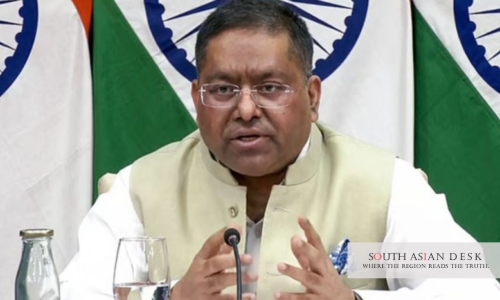
Responding to questions at the Ministry of External Affairs’ weekly media briefing, spokesperson Randhir Jaiswal was asked whether India was engaging with Dhaka to facilitate Hasina’s return and how New Delhi intended to handle Bangladesh’s long-pending extradition request.
“There is no change in our approach to the matter,” Jaiswal said, adding that “any extradition matter is a legal issue, as you very well know, and it will be dealt with accordingly.”
Background to the Sheikh Hasina Extradition Case
Hasina has been living in New Delhi since August 2024, when she fled Bangladesh following a mass student-led uprising that ended her fifteen-year rule. Bangladesh’s interim and subsequent authorities have since filed multiple cases against her, and the country’s International Crimes Tribunal sentenced her to death in absentia in November over her role in the deadly crackdown that preceded her ouster, a crackdown the United Nations says left around 1,400 people dead. Her Awami League party has also been formally banned in the aftermath of the uprising.
Bangladesh is currently governed by a coalition led by Prime Minister Tarique Rahman, which took office in February following elections held after two years of political upheaval. Dhaka has formally sought Hasina’s extradition, and the Sheikh Hasina extradition case has been under formal review in New Delhi since April, when India confirmed the request had been received and said it wished to engage constructively with Bangladesh’s new government.
Hasina has continued to reject the charges underpinning the Sheikh Hasina extradition case from exile, describing the proceedings as politically motivated. In an interview published earlier this month, she said she intended to return to Bangladesh in December alongside senior Awami League figures to contest the closure of her party, and called on other exiled leaders, including former home minister Asaduzzaman Khan Kamal, who also faces a death sentence, to surrender alongside her. Bangladesh’s state minister for foreign affairs, Shama Obaed Islam, responded that Hasina would be sent to prison immediately upon her return, describing her as “a convicted criminal” whose case would proceed under Bangladeshi law.
What India’s Statement Means for India-Bangladesh Relations
Jaiswal’s remarks suggest that New Delhi is, for now, declining to be drawn into the domestic political dispute over Hasina’s fate, framing the Sheikh Hasina extradition case strictly as a legal question rather than a diplomatic one. India has not indicated publicly whether it will ultimately comply with the extradition request, and analysts have noted that the unresolved Sheikh Hasina extradition case has become a persistent source of friction in India-Bangladesh relations since the change of government in Dhaka.
The same briefing also touched on the broader state of bilateral cooperation. Jaiswal was asked about reports that around eleven India-backed development projects in Bangladesh could be shelved because work on them had not yet begun. He said the development cooperation programme between the two countries “is something that is done in mutual consultations, and that continues to be the case,” suggesting New Delhi does not consider the projects to be at immediate risk despite the political strain surrounding Hasina’s status.
What Comes Next in the Sheikh Hasina Extradition Case
With Hasina maintaining that she will return to Bangladesh in December, and Dhaka insisting she will be arrested on arrival, the coming months are likely to keep the Sheikh Hasina extradition case at the centre of India-Bangladesh relations. India’s characterisation of the case as a legal rather than political issue leaves open the possibility of prolonged deliberation, even as both governments continue to describe their broader cooperation, including on development projects, as intact for now.
Published in SouthAsianDesk, July 16, 2026
Follow SouthAsianDesk on X, Instagram and Facebook for insights on business and current affairs from across South Asia.