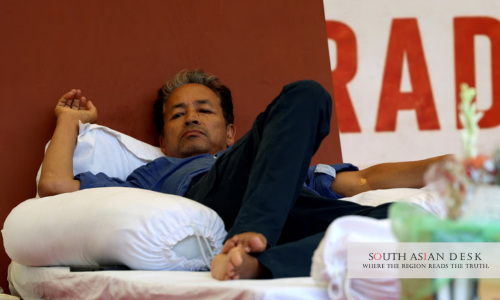
The Sonam Wangchuk hunger strike came to an end on Thursday night, 26 days after the engineer and education reformist began his fast in solidarity with student demonstrators at Delhi’s Jantar Mantar. Wangchuk broke his fast at Medanta Hospital in Gurugram in the presence of Union Ministers J.P. Nadda and Dr. Jitendra Singh, along with senior leaders of the Apex Body of Leh Ladakh, family members and medical staff who had been monitoring his condition.
Origins of the NEET Paper Leak Protest
The demonstration that drew Wangchuk to Jantar Mantar was organised by the Cockroach Janta Party (CJP), a youth-led outfit that began its sit-in to demand accountability from the government over irregularities in the NEET-UG medical entrance examination. The NEET paper leak protest also called for the resignation of Union Education Minister Dharmendra Pradhan, along with compensation for the families of students who died by suicide amid the fallout from repeated examination irregularities. Wangchuk, a longtime advocate for education reform and known for his earlier campaigns on Ladakh’s statehood and ecological protection, joined the CJP’s protest on June 28 and began an indefinite fast shortly afterward.
As the days passed, the NEET paper leak protest grew into one of the more closely watched civil demonstrations in the capital this year, drawing attention from opposition lawmakers, civil society groups and sections of the ruling coalition alike.
Health Concerns and a Forced Hospital Transfer
By the third week of his fast, Wangchuk’s health had deteriorated considerably. Delhi Police moved him to Safdarjung Hospital in the early hours of July 18 on medical grounds, a decision his supporters characterised as a forced removal from the protest site. The transfer followed a police crackdown on July 20, during which student demonstrators at Jantar Mantar were reportedly lathi-charged and dispersed with tear gas, according to accounts from those present. Wangchuk later described his hospitalisation as an “illegal detention” in a handwritten letter and said he feared his fellow protesters could face charges under stringent anti-terror legislation.
Despite mounting pressure to end his fast, Wangchuk set out a series of conditions before he would agree to stop, including an assurance that no protesting students would face punitive legal action, that the government would acknowledge shortcomings in the examination system, and that the paper leak issue would be formally raised in Parliament.
Negotiations That Brought the Sonam Wangchuk Hunger Strike to a Close
The final stretch of the Sonam Wangchuk hunger strike was marked by intensive negotiations between the activist, government representatives and Ladakhi community leaders. In a statement posted on social media after breaking his fast, Wangchuk said that 65 members of Parliament from various political parties had either visited him or signed letters appealing for him to end the strike. He added that his decision followed extended discussions on specific conditions and was made partly out of concern over the potential for violence spreading across the country.
“So with that being fulfilled, I am grateful, and I’ll be happy to break my fast,” Wangchuk said as he accepted a drink offered by one of the ministers present. He indicated that he would explain the terms of the agreement in greater detail through a separate video in the coming days, while urging supporters to remain vigilant against any form of unrest.
Reaction From the Cockroach Janta Party
Even as Wangchuk’s fast concluded, the CJP signalled that its own agitation at Jantar Mantar would continue. Founder Abhijeet Dipke said the group remained “relieved and grateful” that Wangchuk had ended his 26-day fast, thanking him for his sacrifice, but insisted that the sit-in would not stop until Pradhan resigned. The government, for its part, maintained that it was open to discussing the paper leak allegations, though the political standoff over the minister’s position remained unresolved at the time of writing.
What Comes Next
Wangchuk’s decision to end his hunger strike closes one chapter of a protest that has drawn national attention to examination integrity and student welfare, though the broader NEET paper leak protest at Jantar Mantar shows no immediate sign of winding down. Attention now shifts to Parliament, where opposition lawmakers are expected to press the government for a formal debate on examination reforms, and to whether the assurances given to Wangchuk translate into concrete policy action in the weeks ahead.
Published in SouthAsianDesk, July 24, 2026
Follow SouthAsianDesk on X, Instagram and Facebook for insights on business and current affairs from across South Asia.