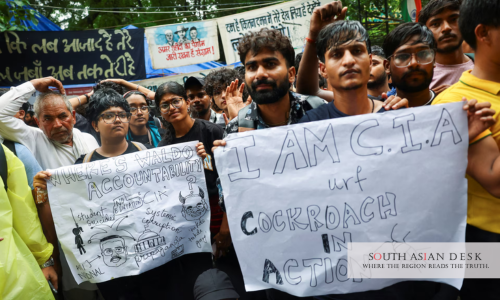
The Delhi youth protests entered a fresh and volatile phase this week after demonstrators clashed briefly with police on the streets of the Indian capital late on Wednesday. Officers fired tear gas and wielded canes to disperse the crowd, according to police and eyewitnesses, as a month-old movement demanding the resignation of India’s education minister showed no sign of easing.
More than 10,000 people were estimated to have gathered at the Jantar Mantar protest site in central New Delhi, local media reported, as leaders of the self-styled “cockroach” movement vowed to continue their agitation until Education Minister Dharmendra Pradhan steps down. The demonstrations, organised under the banner of the Cockroach Janta Party, have grown into the largest youth-led challenge faced by Prime Minister Narendra Modi since he first came to power in 2014.
What Sparked the Delhi Youth Protests
The unrest traces back to widespread irregularities in national medical entrance examinations, with exam paper leaks affecting an estimated two million students in May. The fallout has been severe: several families have linked the deaths of students by suicide to the cancellations and confusion that followed the leaks, adding a deeply personal dimension to what began as a political dispute over accountability.
The Cockroach Janta Party itself emerged in May as an online satire, initially drawing only a few hundred participants. The movement’s name is widely understood as a response to remarks attributed to Chief Justice Surya Kant, who reportedly compared young people to “cockroaches” and “parasites” during a court hearing. What started as a pointed piece of internet mockery has since evolved into a sustained street movement with national visibility, feeding directly into the wider Delhi youth protests now unfolding at Jantar Mantar and beyond.
Tensions escalated sharply on Monday, when tens of thousands of protesters marched toward Parliament in defiance of an official ban, timed to coincide with the opening of the monsoon session. Police and paramilitary personnel responded with tear gas in an effort to hold back the crowds, and reports indicate that at least 178 people, including security personnel, were injured in the ensuing chaos. It marked the largest street rally in the capital in roughly five years.
Modi Pledges Fast-Track Courts
Responding to the sustained pressure, Modi offered his first direct public comments on the matter this week, announcing that fast-track courts would be established to prosecute those responsible for the exam paper leaks. In a post on social media platform X, the prime minister wrote that nothing was more important than the welfare and future of the country’s youth, adding that he had directed relevant authorities to take all necessary steps.
The announcement came after Modi’s government held one round of talks with leaders of the Cockroach Janta Party, though the discussions failed to produce a resolution. The pledge of fast-track courts represents the most concrete policy response the government has offered since the protests began, though it stops well short of the movement’s central demand.
Protesters Reject the Announcement, Reiterate Call for Pradhan’s Resignation
The proposal for fast-track courts was quickly dismissed by protest leaders as inadequate. A spokesperson for the Cockroach Janta Party said the plan amounted to a distraction rather than a genuine solution, arguing that the paper leaks were not the product of a slow judiciary but of what he described as sustained mismanagement within the education ministry.
The party’s core demands remain unchanged: the immediate resignation of Dharmendra Pradhan, the withdrawal of criminal cases filed against peaceful demonstrators, and financial assistance of 10 million rupees, roughly $120,000, for the families of each of the at least 12 students believed to have died by suicide since the exam cancellations began. Organisers have framed the fast-track courts announcement as an attempt to shift attention away from ministerial accountability rather than address it directly.
CJP founder Abhijeet Dipke, addressing supporters late Wednesday night, said the protest had entered its 25th day and signalled no intention of standing down. He told the gathered crowd that the movement was prepared to continue for months if necessary, underscoring the resolve driving the ongoing Delhi youth protests even as authorities intensify their response.
Opposition Parties Join the Pressure Campaign
The protests have drawn active support from opposition politicians, who have used the unrest to disrupt the monsoon session of Parliament this week. Congress party leader Rahul Gandhi was among those who publicly criticised the prime minister’s handling of the crisis, arguing that the government bore primary responsibility for the harm caused to the country’s students. Other opposition parties have echoed calls for Pradhan to step down, adding further political weight to the demonstrators’ cause.
Separately, the Delhi High Court has issued notices to the central government and police over allegations of excessive force used against demonstrators, a development that could add legal scrutiny to the government’s handling of the protests in the weeks ahead.
Security Measures Tighten as Protests Continue
Authorities have responded to the sustained unrest with heightened security measures across the capital. The Delhi Metro Rail Corporation announced it was shutting 16 stations in and around central New Delhi from Thursday until further notice, marking the second large-scale closure of the week due to security concerns. The closures reflect the scale of disruption the protests have caused to daily life in the city, even as demonstrators camp out despite heavy rain and repeated police action.
With neither side showing signs of backing down, the Delhi youth protests appear likely to continue testing the Modi government in the days ahead. The prime minister’s fast-track courts proposal has done little to satisfy demonstrators, and with opposition parties amplifying the movement’s demands inside Parliament, pressure on Education Minister Dharmendra Pradhan’s resignation shows no sign of abating.
Published in SouthAsianDesk, July 23, 2026
Follow SouthAsianDesk on X, Instagram and Facebook for insights on business and current affairs from across South Asia.