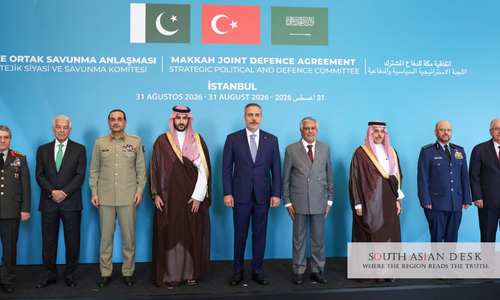
The Mecca Joint Defence Agreement has taken a significant institutional step forward, with Saudi Arabia, Turkey and Pakistan agreeing to establish a permanent secretariat in Saudi Arabia to oversee the trilateral pact. A Pakistani official will serve as the body’s first secretary general for an initial term of three years, the three countries announced in a joint statement issued on Monday.
Decision Reached at Istanbul Meeting
The announcement followed the first meeting of the Strategic Political and Defence Committee, held in Istanbul and attended by senior diplomatic, defence and military officials from all three nations. Turkey was represented by Foreign Minister Hakan Fidan, Defence Minister Yasar Guler and Chief of the General Staff Selcuk Bayraktaroglu. Pakistan’s delegation included Deputy Prime Minister and Foreign Minister Mohammad Ishaq Dar, Defence Minister Khawaja Muhammad Asif, and Chief of Defence Forces and Chief of Army Staff Field Marshal Asim Munir. Saudi Arabia sent Foreign Minister Prince Faisal bin Farhan Al Saud, Defence Minister Prince Khalid bin Salman and Chief of General Staff General Fayyadh bin Hamed Al-Ruwaili.
Speaking after the talks, Fidan confirmed that a secretariat has been established in Riyadh and that the first secretary general would come from Pakistan, describing the arrangement as a historic step toward closer regional security cooperation. He added that the alliance could eventually broaden to include additional countries, subject to conditions agreed upon by its founding members.
What the Saudi Arabia Turkey Pakistan Defence Pact Covers
The Saudi Arabia Turkey Pakistan defence pact, formally known as the Mecca Agreement for Joint Defence, establishes a collective security arrangement in which an armed attack against any one signatory is treated as an attack against all three. The framework has drawn comparisons to Article 5 of the NATO charter, although analysts note that it currently lacks an integrated command structure, a standing joint force or the kind of permanent military machinery that underpins the North Atlantic alliance.
Under the arrangement, the three countries have outlined complementary roles. Saudi Arabia is expected to help finance defence-related projects, Turkey is positioned to contribute advanced defence technology, and Pakistan is expected to provide personnel and operational manpower. Officials involved in the pact have been careful to note that it does not extend the deterrent effect of Pakistan’s nuclear capability to either Saudi Arabia or Turkey.
The trilateral pact builds on an existing bilateral foundation. Saudi Arabia and Pakistan first formalised a collective defence commitment through the Strategic Mutual Defence Agreement, signed in September 2025 in Riyadh, which itself codified decades of military cooperation between the two countries. Turkey and Pakistan have separately strengthened their own defence relationship in recent years, including through the exchange of warships and training aircraft, while Saudi Arabia and Turkey deepened defence industrial ties following a 2023 agreement covering the purchase of Turkish drones.
Why the Joint Defence Secretariat Matters
Establishing a functioning joint defence secretariat is widely regarded as essential to moving the pact from a political declaration to an operational body. Tughral Yamin, a retired brigadier and senior associate at Islamabad’s Institute of Policy Studies, has argued that a dedicated office or secretariat is necessary for the agreement to become truly functional, pointing to NATO’s Supreme Headquarters Allied Powers Europe in Mons, Belgium, as a comparable model. A related headquarters had already been established in Saudi Arabia earlier this year following the formation of a separate Saudi-led maritime coalition.
Regional analysts have also stressed that institutional clarity will be important as the agreement moves toward ratification processes in member states. Sinem Cengiz, a researcher at Qatar University’s Gulf Studies Center, has noted that such structural details need to be settled before the pact is presented to the Turkish parliament for approval.
Context Behind the Strategic Political and Defence Committee
The Strategic Political and Defence Committee meeting in Istanbul took place against a backdrop of heightened tension across the Middle East. Saudi Arabia had earlier come under attack from Iranian drones following the escalation of the broader Iran conflict this year, a development that threatened both oil exports and regional stability. Although Turkey and Pakistan were less directly exposed to the fighting, both countries have expressed concern over the wider instability spreading across the region.
By mid-2026, Pakistan had already deployed several thousand troops, along with fighter aircraft, drones and an air-defence system, to Saudi Arabia under the terms of their bilateral arrangement. Islamabad also opened discussions with Kuwait in July 2026 regarding a possible expanded security arrangement, suggesting the broader coalition built around the Mecca framework may continue to grow.
In their joint statement, the three countries reaffirmed a shared commitment to sustainable peace and regional stability, pledging continued support for de-escalation, restraint and the peaceful resolution of ongoing crises. Whether the newly formed secretariat can translate that commitment into lasting institutional cooperation, according to regional experts, will depend largely on whether the joint mechanisms and defence industrial ventures established under the pact continue to function once the current cycle of regional tension subsides.
Published in SouthAsianDesk, September 1st, 2026
Follow SouthAsianDesk on X, Instagram and Facebook for insights on business and current affairs from across South Asia.