Nepal is planning to rebuild its early warning system for landslides along part of its border with China, according to two Nepali government sources, a week after a glacial flood killed more than 1,000 people. The new Nepal early warning system will feature seismic sensors, cameras and a satellite link, and is intended to close the gaps exposed by last week’s disaster.
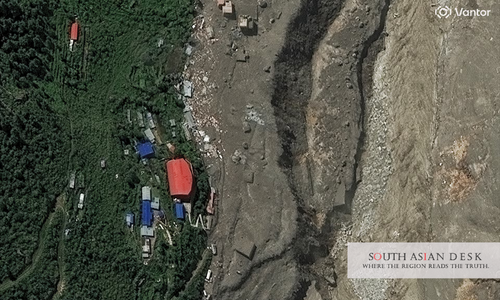
The equipment is being installed at Timure, a border settlement in Nepal’s Rasuwa district, situated on the same river corridor along the border with China where a collapsing glacier sent a wall of mud, water and rock tearing through mountain valleys. At least 1,114 people have died across both countries, with the vast majority of deaths recorded in Nepal, and nearly 4,000 people remain missing.
Why Nepal’s Early Warning System Failed the Rasuwa District
The stretch of border where the new instruments will be placed sits in one of the most sensitive parts of Nepal’s frontier with China’s Tibet region, a high-altitude area closely watched by Kathmandu, Beijing and New Delhi. Nepal has not yet formally announced its plans, and the two government sources spoke on condition of anonymity because they were not authorised to discuss the matter publicly. Both described a strong sense of urgency behind the push to rebuild the Nepal early warning system, warning that the landscape was still adjusting after what one source called a mega event, with the risk that further landslides could follow.
The flood itself exposed serious weaknesses in existing China border flood monitoring. Nepal previously had sensors and monitoring stations in place along this stretch of the border, but officials acknowledged the equipment was not being monitored extensively, which limited its usefulness when the disaster struck. Last week’s flood knocked out at least four gauging stations near the border, cutting off a key source of real time data at the moment it was needed most. That communications blackout is central to why officials now regard rebuilding the Nepal early warning system as an urgent priority rather than a longer term project.
New Sensors and Satellite Links for the Glacial Flood Rasuwa District Corridor
Central to the rebuilding plan is a satellite system known as a Very Small Aperture Terminal, or VSAT, designed to keep monitoring posts connected even when mobile networks fail. This capability is seen as essential for any effective Nepal early warning system, since it would allow monitoring posts in the glacial flood Rasuwa district corridor to detect fresh hazards and issue warnings even during network outages of the kind experienced during last week’s disaster.
China has said it has already shared imagery of the affected areas, along with satellite and hydrological data and early warning information on upstream barrier lakes, with Nepali authorities. Two barrier lakes near the border that formed after the glacial collapse have since drained, easing the immediate danger, though the surrounding terrain remains unstable and continues to be closely watched. An effective Nepal early warning system would give authorities only a few minutes to alert downstream communities in the event of another flood, but officials say that brief window could prove critical to saving lives.
Timing Failures Highlight the Need for Faster China Border Flood Monitoring
The urgency behind rebuilding the Nepal early warning system is underscored by how the last disaster unfolded. The flood struck a border crossing at 8:32 in the morning, yet a public alert was not issued until 9:13, a delay of more than 40 minutes that likely cost precious time for residents in the flood’s path. That gap has become a central point of concern for officials now working to strengthen China border flood monitoring along the same corridor.
By combining seismic sensors, cameras and satellite connectivity, Nepal hopes its rebuilt early warning system will shorten that response window significantly and give communities near the glacial flood Rasuwa district a genuine chance to evacuate before floodwaters arrive. With the terrain still unsettled and further landslides considered possible, officials say the coming weeks will be critical for putting the new system in place before the region faces its next test.
Published in SouthAsianDesk, September 3rd, 2026
Follow SouthAsianDesk on X, Instagram and Facebook for insights on business and current affairs from across South Asia.