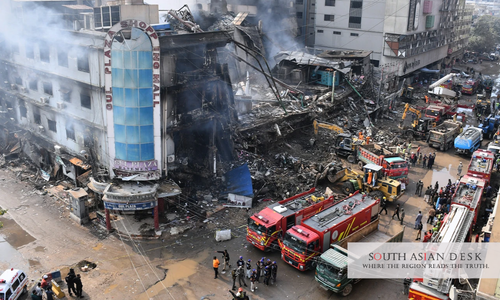
The Gul Plaza fire, one of Karachi’s deadliest commercial disasters in recent memory, has been formally attributed to criminal negligence on the part of the shopping complex’s management, according to a revised police charge sheet that widens responsibility for the tragedy well beyond its immediate cause.
How the Gul Plaza Fire Broke Out
The blaze erupted on January 17 at the multi-story shopping complex situated in Karachi’s densely populated Saddar area. Firefighters took three days to bring the flames fully under control, while search and rescue teams continued working through unstable debris and severely damaged sections of the building for more than a week afterward. The fire eventually claimed more than 70 lives, ranking it among the deadliest building fires the city has witnessed in recent years.
Investigators have consistently maintained that the fire started after an eleven-year-old boy, playing with matchsticks inside an artificial-flower shop registered as shop No. 193, accidentally set the stock alight. The flames then spread rapidly through the tightly packed commercial building, overwhelming those inside before help could arrive.
Police Charge Sheet Cites Criminal Negligence
While the origin of the fire has remained unchanged throughout the investigation, the latest charge sheet significantly broadens the scope of blame. Police concluded that the criminal negligence and carelessness of the Gul Plaza management directly contributed to the scale of the casualties.
Investigators found that the fire-safety equipment installed on the premises was grossly insufficient for a building of its size and commercial use. Only two of the complex’s gates were open at the time the fire broke out, and several iron gates elsewhere in the structure were locked, trapping occupants inside and preventing a swift evacuation.
The charge sheet further noted that management had disconnected the building’s electricity supply during the fire despite being aware that no alternative emergency lighting arrangement existed, a decision that left people struggling to find their way out through smoke-filled corridors and stairwells. Investigators also determined that the management failed to alert the fire brigade about the blaze in a timely manner, delaying the emergency response at a critical stage.
Civic Agencies Cleared of Wrongdoing
The investigation separately examined the conduct of the Karachi Metropolitan Corporation, the fire brigade, Rescue 1122 and the Civil Defense department. Police said that although the response of these bodies was reviewed in detail, none of the emergency and civic agencies involved were found responsible for criminal negligence in connection with the fire.
Charges Against the Shop Owner and Management
According to the charge sheet, the father of the boy linked to the outbreak of the fire, who owned the artificial-flower shop, has been sent for trial along with three members of the Gul Plaza management. The case will now proceed on the basis of this revised and more detailed investigation.
Court Had Rejected Earlier Findings
The current charge sheet follows a setback for investigators in July, when a Karachi court rejected an earlier version of the police report. The court ordered further investigation at the time, ruling that police had not adequately examined whether the fire could have been prevented or whether criminal negligence by relevant authorities had contributed to the deaths. The revised charge sheet appears to respond directly to that court order by documenting the failures attributed to the plaza’s management in far greater detail.
Compensation for the Victims’ Families
Separately, the Sindh government had earlier approved compensation of Rs10 million, roughly $35,800, for each family that lost a relative in the fire. The provincial government also announced interest-free loans and subsistence support for shopkeepers whose businesses were affected by the blaze and its aftermath.
Conclusion
The Gul Plaza fire remains a stark reminder of the risks posed by weak fire-safety compliance in Pakistan’s densely built commercial centers. With police now formally attributing criminal negligence to the plaza’s management and referring its officials for trial, the case is likely to draw renewed attention to the enforcement of building safety codes across Karachi and beyond.
Published in SouthAsianDesk, September 6th, 2026
Follow SouthAsianDesk on X, Instagram and Facebook for insights on business and current affairs from across South Asia.