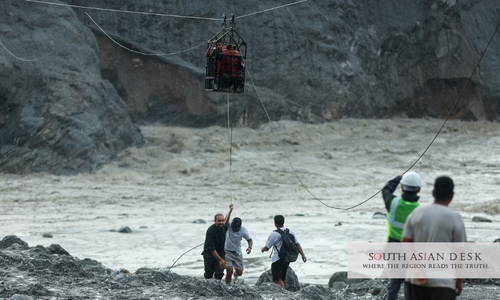
Nepal observed a national mourning day after flood disaster claimed the lives of more than 1,300 people, with grief stricken families across the country entering the traditional Hindu final day of mourning on Monday. The day fell on the 13th anniversary since the catastrophic flooding struck the country’s border region with China, and it came even as authorities continued search and rescue operations in the hope of locating survivors still unaccounted for.
Government offices throughout Nepal, a Hindu majority nation of 30 million people, along with Nepali missions abroad, flew the national flag at half mast to mark the occasion, the Ministry of Home Affairs said in a statement. In Hindu tradition, the 13th day after death is regarded as the concluding stage of the mourning period, during which close family members remain at home while relatives visit to offer condolences and rituals are performed to pray for the departed.
Origins of the Himalayan Floods Death Toll
The disaster behind Nepal’s national mourning day after flood began on August 26, when a glacial lake outburst flood sent a massive wall of mud, rock and water crashing into a river along the Himalayan border shared by Nepal and Tibet. The event, triggered when a section of glacier broke away, washed away entire towns and villages and buried roads and highways under thick layers of debris, cutting off access to some of the worst affected areas.
According to Nepal’s disaster management agency, the combined Himalayan floods death toll across Nepal and Tibet has now surpassed 1,300, with roughly 5,000 people still listed as missing, including foreign nationals. The scale of destruction and the number of those unaccounted for have made this among the deadliest natural disasters to strike the region in recent memory.
Search and Rescue Operations Continue Amid Limited Resources
Despite the solemnity of the mourning day, search and rescue operations have not paused. Authorities said four rescues described as near miraculous had taken place in recent days, offering rare moments of hope amid the grim recovery effort. Rescue teams, including the Nepal Police and Armed Police Force, have continued combing through damaged homes and debris fields in search of both survivors and the remains of victims.
An army spokesperson said that rescue efforts have been concentrated around hydropower stations in the affected region, where officials believe there is still a possibility of finding survivors. Across the border, Chinese authorities reported recovering twelve additional bodies on Sunday as their own search continued for hundreds still missing in Tibet.
Because search and rescue operations remain active and resources continue to be stretched thin, the Nepali government opted not to organise wider public events to mark the day of mourning. A representative of the National Emergency Operation Centre said no formal government programmes had been arranged, given that rescue work in the flood hit areas was still underway.
Government Response and Ongoing Relief Efforts
President Ram Chandra Paudel, Nepal’s ceremonial head of state, travelled to the flood affected areas on Monday to survey the extent of the damage firsthand, according to his office. His visit formed part of a broader government effort to assess the destruction and coordinate the continuing relief response in the wake of the disaster.
At the same time, relatives of flood victims held a demonstration in Kathmandu, displaying banners calling on authorities to intensify efforts to locate their missing loved ones. The protest reflected the mounting frustration among affected families as the number of days since the disaster grows without clarity on the fate of thousands still unaccounted for.
A Nation in Collective Grief
As Nepal marks this national mourning day after flood, the country faces the dual challenge of honouring those already confirmed dead while continuing an urgent search for the thousands still missing. With rituals concluding the formal Hindu mourning period on this 13th day, attention now turns to the longer term task of rebuilding communities devastated by the glacial lake outburst flood and supporting families still awaiting answers about missing relatives.
The disaster has once again highlighted the vulnerability of Himalayan communities to sudden and catastrophic flooding events, a risk that experts have long warned may become more frequent as glacial environments continue to change. For now, the priority for Nepali authorities remains the completion of search and rescue operations, even as the nation begins the difficult process of mourning and recovery.
Published in SouthAsianDesk, September 8th, 2026
Follow SouthAsianDesk on X, Instagram and Facebook for insights on business and current affairs from across South Asia.