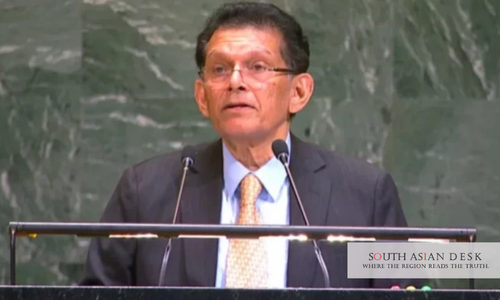
UNGA President Khalilur Rahman used his first remarks in office on Tuesday to pledge close cooperation with member states and the media, stressing that dialogue and the search for common ground must guide his year-long term. Speaking to reporters in New York shortly after assuming office as president of the 81st Session of the United Nations General Assembly, Dr Rahman said multilateralism is being tested in unprecedented ways, though he also sees genuine opportunities, particularly in emerging technologies and artificial intelligence governance.
Dr Rahman, who first arrived at the United Nations as a delegate in 1985, said he intends to place a high premium on cooperation and dialogue throughout his presidency. He acknowledged that not every dispute could be resolved quickly or amicably, but said that reality should not discourage continued efforts to find common ground wherever possible.
UNGA President Khalilur Rahman on Dialogue and Cooperation
Dr Rahman also pledged an open relationship with journalists covering the General Assembly, saying he intends to engage with the media regularly rather than treating press briefings as a one-way exchange. He described this openness as consistent with his working style at home and asked reporters to help make the relationship a genuine two-way conversation.
He placed particular weight on the opening words of the UN Charter, “We the peoples of the United Nations,” arguing that the organisation should not be seen as limited to its member states alone. He said unlocking the UN in this broader sense would be a defining goal of his presidency.
Placing the Rohingya Crisis on the Global Agenda
Asked specifically about the representation of stateless communities such as the Rohingya, Dr Rahman said he would continue bringing their voices before the United Nations. Drawing on his earlier role as Bangladesh’s high representative on the Rohingya issue, he recalled visiting refugee camps and witnessing firsthand the community’s desire to return home.
He noted that the UN secretary-general had also visited the camps, where large gatherings of Rohingya refugees delivered a consistent message that they wanted to go home. Dr Rahman described this as reflecting the deeper agony of a population displaced from its own homeland, and said he intended to keep amplifying that voice within the United Nations as his presidency proceeds.
A Push to Make the UN “Fit for the Future”
Dr Rahman said his campaign had centred on the theme of restoring trust and managing transformation, but that a further priority had emerged once he assumed office: making the United Nations fit for the future. He said the organisation should once again be a place where countries can vote yes with genuine confidence and enthusiasm.
On the question of UN reform, he argued that changes must go well beyond marginal or cosmetic adjustments if they are to help restore public confidence in the institution. He said trust in the organisation is currently in deficit and that deeper reform is required to prepare it not just for the present but for the decades ahead, noting pointedly that the world has moved on considerably since the UN’s founding in 1945. He welcomed the UN secretary-general’s existing reform proposals and said that process would continue under his presidency.
Security Council Reform and the Next Secretary-General
Dr Rahman said he would continue supporting the ongoing process of Security Council reform, drawing on decades of experience at the UN both as a delegate and as a staff member, which he said had given him a comprehensive view of the organisation from multiple angles.
On the selection of the next UN secretary-general, he said he would follow the UN Charter’s established process closely, under which the Security Council recommends a candidate for the General Assembly to appoint. He said he intends to work closely with member states and the president of the Security Council to identify a name as soon as possible, in order to ensure a seamless leadership transition.
On artificial intelligence, Dr Rahman said the United Nations has an important role to play in shaping AI governance and harnessing the opportunities created by rapid technological change. He also said he hoped world leaders attending the upcoming high-level week would use the opportunity to recommit to development, human well-being and human rights.
Commitment to Impartiality and the UN Charter
In his oath of office, Dr Rahman pledged to perform his duties with loyalty, discretion and conscience, and to act solely in the interests of the United Nations. He committed to acting in accordance with the UN Charter and the Code of Ethics for the President of the General Assembly, and pledged not to seek or accept instructions from any government or outside source while carrying out his responsibilities.
He assured member states that he would serve every country equally, regardless of how they voted in his election, and said his presidency would remain firmly anchored in the Charter and the mandates given to the organisation by its members. Closing his remarks, Dr Rahman reiterated that his doors would remain open throughout his term, formally beginning his tenure as president of the 81st session after taking the oath of office at UN Headquarters in New York.
Published in SouthAsianDesk, September 9th, 2026
Follow SouthAsianDesk on X, Instagram and Facebook for insights on business and current affairs from across South Asia.