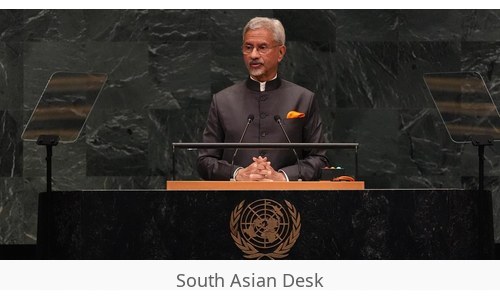
Jaishankar UNGA remarks: On September 26, 2026, Indian External Affairs Minister S. Jaishankar addressed the United Nations General Assembly (UNGA), directly responding to recent statements by Pakistan’s Prime Minister regarding terrorism and the Indus Waters Treaty. Jaishankar’s remarks underscored persistent tensions between India and Pakistan, particularly over regional security and water resource management, reflecting the broader context of India Pakistan relations. His speech, which included a sharp critique of Pakistan’s role in terrorism in South Asia, marked a significant moment in the ongoing diplomatic exchanges between the two nations.
Jaishankar UNGA remarks: Jaishankar’s Response to Pakistan’s Claims
Jaishankar affirmed India’s right to self-defense against cross-border threats, though he did not explicitly name Pakistan’s Prime Minister during the speech. The comments came in direct response to remarks made by Pakistan’s leadership, which had previously raised concerns about India’s actions in Kashmir and water-sharing agreements. This exchange highlights the ongoing challenges in terrorism in South Asia and the fragile dynamics of regional security. Jaishankar’s address emphasized that Pakistan’s arguments aimed to ‘normalize tension’ and that India would not tolerate any actions that threaten its sovereignty or territorial integrity.
The Indus Waters Treaty Discussion
The Indus Waters Treaty, a 1960 agreement governing water distribution between India and Pakistan, was a central topic of discussion. Jaishankar did not elaborate on specific disputes but highlighted the treaty’s importance in maintaining regional stability. The treaty has faced periodic scrutiny due to disputes over infrastructure projects on shared rivers, with both nations accusing each other of violating its terms. These tensions are a critical component of water resource management in the region, further complicating India Pakistan relations. The treaty, while a cornerstone of bilateral cooperation, has often been a flashpoint in the broader context of regional security.
Regional Implications of Jaishankar’s Remarks
The exchange at the UNGA is likely to deepen existing divisions between India and Pakistan, with little immediate prospect of de-escalation. While no formal diplomatic channels were mentioned, the remarks may influence regional dynamics, particularly in multilateral forums like the South Asian Association for Regional Cooperation (SAARC). Other South Asian nations have historically avoided taking sides in the India-Pakistan rivalry, focusing instead on economic and security cooperation. Jaishankar UNGA remarks could further strain regional security frameworks, as the Indus Waters Treaty remains a sensitive issue in water resource management. The speech also underscored the need for a more robust regional approach to counter terrorism in South Asia, which has long been a destabilizing factor in the region.
Historical Context and Future Outlook
The Indus Waters Treaty, signed in 1960 under the World Bank’s auspices, has withstood decades of geopolitical tension. However, recent developments, including Pakistan’s alleged support for militant groups in Indian-administered Kashmir and disputes over hydroelectric projects, have reignited concerns about its viability. Jaishankar’s remarks at the UNGA reflect India’s growing frustration with Pakistan’s perceived double standards, particularly in the context of terrorism in South Asia. While the treaty remains a vital tool for water resource management, its future depends on mutual respect for its provisions and a commitment to regional security.
The Role of Multilateral Forums
The UNGA speech by Jaishankar also highlighted the role of international platforms in addressing regional disputes. By bringing the issue of Pakistan’s alleged support for terrorism to the global stage, India sought to garner international support for its position. This approach aligns with broader efforts to strengthen regional security through multilateral engagement. However, the effectiveness of such strategies depends on the willingness of all stakeholders to engage in constructive dialogue, particularly on issues like the Indus Waters Treaty and terrorism in South Asia.
Follow SouthAsianDesk on X, Instagram and Facebook for insights on business and current affairs from across South Asia.
Sources
- Morning Digest: At UNGA, Jaishankar hits back at Pakistan PM on terrorism, Indus Waters Treaty; Trump rejects Iran proposal for deal to reopen Hormuz; and more – thehindu.com
- “Serial Practitioner Of Terrorism”: S Jaishankar Rips Into Pakistan At UN – ndtv.com
Image: th-i.thgim.com