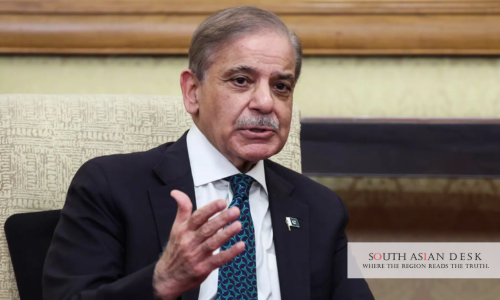
The Indus Waters Treaty dispute between Pakistan and India has escalated further after Prime Minister Shehbaz Sharif warned that any interference with Pakistan’s share of the Indus river system would not be tolerated. Speaking on Thursday at the inauguration of the Yadgar-e-Fatah, or Victory Monument, in Islamabad, a day before Pakistan’s Independence Day, Sharif said that every drop of Pakistan’s water represented a red line for the country.
Sharif accused India of unilaterally and illegally placing the Indus Waters Treaty in abeyance, and he described New Delhi as an enemy of peace. He said Pakistan wanted peaceful relations with India but cautioned that this should not be mistaken for weakness, adding that any future challenge to Pakistan’s sovereignty would be met with a forceful response. The prime minister referenced the four-day military confrontation between the two countries in May 2025, which Pakistan refers to as Marka-e-Haq, saying it had demonstrated the country’s capacity to defend itself.
Background to the Indus Waters Treaty Dispute
The Indus Waters Treaty was brokered by the World Bank and signed by India and Pakistan in 1960 to resolve a long-running dispute over the Indus river basin. Under the agreement, the three eastern rivers, the Ravi, Beas and Sutlej, were allocated primarily to India, while the three western rivers, including the Indus itself, were reserved largely for Pakistan’s use. The treaty had survived several wars and periods of hostility between the two countries over more than six decades before it became the centre of the current standoff.
The present phase of Pakistan India tensions traces back to the Pahalgam attack of April 22, 2025, when gunmen killed 26 people, most of them Indian tourists, in Indian-administered Kashmir. A day after the attack, India announced a series of punitive measures against Pakistan, including placing the Indus Waters Treaty in abeyance. New Delhi has since maintained that it will not resume normal treaty arrangements until Pakistan takes concrete steps against groups it holds responsible for cross-border terrorism.
Shehbaz Sharif’s Red Line Warning and Its Wider Context
Thursday’s remarks were not the first time Sharif has framed the water dispute in stark terms. At the United Nations General Assembly in September 2025, he told delegates that any violation of the Indus Treaty would represent an act of war, and he pledged to defend Pakistan’s water rights on behalf of its more than 240 million people. He repeated similar language in May 2025 at an international conference on glacier preservation in Dushanbe, Tajikistan, warning that Pakistan would not allow the red line to be crossed and that millions of lives should not be held hostage to what he called narrow political gains.
India has firmly rejected Pakistan’s characterisation of the dispute. Officials have said the treaty was signed in good faith in 1960 but argue it has since been undermined by repeated conflict and terrorism originating from Pakistani soil. India has also indicated it intends to make fuller use of its entitlements under the treaty, including through new infrastructure projects, while the agreement remains suspended.
Why the Indus Waters Treaty Dispute Matters
The Indus river system supplies water critical to Pakistan’s agriculture, drinking supply and hydroelectric power, which is why any suggestion of reduced flow is treated in Islamabad as a matter of national survival rather than routine diplomacy. With both countries continuing to trade sharp rhetoric and neither side signalling willingness to compromise, the Indus Waters Treaty dispute remains one of the most sensitive flashpoints in the broader relationship between India and Pakistan, carrying the risk of further escalation if a resolution is not found.
Published in SouthAsianDesk, August 15th, 2026
Follow SouthAsianDesk on X, Instagram and Facebook for insights on business and current affairs from across South Asia.