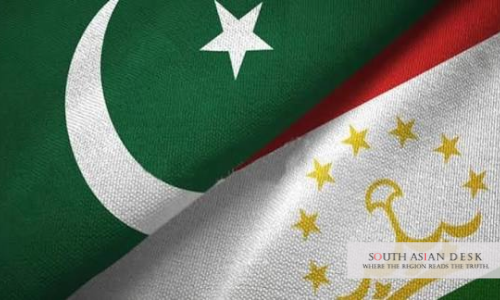
The Pakistan-Tajikistan meeting in Moscow on Monday, 5 October 2026, brought together Ambassador Mohammad Sadiq, Pakistan’s Special Representative for Afghanistan, and Sarwar Bakhti, head of the Middle East and Africa Department at Tajikistan’s Foreign Ministry. The encounter took place on the sidelines of the eighth round of the Moscow Format consultations on Afghanistan, a Russia-led regional forum that convenes envoys and senior officials to discuss the situation in Afghanistan and wider regional concerns.
Pakistan-Tajikistan Meeting: What Was Discussed
According to a statement issued by Mr Sadiq, the two sides discussed the situation in Afghanistan and broader regional developments. Pakistan’s ambassadors to Afghanistan and Russia also attended the meeting. No further detail on specific outcomes has been made public, and the exchange appears to have been one of several sideline contacts held as delegations gathered in the Russian capital.
The Pakistan-Tajikistan Meeting in the Context of the Moscow Format
The Moscow Format consultations are a regional diplomatic mechanism on Afghanistan that brings together Russia, China, India, Iran, Pakistan, the Central Asian states and Afghanistan itself. Senior officials and special representatives from Afghanistan, China, India, Iran, Kazakhstan, Kyrgyzstan, Pakistan, Russia, Tajikistan and Uzbekistan were expected to attend this year, with Belarus and Egypt invited as guests, according to Russian authorities. Foreign Minister Sergey Lavrov attended the inaugural session and addressed the participating delegations.
Last year’s seventh round marked a notable shift, as a Taliban delegation led by Foreign Minister Amir Khan Muttaqi participated as a full member for the first time. Mr Muttaqi is again leading the Afghan delegation in Moscow this year. Pakistan’s delegation, led by Mr Sadiq, also included Ambassador to Russia Faisal Niaz Tirmizi and Ambassador to Afghanistan Ubaid-ur-Rehman Nizamani.
Why Regional Coordination Matters
Tajikistan and Pakistan do not share a border, as Afghanistan’s narrow Wakhan Corridor lies between them. Both states nonetheless have a direct interest in developments inside Afghanistan, and sideline meetings of this kind allow neighbouring and near-neighbouring governments to compare assessments before the formal sessions begin. The agenda of the consultations covers regional peace and security, counter-terrorism, economic cooperation and connectivity, and continued engagement with Afghanistan. Russia has also said that cooperation against terrorism and drug trafficking is among its priorities for the round.
The Pakistan-Tajikistan meeting came at a sensitive moment for Islamabad. Relations between Pakistan and the Afghan Taliban remain strained over terrorism and cross-border security. Reporting before the talks indicated that no bilateral meeting between Mr Sadiq and Mr Muttaqi had been arranged, and a Taliban official said no such request had been made.
Pakistan’s Message at the Consultations
In his address to the forum, Mr Sadiq said terrorism remains at the core of Afghanistan’s problems. He said Pakistan would continue to take “all appropriate measures” to protect its citizens in accordance with international law, and he pointed to what he described as a nexus between the Taliban authorities and terrorist groups operating on Afghan soil. Pakistan’s mission in Moscow separately stated that Islamabad continues to stress the importance of a peaceful and stable Afghanistan and of sustained regional dialogue on shared security and economic challenges.
Outlook for the Afghanistan Talks
The Moscow Format has produced joint statements in previous years, and the seventh round ended with participants rejecting the deployment of foreign military infrastructure in Afghanistan or its neighbouring states. Whether the eighth round yields a comparable consensus will depend on how participants reconcile differing priorities, particularly on counter-terrorism. In this regard, the Pakistan-Tajikistan meeting is best understood as part of the groundwork that shapes positions before collective discussions, and not as a stand-alone development. Any outcome from the Afghanistan talks will be closely watched in Islamabad and Dushanbe alike, given the security concerns both capitals attach to Afghan territory.
Follow SouthAsianDesk on X, Instagram and Facebook for insights on business and current affairs from across South Asia.