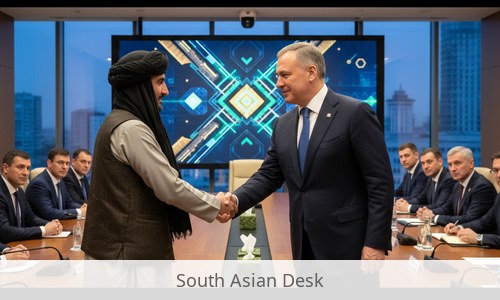
Afghanistan Russia economic cooperation: On October 6, 2026, Afghan Foreign Minister Sher Mohammad Abbas Stanikzai and Russian Deputy Prime Minister Vladimir Overchuk held discussions in Moscow, focusing on expanding economic ties between Afghanistan and Russia. Overchuk emphasized Russia’s readiness to advance practical cooperation, stating conditions are now in place for implementation. The talks align with broader efforts to strengthen bilateral relations amid shifting regional stability and geopolitical dynamics in South Asia.
Afghanistan Russia economic cooperation: Economic Cooperation
The discussions centered on potential sectors for collaboration, including energy, infrastructure, and trade. Russian officials highlighted opportunities for investment in Afghanistan’s mineral resources and transportation networks, while Afghan representatives sought support for stabilizing the national currency and improving customs efficiency. Both sides acknowledged the need for streamlined regulatory frameworks to facilitate cross-border trade. This Afghanistan Russia economic cooperation initiative aims to address these challenges by fostering mutual economic benefits and reducing reliance on Western aid.
Russia’s interest in Afghanistan’s mineral wealth, particularly in copper, lithium, and rare earth elements, has been a recurring theme in bilateral talks. Overchuk noted that Russia’s energy sector could benefit from Afghanistan’s untapped hydrocarbon reserves, while Afghan officials expressed interest in Russian expertise in infrastructure development. The proposed joint ventures in transportation networks, including road and rail projects, could enhance connectivity between Central and South Asia, potentially linking Afghanistan to Russian markets via transit routes.
Geopolitical Context
Afghanistan’s international isolation since 2021 has constrained its diplomatic and economic engagement. Russia, as a regional power with historical ties to Kabul, has positioned itself as a key partner in countering Western influence. This meeting reflects Moscow’s strategic interest in maintaining a foothold in South Asia, particularly as tensions with Pakistan and India over Afghan stability persist. The Muttaqi Overchuk meeting underscores the importance of regional stability in shaping South Asia relations and Russia’s broader geopolitical dynamics.
The geopolitical landscape has evolved significantly since the Taliban’s return to power in 2021. With Western nations imposing sanctions and restricting aid, Afghanistan has turned to regional actors like Russia, China, and Iran for economic support. Russia’s engagement with Afghanistan is part of its broader strategy to counterbalance U.S. influence in the region and reinforce its role as a mediator in South Asian affairs. This aligns with Moscow’s historical role as a key player in Afghan politics, dating back to the Soviet-Afghan War and subsequent diplomatic ties.
Future Implications
Strengthened Russia-Afghanistan ties could reshape regional power dynamics, potentially altering Afghanistan’s approach to neighboring countries. While economic benefits may include increased investment and reduced reliance on Western aid, challenges such as security concerns and infrastructure gaps remain. The outcome of these discussions will be closely watched by regional stakeholders, with implications for both Afghanistan’s domestic policies and its role in South Asia relations.
The potential for Russia to act as a stabilizing force in Afghanistan is a key point of interest for regional actors. By deepening economic ties, Moscow could help mitigate the risk of Afghanistan becoming a hub for extremist groups, which has long been a concern for Pakistan and India. However, the success of this partnership will depend on Russia’s ability to navigate Afghanistan’s complex political landscape and ensure that economic initiatives do not exacerbate existing divisions.
Expanding the Horizon of Collaboration
The Muttaqi Overchuk meeting also touched on the potential for joint ventures in renewable energy projects, such as solar and wind power, which could address Afghanistan’s energy deficit while aligning with Russia’s green energy goals. Additionally, discussions included the possibility of establishing a joint economic commission to oversee trade agreements and resolve disputes. These proposals reflect a desire to institutionalize the Afghanistan Russia economic cooperation framework, ensuring long-term sustainability.
Russia’s interest in renewable energy aligns with its own climate commitments and the growing global demand for clean energy. Afghanistan, with its abundant solar and wind resources, could become a regional hub for green energy production. The proposed joint ventures could also create employment opportunities and stimulate local industries, contributing to Afghanistan’s economic recovery.
Regional Stability and Strategic Alliances
Regional stability remains a cornerstone of the Afghanistan-Russia partnership. By fostering economic interdependence, both nations aim to create a buffer against external pressures and internal instability. This aligns with broader geopolitical dynamics where Russia seeks to reassert its influence in South Asia, countering the growing presence of other global powers. The collaboration also serves as a model for other regional actors, demonstrating how economic ties can contribute to peace and development.
The partnership between Afghanistan and Russia could also have implications for the broader South Asian region. By reducing Afghanistan’s dependence on Western aid and fostering closer ties with Moscow, Kabul may seek to balance its relationships with neighboring countries like Pakistan and India. This could lead to a more multipolar regional order, where multiple powers engage with Afghanistan on economic and security issues.
Challenges and Opportunities
Despite the optimism, the path forward is not without obstacles. Security concerns, including the threat of terrorism and organized crime, pose risks to infrastructure projects and trade routes. Additionally, Afghanistan’s complex political landscape requires careful navigation to ensure that economic initiatives do not exacerbate existing divisions. However, the potential rewards—such as job creation, improved infrastructure, and enhanced trade—make these challenges worth addressing.
Security remains a critical concern for both countries. Afghanistan’s porous borders and the presence of extremist groups like the Taliban and ISIS-K could hinder the implementation of large-scale infrastructure projects. Russia, which has its own security challenges in the North Caucasus, may be cautious about investing in Afghanistan without assurances of stability. Addressing these concerns will require coordinated efforts between Kabul and Moscow to ensure the safety of investments and personnel.
Follow SouthAsianDesk on X, Instagram and Facebook for insights on business and current affairs from across South Asia.