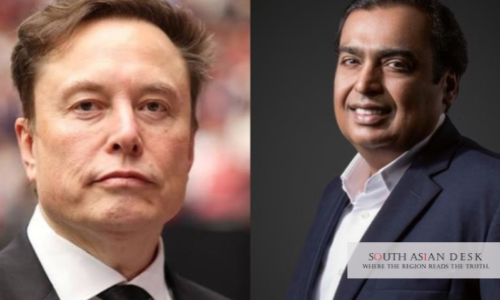
The Starlink launch in India has become the centre of a public dispute after Elon Musk questioned the influence of Mukesh Ambani over the country’s telecom market. The remarks, covered by Al Jazeera and other outlets, come amid reports shared by Musk about a Reliance-linked firm’s role in Bharatiya Janata Party (BJP) campaigns and political donations. The Indian government has rejected any suggestion that Starlink is being treated unfairly.
Why the Starlink Launch in India Remains Delayed
Starlink, the satellite broadband service operated by Musk’s SpaceX, has been waiting for approval to operate commercially in India for several years. Reuters reported in 2025 that the company had been awaiting licences since 2022, with no clear timeline for a decision.
In recent days, Musk has argued publicly that the delay is unjustified. In an earlier post reported by the South China Morning Post, he said Starlink was being blocked by “certain oligarchs” seeking to protect a monopoly, and invited readers to guess who they were. He then went further, asking whether Ambani is the real boss of India. The question referred to the chairman of Reliance Industries, whose telecom arm, Reliance Jio, is among the country’s dominant operators.
Musk’s Criticism of Mukesh Ambani
The criticism is notable partly because the two businessmen had appeared to reach a truce. Musk and Ambani clashed for months over how spectrum for satellite services should be allocated. Reliance favoured an auction, while Musk wanted administrative allocation, which is the approach most common globally. The Indian government sided with Musk’s position.
In March 2025, Starlink signed separate agreements with Reliance Jio and Bharti Airtel to distribute its equipment in India. Both deals were conditional on Starlink obtaining government approval to begin operations. The latest dispute suggests that tension over the Starlink launch in India has not disappeared.
The scale of the incumbents helps explain the debate. According to government data cited by the South China Morning Post, Reliance Jio and Bharti Airtel together account for roughly 910 million broadband subscribers, which is more than 80 per cent of the market.
Reports on Political Donations
The Hindu reported that Musk shared coverage about a Reliance-linked firm and its alleged role in BJP campaigns and political donations. These claims have not been verified in the material reviewed for this article, and Reliance Industries has not confirmed them. They should be read as allegations circulating in the public debate rather than established facts.
The episode has nonetheless drawn in domestic politics. Congress leader Rahul Gandhi used the exchange to target Prime Minister Narendra Modi over his perceived closeness to Ambani, a charge the government has consistently resisted. The controversy has once again put the relationship between large business groups and political parties in India under scrutiny.
Government Response and Regulatory Questions
Contrary to the impression that officials have stayed silent, the Centre has defended its approach. It has rejected the suggestion that Starlink faces unfair treatment and described India’s rules for satellite internet as fair. Reporting on the Ministry of Communications also indicates that it dismissed Musk’s earlier claim about oligarchs as unfounded. According to that reporting, the ministry said that three satellite communications providers, Starlink, Reliance Jio and OneWeb India Communications, hold telecom licences and are undergoing security assessments.
The regulatory debate has also unfolded amid security concerns about the presence of Starlink equipment in India. Musk subsequently said that Starlink’s satellite beams were switched off over India and had never been active there. India’s framework for foreign technology firms combines openness to investment with caution in sectors considered strategically sensitive, and satellite broadband sits squarely in that category.
What the Dispute Means for Satellite Broadband
India is a potentially lucrative market for satellite broadband, particularly in remote areas with limited connectivity. The outcome of the current dispute will therefore matter to foreign investors watching how licensing decisions are made. A clear timetable for approval, along with transparent reasons for any delay, would help address concerns raised by the company.
For now, the two sides hold sharply different views. Musk portrays the delay as the result of entrenched domestic interests, while the government insists that its process is fair and still under way. Until Starlink receives final clearance, the Starlink launch in India is likely to remain a test of how the country balances competition, security and the influence of its largest corporate groups.
Follow SouthAsianDesk on X, Instagram and Facebook for insights on business and current affairs from across South Asia.
Sources
- Starlink row: Musk shares reports on Reliance-linked firm’s BJP campaign role, political donations – thehindu.com
- Elon Musk lashes out at Indian ‘Prime Minister’ Mukesh Ambani in Starlink – aljazeera.com
Image: th-i.thgim.com