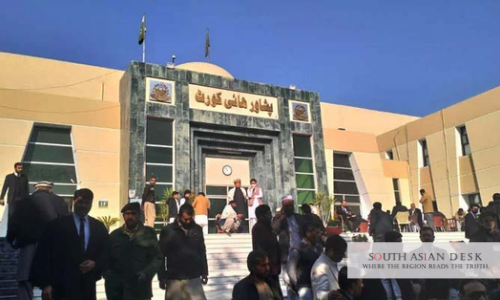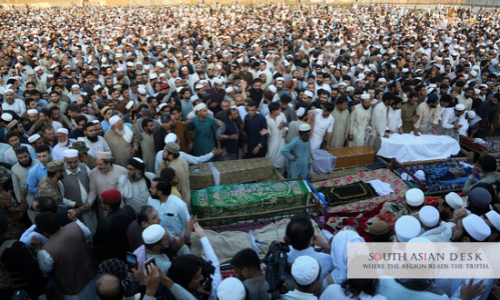
The Pakistan school roof collapse in the northwestern city of Peshawar has left a community in grief, with families burying children who set out for lessons on Thursday and never returned. Reuters reported that 34 students, all below the age of 13, and a female teacher were killed when the roof of their school came down.
How the Pakistan School Roof Collapse Unfolded
The roof fell on nearly 110 students who were taking lessons in three classes at the Al-Khair Education Center, which is located in narrow alleys on the outskirts of Peshawar. School bags, books and broken furniture were left scattered across the site.
Residents were the first to respond. They clawed through the debris with their bare hands and carried bloodied children to waiting ambulances before police and rescuers arrived. Rescue efforts continued for hours.
Most of the 45 injured children were discharged after receiving first aid, but hospital officials said three remained in critical condition.
Families Mourn the Victims
Among the dead was seven-year-old Rumaisa Khan, who had left home on Thursday wearing a new pair of shoes bought by her father, Ismail Khan, a garment shop owner. He and his brother pulled her from the rubble and rushed her to a hospital, where she was declared dead. “She left us too early,” he said on Friday.
Another victim, 13-year-old Mohammad Amir, had dreamed of becoming a religious scholar, his family said. His brother, Mohammad Haroon, told Reuters that the family had trusted the school as a place where Amir could learn and grow. Amir was the youngest of seven siblings, and Haroon, 24, the eldest, helped residents and rescuers pull children from the debris.
Maulana Zakirullah, a 38-year-old prayer leader at a mosque, lost his two sons, Mohammad, 10, and Abu Bakar, 8. He said he was asleep when they left for school and did not see them off. He saw both boys again only in coffins at a hospital several hours later.
What Caused the Peshawar School Roof Collapse
Peshawar police chief Mian Saeed said the building failed because of an overloaded roof. According to Saeed, construction had been added on top of a weak structure, which led to the collapse. He said the school’s owner had been arrested.
Authorities have also launched an investigation that includes an audit of all such school buildings. The scope and timeline of that audit have not been detailed in the reports available so far.
Low-Cost Private Schools and Recurring Safety Concerns
The tragedy has renewed attention on the conditions in which many Pakistani children are educated. Reuters reported that Pakistan spends less than 1 percent of its gross domestic product, which is nearly 450 billion dollars, on education. As a result, many families depend on low-cost private schools.
Many of these institutions operate from poorly maintained rented buildings with limited oversight, which has contributed to recurring safety concerns. In June, at least 14 children died when the roof of a tutoring centre collapsed in the eastern city of Lahore.
What Happens Next
The immediate priorities are the recovery of the three children still in critical condition and the continuation of the criminal investigation into the school’s owner. The planned audit may prove more consequential in the longer term, as it could reveal how many similar buildings are at risk and what action is required to make them safe.
For the families of Peshawar, however, such measures arrive too late. The community that gathered on Friday to mourn is left with an accounting of ordinary hopes lost, from a girl in new shoes to a boy who wanted to study religion, and with questions about whether the warning signs were missed.
This article is based on reporting by Reuters.
Follow SouthAsianDesk on X, Instagram and Facebook for insights on business and current affairs from across South Asia.