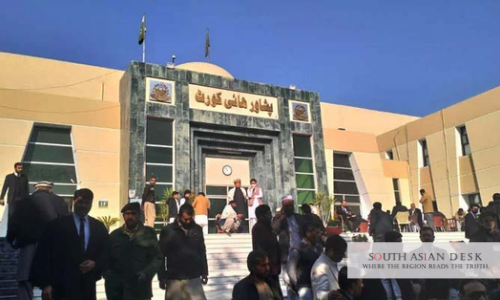
The Peshawar High Court hearing on governor’s rule in Khyber Pakhtunkhwa has been scheduled for October 20, when the court will take up separate petitions challenging the imposition of governor’s rule and an emergency in the province. The petitioners include the chairman of the Pakistan Tehreek-e-Insaf (PTI), Barrister Gohar Khan, and Advocate Salman Khan.
Peshawar High Court Hearing on Governor’s Rule: Who Has Challenged the Measures
According to The News International, the petitions by Gohar Khan and Salman Khan were filed separately. They name the Federation of Pakistan, the president, the prime minister, the Khyber Pakhtunkhwa governor and other relevant authorities as respondents.
A third challenge has come from the opposition alliance Tehreek Tahaffuz Aiyeen-e-Pakistan (TTAP). Its petition was filed by Allama Raja Nasir Abbas, who heads the Majlis Wahdat-e-Muslimeen, and Opposition Leader Mahmood Khan Achakzai, along with other leaders. The report did not say whether the court has fixed the same date for the alliance’s petition, so readers should confirm the schedule with the court.
How the Khyber Pakhtunkhwa Emergency Came About
The Khyber Pakhtunkhwa emergency was imposed on October 11 after President Asif Ali Zardari approved the move on the advice of Prime Minister Shehbaz Sharif. The proclamations were issued under Articles 232 and 234 of the Constitution.
The federal government cited the province’s deteriorating security situation and concerns over counterterrorism efforts. The PTI, which leads the provincial government and was founded by Imran Khan, has opposed both the emergency and governor’s rule.
Under the new arrangement, Governor Faisal Karim Kundi has taken charge of running the province on behalf of the federal government. He is assisted by an 11-member technocratic advisory council for Khyber Pakhtunkhwa.
Parliament Approves the Proclamations
Parliament approved the emergency and governor’s rule during a joint sitting a day before the court date was announced. The resolutions seeking approval of the presidential proclamations were moved by Federal Minister for Parliamentary Affairs Tariq Fazal Chaudhary and were adopted after a heated debate between treasury and opposition members.
The vote coincided with a further escalation in the political standoff. The Tehreek Tahaffuz Aiyeen-e-Pakistan announced that it was ending negotiations with the Centre over what it called unconstitutional measures. That decision suggests that the dispute is unlikely to be settled through political talks alone, and it increases the importance of the court proceedings.
What the PTI Petition Argues
In its plea, filed through lawyer Ali Zaman, the party asked the court to declare the imposition of the emergency and governor’s rule unconstitutional and to set them aside. The PTI petition argues that using terrorism as grounds to curtail the powers of an elected provincial government amounts to discriminatory treatment.
The party also contends that the federal government cannot strip a provincial administration of its powers because of political differences. To support the claim of discrimination, it points out that governor’s rule was not imposed in Balochistan despite terrorism and loss of life there. It adds that no such rule was applied in Khyber Pakhtunkhwa itself between 2007 and 2015.
The petition says the party supports counterterrorism operations and efforts to restore peace in the province. It alleges, however, that accusations of failing to act effectively against terrorism are being used to increase political pressure. The party further states that it secured a two-thirds majority in the province in the 2024 general elections.
On the constitutional questions, the petition argues that governor’s rule must meet the requirements and procedure laid down in Article 234. It also asks the court to examine the emergency declaration under Article 232 and the relevant parliamentary requirements.
Peshawar High Court Hearing on Governor’s Rule: Competing Positions
The federal government has presented the measures as a response to a security emergency, while its opponents describe them as a political tool. These accounts are not mutually exclusive in public debate, but the court will be asked to decide a narrower question, namely whether the procedures and grounds set out in the Constitution were properly followed.
The report did not include a government response to the specific claims in the petitions. Any reply from the respondents is likely to emerge only once the hearing begins.
What Happens Next
The Peshawar High Court hearing on governor’s rule on October 20 will be the first judicial test of the measures. The court may seek replies from the federal government and other respondents, and it could consider whether to grant any interim relief, although the report does not indicate what orders the petitioners will request at this stage.
Until the court rules, Governor Kundi will continue to run the province on the federation’s behalf. The outcome may carry consequences beyond Khyber Pakhtunkhwa, as it could shape how the constitutional provisions on emergencies and governor’s rule are interpreted in future disputes between the Centre and the provinces.
Follow SouthAsianDesk on X, Instagram and Facebook for insights on business and current affairs from across South Asia.
This article is based on reporting by The News International.