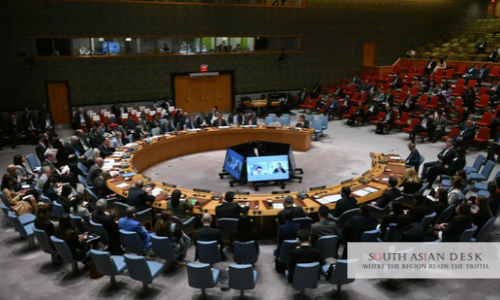
UN Security Council veto reform must be pursued as part of a comprehensive overhaul of the Council, India has said, reiterating that the veto held by the five permanent members should not become an instrument of “narrow political expediency”. The position was set out by India’s Permanent Representative to the United Nations, Parvathaneni Harish, in a statement to the General Assembly reported on October 27.
Mr Harish described the veto as a responsibility that carries a heavy burden and must be exercised with great restraint, particularly on matters bearing on international peace and security. At present, the privilege rests only with the five permanent members of the Council.
India’s Case Against the Current Use of the Veto
The Indian envoy pointed to the historical record to argue that the veto has been used unevenly and has damaged the standing of the Council. Over the life of the United Nations, he said, the veto has been exercised 331 times on around 200 resolutions. Two of the five permanent members have not used it for more than three and a half decades, and most vetoes or threats of vetoes have come from only three of them.
He also questioned the effectiveness of recent efforts to improve accountability. The Veto Initiative of 2022, which requires the General Assembly to hold a debate each time a veto is cast, was seen as a sign of change, Mr Harish said. The record of the large number of vetoes cast since the adoption of General Assembly resolution 76/262, however, tells a contrary story, in his assessment.
Why UN Security Council Veto Reform Cannot Be Addressed in Isolation
A central argument in the statement was that the veto cannot be examined separately from the rest of the reform agenda. Mr Harish said that limiting the veto is inseparable from questions of membership categories, regional representation, the size of the Council and its working methods. India therefore wants progress on all five clusters together, and he warned that addressing the veto in isolation would not change the way the permanent members make decisions.
To move the process forward, India called for the early start of text-based negotiations, with clearly defined timelines and milestones. Negotiations of that kind, which work from an agreed draft text, have long been sought by supporters of reform as a way to move beyond general statements of position.
The Hidden Veto Inside the Council
The ambassador also drew attention to a form of blocking power that is less visible than a cast veto. He said that every Council member, whether elected or permanent, holds what amounts to a de facto veto over presidential statements, press statements and decisions of sanctions committees. Under the unwritten rule of consensus, he explained, a single member can hold or block a proposal, most often without offering an explanation.
Alignment With the Common African Position
On the question of who should hold the veto in a reformed Council, India restated a position it describes as principled and well known. It is aligned with the Common African Position, under which every permanent member of an expanded Council would have the same rights and responsibilities. Mr Harish said that as long as the veto exists, it must be held by all permanent members, and that fairness and justice demand equal treatment.
For that reason, India rejects proposals to create a second tier of permanent seats. Mr Harish said that a new category of permanent members, with or without the veto, would complicate an already difficult discussion and would entrench the very inequity that reform is meant to correct. He added that periodic elections and the concept of permanency are fundamentally contradictory.
Significance of the Statement
The statement does not break new ground in substance. India has long argued for a larger Council and for permanent membership for itself, and it has often criticised the way the veto is used. What stands out is the emphasis on a package approach and on procedural steps, namely text-based negotiations with timelines, as the starting point for any change. The intervention also reflects a continuing effort by India to align its position with African states on the question of equal veto rights.
Any change to the structure of the Security Council would require amendment of the UN Charter, which in turn needs the support of the permanent members themselves. The diplomatic debate over UN Security Council veto reform is therefore likely to continue, and the statement by Parvathaneni Harish shows how India intends to frame its contribution to it.
Follow SouthAsianDesk on X, Instagram and Facebook for insights on business and current affairs from across South Asia.