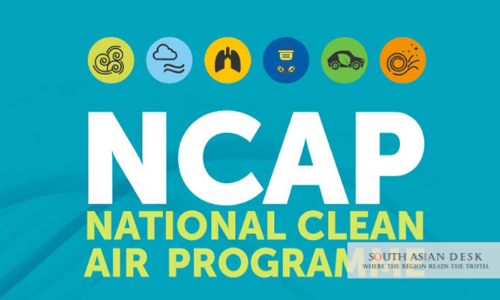
The National Clean Air Programme (NCAP) has fallen well short of its goals in most of the 130 cities it covers, according to a new analysis by the Centre for Research on Energy and Clean Air (CREA). Only 21 cities achieved a reduction of more than 40 per cent in PM10 pollution against the 2017-18 baseline, even though Rs 12,087 crore was utilised under the programme.
The findings raise questions about whether public spending has translated into sustained improvements in air quality, as the extended implementation period of the programme ended in 2025-26.
What the National Clean Air Programme Set Out to Achieve
Launched in January 2019, the programme initially aimed to cut PM10 pollution by 20 to 30 per cent by 2024-25, compared with 2017-18 levels. The target was later revised to a reduction of up to 40 per cent, or to meet the national standard, by 2025-26. The prescribed annual PM10 limit is 60 micrograms per cubic metre.
CREA compared annual PM10 concentrations in all 130 cities across three years: the original baseline of 2017-18, the starting year of 2019-20 and the closing year of 2025-26. Its findings show that 117 of the 130 cities exceeded the limit in 2025-26, while only 13 met it. The number of cities above the standard had stood at 125 in 2017-18 and 112 in 2019-20, which means it rose again over the later period.
Progress Depends on the Baseline Used
The analysis shows that the picture changes with the year chosen for comparison. Against 2017-18, 21 cities recorded reductions of more than 40 per cent and 44 achieved reductions above 30 per cent. Measured against 2019-20, however, only eight cities cut PM10 by more than 40 per cent and 25 by more than 30 per cent. PM10 levels actually rose in 43 cities between 2019-20 and 2025-26, and stayed unchanged in three.
CREA also noted that a large reduction does not necessarily mean a city meets the standard. Although 21 cities recorded cuts of more than 40 per cent from the original baseline, only 13 reached the prescribed limit.
Funds Under the National Clean Air Programme and Outcomes
According to the analysis, which draws on data from the PRANA portal, Rs 16,824 crore was released across the 130 cities, of which Rs 12,087 crore, or about 72 per cent, was utilised. Cities that cut PM10 by more than 40 per cent utilised Rs 3,023 crore, while those with reductions of 30 to 40 per cent utilised Rs 3,679 crore.
Several cities spent heavily yet recorded higher pollution. Chennai utilised Rs 449 crore, the highest among cities where PM10 rose against the 2017-18 baseline, and its concentration was 9.1 per cent higher in 2025-26 than in 2017-18. Jaipur utilised Rs 353 crore, and its PM10 level rose by 14.5 per cent compared with 2019-20. The analysis cautions that these figures do not prove that spending caused pollution to rise, or that the programme alone was responsible for the changes.
Concerns Over Dust Mitigation Spending
Manoj Kumar, an analyst at CREA, told ETV Bharat that 68 per cent of funds had gone towards dust mitigation, which reflects a disproportionate focus on one part of the problem. He argued that each city should set priorities according to its own pollution sources and favour long-term measures that deliver lasting emission cuts over temporary relief.
Source studies cited by the Environment Ministry attribute between 14 and 58 per cent of PM10 in studied cities to road dust and construction, with vehicles, industry and waste or biomass burning also contributing significantly. Experts say this variation shows why uniform spending priorities are unlikely to work.
Government Reports a Different Tally
The government’s own figures present a somewhat more favourable view. In a reply to the Rajya Sabha on July 30, 2026, the Union Environment Ministry said 108 of the 130 cities recorded lower annual PM10 concentrations in 2025-26 than in 2017-18. It reported that 26 cities achieved reductions of more than 40 per cent and that 14 met the national standard, up from six in 2017-18.
The ministry also reported that Rs 16,423.56 crore had been released and Rs 11,575.54 crore, or 70.5 per cent, utilised. CREA acknowledges discrepancies between its calculations and the official numbers, so the two sets of data should not be treated as interchangeable.
Looking Ahead to NCAP 2.0
Attention now turns to the next phase of the programme. The CREA analysis recommends extending action beyond individual cities through state-level, regional and airshed-based plans, since pollution crosses administrative boundaries. It also calls for explicit PM2.5 targets alongside PM10 and greater attention to industry, transport and household fuel use.
A separate CREA assessment found that 1,787 of 4,041 cities exceeded India’s annual PM2.5 standard in each of five years between 2019 and 2024, while only 67 of them fell under the programme. How NCAP 2.0 widens its coverage, and whether it ties funding more closely to measurable air quality gains, will determine whether the next round of spending performs better than the first.
Follow SouthAsianDesk on X, Instagram, and Facebook for insights on business and current affairs from across South Asia.
Read More: