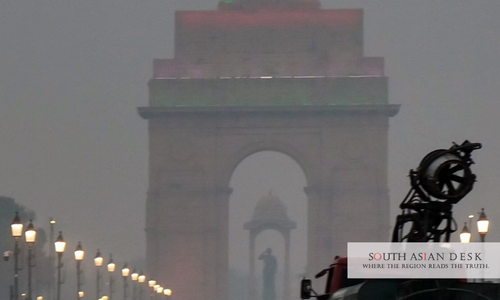
Allegations of AQI data manipulation in Delhi have intensified the political dispute over the capital’s air quality, after the Aam Aadmi Party (AAP) on Wednesday accused the BJP-led Delhi government of tampering with pollution readings and demanded legal action against Chief Minister Rekha Gupta and Environment Minister Manjinder Singh Sirsa. The claims were made as the city’s air quality remained in the “very poor” category, with the Central Pollution Control Board (CPCB) recording an Air Quality Index of 379 on Wednesday, according to Hindustan Times and PTI.
What AAP Has Alleged
AAP Delhi unit president Saurabh Bharadwaj alleged that air quality monitoring stations were being sprinkled with water in order to lower the readings they record. He pointed in particular to the Jahangirpuri station, which is located in one of the most polluted areas of the city. Mr Bharadwaj said that he and several other AAP leaders and councillors had posted on X that the Jahangirpuri station was being sprinkled with water, and that the party had raised the issue repeatedly with Ms Gupta and Mr Sirsa without receiving a response to its concerns.
In a formal complaint to the CPCB, Mr Bharadwaj sought criminal proceedings against the chief minister and the environment minister for alleged manipulation of ambient AQI data. He also demanded an immediate, independent and high-level investigation into what he described as physical interference with monitoring stations, along with a strict audit of the data acquisition systems and monitoring locations managed by the Delhi Pollution Control Committee.
The Public Health Argument
The complaint places considerable emphasis on the consequences for vulnerable residents. In his letter, Mr Bharadwaj said millions of people, including severe asthmatics, patients with chronic obstructive pulmonary disease, pregnant women, senior citizens and young children, rely on official AQI readings when deciding on their daily activities. He alleged that the publication of fabricated, lower figures would give such patients a false sense of security, which could lead them to venture outdoors or skip necessary medical precautions, and could in turn trigger serious respiratory and cardiovascular complications.
He urged the CPCB and the Commission for Air Quality Management (CAQM) to use their statutory powers to investigate. The party also announced a social media campaign to raise awareness of air pollution and the alleged data manipulation, arguing that many vulnerable people would be unable to take part in physical protests.
Context: GRAP Measures and an Earlier Dispute
The allegations come shortly after the CAQM invoked Stage II of the Graded Response Action Plan across Delhi-NCR on November 2, when the city’s AQI rose sharply from 117 on October 31 to 324 on November 2. The commission attributed the deterioration to unfavourable meteorological conditions. Notably, the Stage II measures themselves include regular mechanical road sweeping, water sprinkling and the deployment of anti-smog guns, so water sprinkling is an officially prescribed dust-control step. The dispute raised by AAP therefore concerns where and why water is being applied, rather than whether it is used at all.
Similar claims are not new. Last year, Mr Bharadwaj made comparable allegations about the Jahangirpuri station, and media organisations including Newslaundry and The Wire reported at the time on water being sprayed around monitoring sites in the city. The latest complaint repeats the charge and escalates it by seeking criminal proceedings against two senior office-holders.
Political Backdrop
Mr Bharadwaj said the party had expected pollution management to improve during the second year of the BJP government’s tenure but claimed that little had changed. The AAP and the BJP have long traded blame over Delhi’s worsening air. Mr Sirsa had earlier blamed the AAP government in Punjab for stubble burning incidents that contribute to pollution in the national capital.
There was no immediate response from the Delhi government or the BJP to the latest allegations, according to PTI. The claims therefore remain allegations at this stage, and neither the CPCB nor the CAQM has publicly indicated how it will treat the complaint.
AQI Data Manipulation in Delhi: What to Watch
The next step will be whether the CPCB acts on the complaint or seeks clarification from the Delhi government and the Delhi Pollution Control Committee. An audit of monitoring locations and data systems, as Mr Bharadwaj has requested, would offer a way to settle the factual question independently. Meanwhile, with the city’s air quality in the very poor range and further winter deterioration expected, the credibility of official readings is likely to remain a central issue in the debate over how Delhi manages its seasonal pollution.
Follow SouthAsianDesk on X, Instagram and Facebook for insights on business and current affairs from across South Asia.