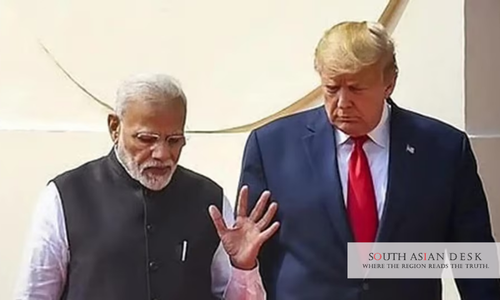
India-US ties are under fresh scrutiny in New Delhi after the Democratic Party won control of both chambers of the United States Congress in Tuesday’s midterm elections, delivering a heavy defeat to President Donald Trump’s Republicans. According to projections by CBS News, CNN, NBC News and NPR, Democrats took the House of Representatives and also flipped the Senate, erasing a Republican majority that stood at 53 seats to 47 before the vote. A Hindustan Times analysis by Shishir Gupta noted that the margin exceeded forecasts, which had favoured Democrats in both chambers, and said that India will now watch closely how Washington proceeds.
What Democratic Control of Congress Could Mean for Delhi
Democratic control of Congress does not by itself reset the relationship, but it changes the political environment in which the White House operates. The Senate result matters in particular, since that chamber confirms presidential nominees and judges. Analysts quoted by Indian media have suggested that a Democratic Congress could increase scrutiny of the economic impact of tariffs on American businesses and challenge measures such as the proposed $100,000 fee for H-1B visas.
Democrats have also been publicly critical of the administration’s approach to India. In August 2025, Democrats on the House Foreign Affairs Committee accused the president of singling out India with tariffs over Russian oil purchases while sparing China, a larger buyer, and argued that the policy was sabotaging the bilateral relationship. Ranking member Gregory Meeks said at the time that the tariffs threatened a “vital relationship.”
Tariffs and Russian Oil Remain Open Questions
The practical gains for India may nevertheless be limited. According to Kotak Neo, tariffs on several Indian exports had been pushed as high as 50 per cent before the rate on most Indian goods was reduced to 18 per cent, and negotiations have remained difficult, particularly over agricultural market access and Russian oil purchases. Former Secretary (Economic Relations) in the Ministry of External Affairs Pinak R Chakravarty told The Statesman that the era of American protectionism is not over and that the executive may now have more say on the trade deal than politicians do.
The Hindustan Times analysis lists the same irritants, noting that the administration threatened India with steep tariffs for buying Russian oil and later struck its own arrangement with Russia to purchase diesel ahead of the midterms. It also cites continuing pressure on H-1B and student visas as factors that have distanced New Delhi from Washington. India has consistently maintained that its energy purchases are driven by national interest and market conditions.
The Pakistan Factor and the Operation Sindoor Ceasefire
A second strand of the analysis concerns Washington’s relationship with Islamabad. The article says President Trump has sided with Pakistan’s Field Marshal Asim Munir, and it describes the president’s claim of credit for the Operation Sindoor ceasefire between India and Pakistan as one of the biggest irritants for Delhi. Mr Trump announced the ceasefire on social media on May 10, 2025. Pakistan has since thanked him and moved to nominate him for the Nobel Peace Prize.
India’s position, as set out in the analysis, is that Islamabad sought the ceasefire while under pressure from an Indian offensive. It states that Pakistan’s Director General of Military Operations called his Indian counterpart on the afternoon of May 10 to request a halt, and that Mr Trump posted online before New Delhi could make its own announcement. The article adds that, in India’s account, the nuclear dimension never came into play during the conflict, which followed the killing of 26 civilians, mostly tourists, in Pahalgam. These details reflect India’s version of events, and the US administration has characterised its role differently.
The analysis also points to Washington’s public backing of Pakistan’s claim that terrorism against it originates in Afghanistan, and to the use of Islamabad as a mediator in talks with Iran. New Delhi, it says, fears that closer US-Pakistan military ties could lead to the upgrading of American-made aerial platforms in Pakistan’s arsenal.
India-US Ties: The Road Ahead
The article concludes that India has no intention of gloating over Mr Trump’s electoral setback and wants an end to both the Ukraine and Iran wars. It also notes that the Quad summit India was due to host in 2025 has still not taken place. With the new Congress due to convene in January, the Hindustan Times analysis argues that the ball is now in Washington’s court to put India-US ties back on track. Whether Democratic oversight translates into a softer line on tariffs and visas, or whether the White House retains the upper hand on trade and foreign policy, will become clearer in the coming months.
Follow SouthAsianDesk on X, Instagram and Facebook for insights on business and current affairs from across South Asia.