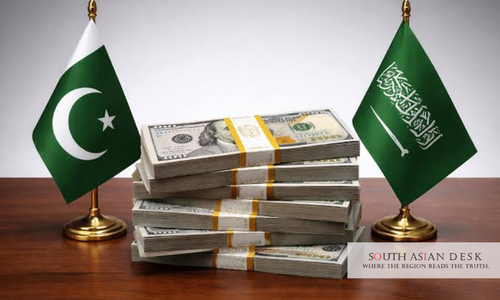
The Saudi $3 billion rollover confirmed on Wednesday gives Pakistan added financial stability at a time when hopes of securing a proposed $10 billion US backstop facility appear to have dimmed. Finance Minister Muhammad Aurangzeb disclosed the extension to journalists at Parliament House, saying the arrangement had been renewed for what he described as a reasonable period.
Saudi $3 Billion Rollover Extends a Key Financial Lifeline
Riyadh first provided the $3 billion in April this year to bridge a gap created by $3.5 billion in repayments owed to the United Arab Emirates. The deposit carried a three-month term and matured on October 31. Asked how long the new extension would last, Mr Aurangzeb urged against concern, pointing to the strategic relationship between the two countries.
The minister said he had held a productive meeting with his Saudi counterpart, Mohammed Al-Jadaan, on the sidelines of the recent World Bank and International Monetary Fund meetings in Bangkok. Saudi Arabia had already extended a separate $5 billion facility until 2028. Mr Aurangzeb rejected suggestions that Pakistan had sought further assistance from Riyadh, saying such support was not required.
Fading Hopes for the US Backstop Facility
The rollover comes as expectations surrounding the $10 billion Exchange Stabilisation Support Facility, which Pakistan requested from Washington in July, have been tempered. Mr Aurangzeb, who had himself raised hopes for the arrangement over several months, now describes it as helpful but not essential.
According to the minister, the original aim in July was to secure access to international capital markets, and that objective has been met. Pakistan issued a $3 billion bond in September against orders worth $6 billion. Should the US backstop facility materialise, he said, it would serve as a liquidity support measure for the sovereign. Otherwise, the government intends to proceed with further Eurobond and Panda bond issuances, as well as a rupee-linked, dollar-settled bond.
He added that he had met between 70 and 80 institutional investors in Bangkok, who held a clear view of Pakistan and had indicated interest in five-year and 10-year maturities. The minister said this reflected a horizon extending beyond the current IMF programme. He also noted that the US Export-Import Bank and the Development Finance Corporation were expected to support their investors and exporters in Pakistan, which he described as real financing and real credit.
On the IMF front, Mr Aurangzeb said the Fund’s Executive Board would meet in December to consider a disbursement of $1.2 billion.
Strengthening Foreign Exchange Reserves
The minister said foreign exchange reserves currently cover more than three months of imports and are expected to reach four months of cover by the end of the year through capital market inflows. Reserves have crossed $21.5 billion, which he called the highest level in the country’s history. He credited fiscal discipline for containing the fiscal and current account deficits despite floods, regional conflict and sizeable oil and wheat import bills. The current account deficit, he said, would not exceed 1 percent this year.
External Debt Reduction Remains a Government Priority
Appearing earlier before the Senate Standing Committee on Finance, Mr Aurangzeb said the government was targeting an external debt reduction of $4 billion during the current fiscal year and $3.5 billion in the next, compared with $4.5 billion in the last fiscal year. He said the strategy centred on replacing expensive short-term borrowing with longer-maturity financing raised through bonds and private placements, thereby lowering refinancing risks.
He noted that external debt had grown by $5 billion to $6 billion annually, rising from $45 billion in 2014-15 to roughly $100 billion, but had increased by only $1 billion a year over the past two years. The recent Eurobond, Panda bond and private placement transactions, he said, were replacement borrowing intended to swap costly facilities for cheaper ones rather than add to the overall burden.
Public Debt Eases but Financing Needs Persist
Finance Secretary Imdadullah Bosal told the committee, chaired by Senator Saleem Mandviwalla, that public debt had declined to 68.6 percent of gross domestic product by the end of June 2026, from 75.1 percent in fiscal year 2022-23. Year-on-year growth in public debt slowed to 7.7 percent in the last fiscal year, the lowest in 20 years, he said.
Domestic debt stood at Rs58.8 trillion at the end of August 2026, while foreign debt remained stable at $98.2 billion. Net financing requirements after rollovers and refinancing amount to $11 billion, of which $5 billion was repaid in the first four months of the fiscal year. The remaining $6 billion falls due over the next seven months.
With the Saudi extension secured and market access restored, the government appears positioned to meet these obligations. Whether the US facility ultimately materialises, Mr Aurangzeb said Pakistan would move forward either way.
Follow SouthAsianDesk on X, Instagram and Facebook for insights on business and current affairs from across South Asia.