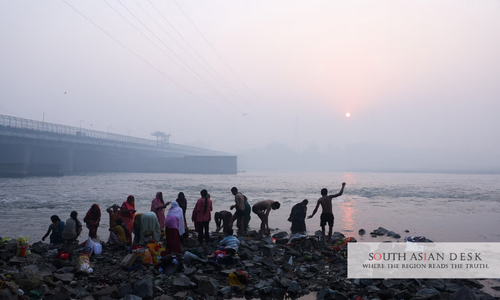
Delhi air pollution reached alarming levels on Saturday, November 7, with the Indian capital ranking as the world’s most polluted major city, according to Swiss air quality monitoring group IQAir. The development came a day before Diwali, the Hindu festival of lights, when widespread firecracker use is expected to place additional pressure on already deteriorating air quality.
IQAir’s live global ranking placed Delhi at the top of its list at 10:35 a.m. local time, recording a United States Air Quality Index (AQI) reading of 581. The figure was approximately twice the reading recorded in neighbouring Lahore, Pakistan, which stood at 285 at the same time.
The ranking highlights the severity of the pollution crisis confronting northern India as the region enters the winter season. Authorities have already introduced precautionary measures, including directing schools in and around Delhi to offer online classes and encouraging employees to work from home in response to worsening air quality.
According to India’s Central Pollution Control Board (CPCB), Delhi recorded an AQI of 363 at 10 a.m. on Saturday, placing the city in the ‘very poor’ category under India’s national air quality classification system.
Delhi Air Pollution Reaches Severe Levels Before Diwali
The latest readings have raised concerns about the potential impact of Diwali celebrations on the city’s already deteriorating environment. The festival, which falls on Sunday this year, is traditionally marked by fireworks and firecrackers, which can release substantial quantities of particulate matter and other harmful pollutants into the atmosphere.
Although firecracker-related emissions are not the only source of Delhi’s pollution, they can significantly worsen air quality during a period when atmospheric conditions are already unfavourable for dispersing pollutants.
Local media reports, citing official data, described Friday’s air quality as the worst recorded on the eve of Diwali in eight years. The development has renewed concerns about the effectiveness of measures intended to control seasonal pollution, particularly during the festival period.
Authorities have responded by encouraging residents to limit activities that could increase exposure to polluted air. The decision to allow online classes in schools around Delhi is intended to reduce the need for children to travel and spend time outdoors during periods of poor air quality.
The recommendation for employees to work from home is also part of efforts to limit commuting-related emissions and reduce public exposure. However, the effectiveness of these measures will depend partly on compliance and whether pollution levels improve in the coming days.
IQAir Ranks Delhi as the World’s Most Polluted Major City
The IQAir ranking provides an indication of the scale of Delhi’s air pollution compared with other major urban centres worldwide. Its reading of 581 placed the Indian capital significantly ahead of other cities included in the live ranking, with Lahore recording 285.
However, the two figures should be understood within the context of the different air quality measurement systems used internationally. IQAir’s ranking relies on a United States AQI-based reading derived from concentrations of air pollutants, while India’s CPCB uses its own national AQI methodology.
Consequently, IQAir’s reading of 581 should not be directly compared with the CPCB’s official reading of 363 as though both figures were generated using an identical scale.
Nevertheless, both monitoring systems indicated seriously deteriorating conditions in Delhi. Under India’s classification system, an AQI of 363 falls within the very poor category, which can cause respiratory discomfort to people with prolonged exposure and pose particular risks to vulnerable groups.
The difference between the two readings also illustrates why international pollution rankings and domestic air quality assessments can produce different numerical results even when monitoring the same city.
Why Air Pollution Worsens in Delhi During Winter
Delhi’s recurring air pollution crisis is closely associated with seasonal weather patterns and a combination of human activities. Pollution levels typically rise across northern India as winter approaches, when colder atmospheric conditions make it more difficult for pollutants to disperse.
Cold, dense air can contribute to the accumulation of emissions close to the ground, particularly when atmospheric mixing is limited. As a result, pollutants released by vehicles, industrial activities and construction sites can remain concentrated over populated areas for extended periods.
Crop-residue burning in neighbouring agricultural regions is another major contributor to seasonal air pollution. Farmers in parts of northern India burn leftover crop material to clear fields between agricultural cycles. The resulting smoke can travel across state boundaries and contribute to deteriorating air quality in Delhi and surrounding areas.
Construction dust, road dust and emissions from vehicles further compound the problem. These sources combine with unfavourable weather conditions to create periods of particularly high pollution during the winter months.
The seasonal nature of the crisis means that Delhi’s air quality is affected by factors extending beyond the boundaries of the capital itself. Regional coordination is therefore important for addressing pollution sources that cannot be controlled through city-level measures alone.
Diwali Firecrackers Raise Further Concerns Over Delhi’s Air Quality
The timing of the latest pollution spike has intensified concerns about the environmental consequences of Diwali celebrations. Firecrackers release particulate matter and chemical compounds that can contribute to short-term deterioration in air quality, particularly when weather conditions prevent pollutants from dispersing.
Delhi has experienced similar post-Diwali pollution episodes in previous years, with fireworks contributing to sharp increases in airborne pollutants. The combination of firecracker emissions, vehicle exhaust, construction dust and seasonal crop burning can create particularly hazardous conditions.
The potential health consequences are especially concerning for children, older people and individuals with existing respiratory or cardiovascular conditions. Exposure to high concentrations of fine particulate matter can irritate the respiratory system and aggravate existing health problems.
The latest developments also underline the limitations of relying primarily on temporary restrictions during major pollution episodes. While measures such as remote schooling and working from home can help reduce exposure and certain sources of emissions, the underlying causes of Delhi’s pollution require sustained intervention.
As the city approaches Diwali, attention will remain focused on whether pollution levels deteriorate further following the celebrations. The latest IQAir ranking serves as another indication of the challenges facing India’s capital, where seasonal weather conditions and persistent emission sources continue to undermine efforts to improve air quality.
Follow SouthAsianDesk on X, Instagram and Facebook for insights on business and current affairs from across South Asia.
Read More: