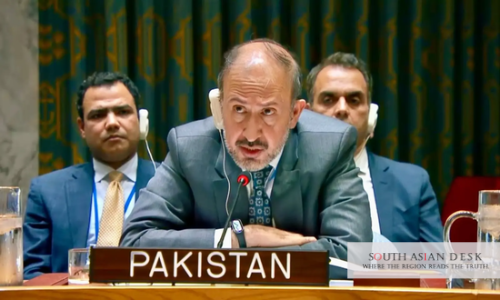
Gulf de-escalation was the central appeal made by Pakistan on Friday as the United States, Iran and the Gulf Cooperation Council (GCC) presented sharply conflicting accounts of regional insecurity before the UN Security Council. The meeting focused on attacks against shipping and threats to maritime security, and it underlined growing fears that the confrontation could disrupt international trade, energy supplies and food shipments while raising the risk of a wider regional conflict.
Pakistan Makes the Case for Gulf De-escalation
Speaking before the Council, Pakistan’s Permanent Representative to the United Nations, Ambassador Syed Haider Shah, called for an immediate end to military provocations in the Gulf and for renewed regional diplomacy. He condemned attacks on Gulf countries and urged respect for their sovereignty and territorial integrity, the protection of civilians and commercial shipping, and the restoration of normal maritime traffic.
Ambassador Shah also condemned attacks and threats by Houthi militia against Saudi Arabia, including strikes on civilian infrastructure and on vessels engaged in lawful trade. He reaffirmed Pakistan’s support for the kingdom’s sovereignty, security and territorial integrity.
Drawing attention to the strategic importance of the Strait of Hormuz and the Bab el-Mandab Strait, he warned that threats to navigation endanger seafarers, disrupt international commerce and deepen energy and food insecurity, particularly in vulnerable economies. He called for respect for freedom of navigation and for the safe and unimpeded delivery of humanitarian supplies.
Lasting peace, the ambassador said, required addressing the underlying causes of regional conflicts through a framework built on common security, peaceful coexistence and mutual prosperity. He urged all parties to end attacks, keep communication channels open and support diplomatic initiatives, including the good offices of the UN secretary-general.
Tehran and Washington Trade Accusations
The United States and Iran offered sharply contrasting accounts of the crisis, each blaming the other for the growing threats to maritime security. Iranian Ambassador Gholamhossein Darzi accused Western members of the Council of ignoring the origins of the confrontation and of attempting to reverse the roles of aggressor and victim.
He identified wars launched by the United States and Israel on June 13, 2025, and February 28, 2026, as the root causes of the present insecurity, describing them as unprovoked. He said the attacks violated international law and had targeted Iran’s supreme leader, government officials, nuclear scientists and civilian infrastructure. Ambassador Darzi put the Iranian death toll at 5,000, including 254 children, and characterised the attacks as war crimes and crimes against humanity. In his view, the insecurity surrounding the Strait of Hormuz is a direct consequence of those acts.
While insisting that Iran remained committed to peace in the Persian Gulf, he argued that the presence of foreign military forces was itself a major source of instability and a threat to maritime safety. He rejected Security Council Resolution 2817 (2026), calling it politically motivated and accusing it of ignoring the origins of the crisis, denying Iran’s right to self-defence and failing to identify those responsible for the aggression. Tehran had not closed the door to diplomacy, he said, but Washington must end its military actions, provide credible guarantees against their repetition and lift what he called unlawful coercive measures.
The US representative, Ambassador Jennifer Locetta, presented a very different picture. She accused Iran of aggression against its neighbours and of threatening international shipping through missiles, drones and what she described as unlawful mines in the Strait of Hormuz, as well as attacks in the Bab el-Mandab Strait. These actions, she said, endanger global energy and food security.
Ambassador Locetta noted that Resolution 2817 demands that Iran stop attacks on shipping and neighbouring states and that it attracted 136 co-sponsors. She argued that Tehran was defying the international community. She also accused the Houthis of attacking Saudi airports and energy installations with Iranian backing and of imposing an illegal, self-declared embargo on maritime traffic through the Bab el-Mandab Strait, in violation of Security Council resolutions including Resolution 2216 (2015). She urged Council members to hold Iran accountable.
Gulf States Seek Action From the UN Security Council
The GCC presented its own account of the attacks against its member states. Secretary-General Jasem Mohamed Albudaiwi said Gulf countries had faced more than 7,000 Iranian missiles and drones since February 28, targeting airports, ports, oil and gas facilities, power stations, water desalination plants and residential neighbourhoods. He said the strikes had caused deaths and injuries, extensive damage to property and infrastructure, and serious environmental consequences in the Arabian Gulf.
Describing the strikes as flagrant violations of the sovereignty and territorial integrity of GCC members, Mr Albudaiwi said they threatened international peace and security and required action by the Security Council to ensure they stopped and were not repeated.
Speaking earlier on behalf of the GCC, Bahrain’s Ambassador Jamal Fares Alrowaiei welcomed mediation efforts by Oman, Qatar and Pakistan and reaffirmed the bloc’s commitment to diplomacy and de-escalation. He insisted that the security of GCC states is indivisible and that Gulf countries must take part in any negotiations on regional security.
A Diplomatic Settlement Remains Difficult
The competing positions underscored how hard it will be to secure a diplomatic settlement, despite widespread concern over the wider consequences of continued attacks and restrictions on shipping. The debate centred on restoring freedom of navigation, ending attacks on commercial vessels and civilian infrastructure, protecting seafarers and ensuring humanitarian access. Speakers also stressed the need for mediation, including efforts to facilitate talks between the United States and Iran, and for a negotiated settlement of broader regional and nuclear-related disputes.
Pakistan reiterated its commitment to working with Gulf countries and international partners to promote Gulf de-escalation, maritime security and lasting regional peace and stability. With the United States, Iran and the GCC still far apart on who bears responsibility, the mediation role played by Pakistan, Oman and Qatar is likely to remain central to any effort to ease tensions along one of the world’s most important trade routes.
Follow SouthAsianDesk on X, Instagram and Facebook for insights on business and current affairs from across South Asia.