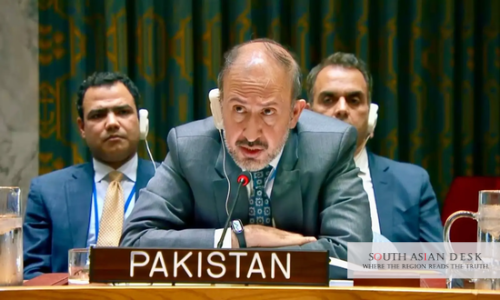
Pakistan Houthi attacks Saudi Arabia condemnation came before the United Nations Security Council on November 12, as Islamabad called for an immediate and unconditional end to Houthi attacks against the Kingdom. Pakistan’s Permanent Representative to the UN, Ambassador Syed Haider Shah, made the statement after the Security Council unanimously adopted a resolution renewing targeted sanctions against individuals and entities threatening peace and stability in Yemen.
The resolution extends the existing financial and travel restrictions against designated individuals until November 14, 2027. It also renews the mandate of the UN Panel of Experts monitoring the sanctions until December 15, 2027. Alongside extending the sanctions framework, the council condemned Houthi military escalation inside Yemen, cross-border attacks against Saudi Arabia and threats to commercial shipping.
Pakistan voted in favour of the resolution and used its explanation of vote to reaffirm its support for Saudi Arabia’s sovereignty, territorial integrity and security. Shah said that the Kingdom had a legitimate right to defend its territory and protect its citizens and residents in accordance with the UN Charter and international law.
Pakistan Houthi Attacks Saudi Arabia: Islamabad Reaffirms Support for Riyadh
Addressing the Security Council, Ambassador Shah strongly condemned the continued Houthi attacks against Saudi Arabia, describing Pakistan’s support for the Kingdom as firm and unwavering. He called for an immediate and unconditional cessation of the attacks, reiterating Islamabad’s solidarity with the Saudi leadership, government and people.
Pakistan’s statement reflects its position that attacks against Saudi territory and civilian infrastructure constitute a serious threat to regional security. The ambassador also emphasised that the Kingdom’s right to protect its territory and population must be understood within the framework of international law.
At the same time, Pakistan reiterated that its support for Saudi Arabia’s security should not be separated from the need for a broader political settlement in Yemen. Shah called for an inclusive, Yemeni-owned and Yemeni-led political process under United Nations leadership, stressing the importance of preserving Yemen’s sovereignty, independence, unity and territorial integrity.
Islamabad also expressed its readiness to support international efforts aimed at restoring peace and stability in Yemen and addressing the country’s continuing humanitarian crisis.
UN Security Council Renews Yemen Sanctions Until 2027
The resolution adopted on November 12 renews the targeted sanctions established under Security Council Resolution 2140, originally adopted in 2014. These measures include an asset freeze and travel ban against individuals designated as threatening Yemen’s peace, security and stability.
The council also extended the mandate of the Panel of Experts, which assists the 2140 Sanctions Committee by monitoring developments, investigating sanctions violations and reporting on activities that could undermine stability in Yemen.
A significant element of the renewed framework concerns the Houthis’ ability to manufacture and acquire weapons. The resolution seeks to restrict access to components and chemicals that can be used in the production of drones and missiles. UN monitoring has indicated that the group has maintained and developed its arsenal through smuggling networks and the diversion of equipment originally intended for civilian purposes.
The council has tasked member states with deciding by January 11 what measures should be taken to prevent the Houthis from acquiring specified items, based on a list to be prepared by the expert panel. The panel has also been asked to examine revenue generated through Houthi control of important economic sectors in Yemen and recommend ways to prevent those funds from being diverted towards military activities.
The resolution further reiterates that the arbitrary detention of UN personnel, diplomats and humanitarian workers by the Houthis could constitute grounds for additional sanctions. This provision follows the death in Houthi custody of Mohammad El-Shami, a Yemeni employee of the UN Human Rights Office who had been detained since June 2024.
The targeted financial and travel restrictions should be distinguished from the arms embargo imposed under Resolution 2216 in 2015, which remains in force without a specified expiry date.
Disagreements During Negotiations Over Yemen Sanctions
Although the resolution was ultimately adopted by consensus, negotiations exposed differences among Security Council members over how strongly the text should characterise the Houthis and address the group’s military capabilities.
Britain initially sought to restore language describing the Houthis as a terrorist group, a designation used in earlier sanctions resolutions. However, it dropped the proposal after Russia objected that such wording could complicate political negotiations. Bahrain, supported by the United States, also sought the inclusion of stronger language, but the proposal was not incorporated into the final text.
China, with Russia’s support, raised objections to the proposed list of dual-use items and the expansion of the expert panel’s mandate. These disagreements highlighted the difficulty of securing consensus on sanctions while maintaining space for diplomatic engagement.
Yemen’s ambassador to the UN, Abdullah Al-Saadi, welcomed the condemnation of Houthi actions but expressed disappointment that the council had not adopted stronger language. He also called for an end to the longstanding siege of Taiz and accused the group of using starvation as a weapon of war.
Pakistan, meanwhile, emphasised that sanctions monitoring must remain professional, impartial and consistent with the Security Council’s mandate. Shah argued that these standards were necessary to preserve the credibility and effectiveness of the Panel of Experts.
Renewed Houthi Attacks Raise Concerns Over Regional Security
The latest Security Council action comes amid renewed hostilities between the Houthis and forces aligned with Yemen’s internationally recognised government. The Houthis seized the capital, Sanaa, in 2014, prompting a Saudi-led military intervention in March 2015 in support of the Yemeni government.
A UN-brokered truce in 2022 largely reduced the intensity of fighting, but hostilities have since resumed. The Houthis have launched missile and drone attacks targeting Saudi territory, including airports, ports and oil installations, while Saudi Arabia has carried out airstrikes in Yemen.
The escalation has also raised concerns about maritime security around the Bab el-Mandeb Strait, a strategically important passage connecting the Red Sea with the Gulf of Aden. The route is a major channel for international trade and commercial shipping, making threats to vessels a concern extending beyond the immediate parties to the conflict.
Continued instability in the area could have implications for regional trade, energy transportation and international shipping. The Security Council’s condemnation of attacks against commercial vessels therefore forms an important part of the broader effort to contain the conflict.
Pakistan Calls for Political Settlement Alongside Security Measures
Pakistan’s position at the Security Council combines its condemnation of attacks against Saudi Arabia with support for a negotiated settlement in Yemen. Islamabad has maintained that the country’s territorial integrity and political independence must be respected, while emphasising that a sustainable resolution requires an inclusive process involving Yemenis themselves.
The renewed sanctions framework is intended to place pressure on individuals and entities undermining stability, restrict access to materials used in weapons production and strengthen international monitoring. However, sanctions alone cannot resolve the political and humanitarian dimensions of Yemen’s prolonged conflict.
Pakistan’s call for an immediate end to Houthi attacks on Saudi Arabia, alongside its support for a Yemeni-led political process, reflects the two concerns at the centre of its position: regional security and a lasting settlement to the conflict. As hostilities continue and maritime security remains under pressure, the effectiveness of international measures will depend on both enforcement and meaningful diplomatic engagement.
Follow SouthAsianDesk on X, Instagram and Facebook for insights on business and current affairs from across South Asia.
Read More: