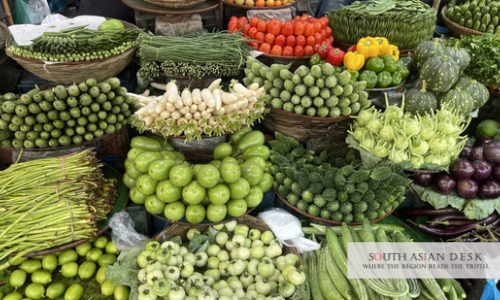
Dhaka food prices continue to weigh heavily on shoppers, even as the early arrival of seasonal produce has brought modest relief to part of the market. A visit to several kitchen markets in the capital on a recent Friday found that cheaper vegetables had done little to offset the cost of protein staples, leaving many families struggling to manage their monthly spending.
Winter Vegetables Offer Limited Relief
The clearest improvement has come from winter vegetables, whose growing supply has pushed down the cost of several everyday items. Beans were selling for between Tk60 and Tk80 per kg, while cauliflower cost Tk40 to Tk50 apiece and cabbage Tk50 to Tk60. Radish was priced at Tk40 to Tk60 per kg, and eggplant ranged from Tk40 to Tk70 depending on variety and size.
The relief, however, has not been uniform. Tomatoes and green chillies were both selling at around Tk120 per kg, carrots cost Tk140, and round eggplants reached as high as Tk120. Vendors said that not all winter vegetables had arrived in sufficient quantities and that prices could fall further as supplies grow. The current level of green chilli still marks a considerable fall from the peak seen in early August, when flooding and heavy rainfall disrupted supply and pushed the price to about Tk400 per kg in Dhaka’s kitchen markets.
Fish and Meat Prices Stay Out of Reach
While vegetables have become easier to afford, fish and meat prices have barely moved. Rohu was selling for Tk280 to Tk380 per kg depending on size, katla for Tk350 to Tk380 and pabda for Tk380 to Tk420. More affordable varieties included farmed koi at Tk200 to Tk220, pangas at Tk160 to Tk250, and large tilapia, silver carp and grass carp at Tk180 to Tk200.
Ilish, the national fish, remained beyond the reach of many consumers, selling for between Tk800 and Tk2,300 per kg according to size and quality. In some markets, the largest fish were priced as high as Tk2,600 per kg.
The meat market showed a similar pattern of stability at elevated levels. Broiler chicken cost Tk180 to Tk190 per kg, Sonali chicken Tk310 to Tk330, beef Tk800 to Tk850 and mutton Tk1,200 to Tk1,250. These figures are close to those recorded in late April, when beef sold for about Tk820 per kg and mutton for Tk1,250. A dozen brown eggs sold for Tk145 to Tk150, while white eggs cost Tk130 to Tk135.
Why Dhaka Food Prices Remain Stubbornly High
Sellers offer several explanations for the persistence of high protein prices. Fish retailers have said that wholesale rates are themselves elevated, and that transport and handling costs leave them little room to cut prices at the counter. Poultry and egg traders, for their part, have previously pointed to the damage caused by flooding, excessive rainfall and heat on farms over recent months, which they say reduced the number of laying hens and broiler chickens and tightened supply.
Vegetable prices follow a different logic. Sellers explain that retail rates move with wholesale supply, rising when arrivals are low and easing when they improve. That is why the arrival of seasonal produce has had an immediate effect on vegetables, while fish, meat and eggs, which depend on longer production cycles, have been slower to respond.
Pressure on Household Budgets
For low-income consumers in particular, the imbalance between cheaper vegetables and costlier proteins has left household budgets under strain. Shoppers interviewed in the markets said that although some vegetable prices had fallen, the overall cost of a basket of essentials remained high, and that the price of fish, meat and eggs continued to dictate what ends up on the family table. Many said that even a small reduction in these items would bring greater relief than the current fall in vegetable rates.
The experience of earlier months suggests that such pressure can alter buying habits. In August, shoppers told reporters that persistently high prices were forcing them to buy less fish and meat, and a day labourer interviewed in a separate report described having to choose between fish, vegetables and rice on a daily wage of Tk500 to Tk600.
Outlook for Dhaka Food Prices
Much will depend on how quickly winter vegetables reach the market in larger volumes, and on whether supplies of poultry and eggs recover from the setbacks of recent months. Vendors expect further declines in vegetable rates in the coming weeks, but few anticipate quick relief for fish and meat. Until wholesale costs ease, Dhaka food prices are likely to keep testing the patience, and the purses, of ordinary consumers.
Follow SouthAsianDesk on X, Instagram and Facebook for insights on business and current affairs from across South Asia.
Read More: