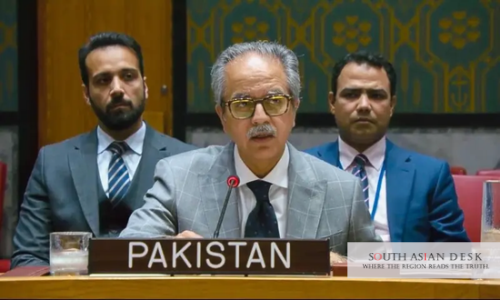
Pakistan condemns Houthi attacks on Saudi Arabia in the strongest terms, its envoy told a United Nations debate on Thursday, reaffirming Islamabad’s support for the kingdom’s security and its right to self-defence. The statement was delivered at a meeting of the UN Security Council on the Middle East and comes as regional tensions continue to escalate, according to a report by The News International.
Pakistan Condemns Houthi Attacks: Usman Jadoon Calls for the Attacks to Stop
Pakistan’s acting Permanent Representative to the United Nations, Ambassador Usman Jadoon, said the attacks “must cease immediately.” He reiterated Islamabad’s support for efforts to secure a peaceful settlement in Yemen and backed the UN special envoy’s initiative to resume dialogue aimed at a comprehensive and lasting peace in the country.
The remarks followed a particularly violent period for Saudi Arabia. Al Jazeera and The Washington Post reported that a Houthi strike on King Khalid International Airport in Riyadh on October 10 killed at least 12 people and injured more than 300. The group has also targeted other Saudi airports, and Al Jazeera reported that it struck an administrative building belonging to the state oil company Aramco in the eastern city of Dhahran on October 13. Several international airlines have since suspended flights to Saudi Arabia and neighbouring countries, according to the same outlet.
The UN special envoy for Yemen, Hans Grundberg, has described the airport attacks as a grave escalation that threatens regional security and complicates peace efforts, according to published accounts of his statement. The United States has also condemned the strikes.
Why Yemen Peace Efforts Remain Central
By linking its condemnation to Yemen peace efforts, Pakistan signalled that it sees diplomacy, rather than further military escalation, as the route out of the crisis. Reporting by Al Jazeera indicates the fighting has intensified in recent weeks, with the Houthis saying their strikes are retaliation for Saudi attacks on airports in Sanaa and Hodeidah. The Saudi-led coalition has said the attacks will not go unpunished. Those competing narratives underline how difficult it will be to revive talks.
The Gaza Ceasefire Dominates the Debate
The Security Council session was devoted largely to the wider Middle East, and much of the discussion centred on Gaza. The UN’s acting Special Coordinator for the Middle East Peace Process, Ramiz Alakbarov, warned that the Gaza ceasefire remains extremely fragile. Citing Gaza’s Ministry of Health, he said around 1,500 Palestinians, including more than 320 children and 140 women, had been killed since the truce took effect. He added that winter could worsen conditions for about 950,000 people living in flood-risk areas, and that more than 4,000 buildings used as shelters faced possible collapse.
Alakbarov urged full implementation of the Gaza plan, which includes the disarmament of Hamas, the withdrawal of Israeli forces, the deployment of an international stabilisation force and the transfer of governance to the National Committee for the Administration of Gaza.
Palestinian Deputy Permanent Observer Majed Bamya accused Israel of continuing to kill Palestinians despite the truce. He said more than 1,000 Palestinians had been killed in the occupied West Bank, including East Jerusalem, over three years, and called for Gaza and the West Bank to be reunited under the Palestinian Authority.
Pakistan’s Position on Palestine and the Two-State Solution
On Gaza, Pakistan called for a full ceasefire, unhindered humanitarian aid, immediate reconstruction, support for UNRWA and the release of withheld Palestinian revenues. Jadoon condemned Israeli incursions into the Al-Aqsa Mosque and rejected forced displacement and the fragmentation of Gaza and the occupied West Bank. He also called for an end to settlement expansion and settler violence.
He warned that Israel’s E1 project, approved last year, threatens Palestinian territorial contiguity by further separating East Jerusalem from the West Bank. Citing Security Council Resolution 2803, the Comprehensive Plan to End the Gaza Conflict and the New York Declaration, he reaffirmed Pakistan’s support for their full implementation and for a two-state solution. Such a solution, he said, should be reached through a credible, time-bound and irreversible process leading to an independent, sovereign and contiguous Palestinian state on the pre-1967 borders, with Al-Quds Al-Sharif as its capital.
International Reactions
Other members voiced their own concerns. France warned that settlement expansion, settler violence and financial pressure on the Palestinian Authority were fuelling instability. Britain urged that the E1 project be halted, its tender withdrawn and restrictions on humanitarian aid lifted. The United States defended President Donald Trump’s Gaza peace plan, which was endorsed by Resolution 2803 in 2025, and said its success depends on Hamas disarming.
What the Statement Signals
By stating that Pakistan condemns Houthi attacks on Saudi Arabia while also pressing for a settlement in Yemen and a durable outcome in Gaza, Islamabad has sought to position itself as a supporter of Saudi security and of diplomatic solutions. Whether the Security Council can translate such statements into action remains uncertain, as the Houthi campaign against Saudi targets continues and the Gaza truce remains under strain.
Follow SouthAsianDesk on X, Instagram and Facebook for insights on business and current affairs from across South Asia.