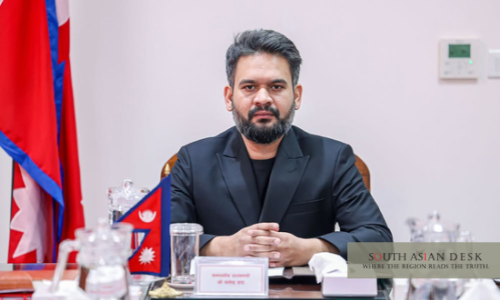
Nepal-China ties took centre stage on Friday when Prime Minister Balendra Shah met a 20-member delegation of ruling party lawmakers at Singha Durbar and urged them to keep the national interest at the heart of their talks in Beijing. The meeting came days before Shah is due to travel to New Delhi, and it underlines Kathmandu’s effort to keep a careful balance in its relations with its two powerful neighbours.
A Parallel Diplomatic Push in Beijing and New Delhi
The delegation of the Rastriya Swatantra Party (RSP) leaves for China on Sunday for nearly two weeks of political and diplomatic engagement. It is led by the party’s general secretary and lawmaker Bipin Acharya and is scheduled to return on November 26. Prime Minister Balendra Shah, meanwhile, is expected to begin his visit to India on November 22, which will be his first official bilateral trip abroad since taking office in March.
The timing has drawn attention to a long-standing challenge for Nepal, which is to maintain close ties with both India and China without being drawn into their competing strategic interests. According to The Kathmandu Post, the visit to China is being undertaken by lawmakers rather than by an official government delegation. Shah nevertheless made clear that they would be representing the ruling party and, by extension, the country’s political establishment.
What the Prime Minister Asked the Delegation to Raise
Lawmakers who attended the meeting told the Post that Shah advised the delegation to discuss the Belt and Road Initiative, Chinese-funded projects, tourism, economic cooperation and the implementation of earlier bilateral agreements. He reportedly told them they should feel free to raise issues that matter to Nepal, even though they are not part of the government.
The prime minister also urged the lawmakers not to approach Beijing with an inferiority complex simply because Nepal is the smaller country. On the Belt and Road Initiative, which has remained contentious in Nepal because of concerns over financing, implementation and debt, he asked the delegation to proceed carefully and to explain how Nepal can use the initiative in its own interest.
Shah also suggested that the lawmakers raise the possibility of converting Chinese loans for airport projects into grants, although he acknowledged that a commitment of that kind was unlikely during the visit. In addition, he asked the delegation to seek clarity from Chinese officials about stalled projects and what is needed to move them forward. The delegation will also explore cooperation under China’s Global Development Initiative, particularly in tourism, infrastructure and economic development.
In Beijing, the lawmakers are due to meet a member of the Chinese Communist Party’s Politburo and senior officials from the party’s International Department. The Post reports that the Chinese party had asked the RSP to send a high-level delegation and is arranging the visit.
Balance and a Non-Aligned Foreign Policy
Deputy parliamentary party leader Ganesh Parajuli said the prime minister had stressed the importance of preserving Nepal’s non-aligned foreign policy while raising state commitments and the progress of bilateral agreements. According to Parajuli, Shah also said Nepal should keep balanced relations with both neighbours and with other countries. RSP chief whip Kabindra Burlakoti said the visit should go beyond tourism and contribute to the development interests of both countries, and that the delegation would not discuss border disputes involving Nepal, India and China, since those matters belong to the government and official diplomatic mechanisms.
The India Visit and Its Economic Agenda
Shah’s decision to travel to India marks a departure from his earlier position that he would not make foreign visits during his first year in office. He accepted an invitation from Indian Prime Minister Narendra Modi, which was conveyed by Indian Foreign Secretary Vikram Misri during a visit to Kathmandu on November 4 and 5.
Talks are expected to cover a proposal for a $2 billion economic assistance package. Kathmandu has sought $1 billion in grants and $1 billion in concessional loans. The proposed grants include $500 million for the Butwal-Pokhara Expressway and $500 million for rebuilding infrastructure damaged by the Bhotekoshi flash flood, while the loans would mainly finance hydropower projects and transmission lines. Nepal has asked for the loans to be provided in Indian rupees rather than US dollars to reduce exchange rate risk. Other items on the agenda include the Pancheshwar Multipurpose Project, petroleum pipelines, trade, energy and connectivity.
Nepal-China Ties: A Word of Caution From a Former Diplomat
Former foreign secretary Madhu Raman Acharya has cautioned against going to India with a long wish list. He told the Post that Shah should talk to the Indian side as an equal counterpart and focus on restoring political trust, leaving existing mechanisms to handle other issues.
Taken together, the two engagements offer an early indication of how the Shah government intends to manage Nepal-China ties and its relationship with India. The outcome of the delegation’s meetings in Beijing, followed by the prime minister’s talks in New Delhi, will show how far Kathmandu can advance its interests while keeping its balance between its two neighbours.
Follow SouthAsianDesk on X, Instagram and Facebook for insights on business and current affairs from across South Asia.
Read More: