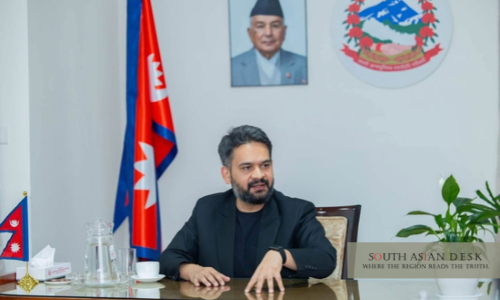
Ordinances in Nepal have become a routine instrument of governance under Prime Minister Balendra Shah, whose administration has issued 13 of them in less than eight months and recommended two more to the President. The pace has drawn criticism from constitutional experts and former parliamentary officials, who note that the government commands a near two-thirds majority in the House of Representatives and therefore has little obvious need to bypass the legislature.
How the Balendra Shah Administration Came to Rely on Ordinances
Since the Rastriya Swatantra Party (RSP) took office in March, the Balendra Shah administration has used ordinances far more often than many observers expected from a government with such a large mandate. The first batch of eight was issued between April 30 and May 5, barely a month after the government assumed power. The President, acting on the government’s recommendation, had summoned a joint session of both houses of parliament for April 30, but the decision was suspended a day later. The constitution does not permit ordinances while both houses are in session, so the suspension cleared the way for the ordinances to be issued.
The eight ordinances amended 81 laws, covering cooperatives, public procurement, universities, money laundering, health science academies, the removal of public office-holders and the Constitutional Council, among other areas. A second batch of five followed soon after parliament’s session ended on October 2, touching disaster management, forests and land, and a new academy for science, technology and innovation. On November 3, the Cabinet recommended two further ordinances, one amending the Press Council Nepal Act and another amending several Acts on culture, tourism and civil aviation.
What Article 114 Allows
Under Article 114 of the constitution, the President may issue an ordinance on the Cabinet’s recommendation only when parliament is not in session and immediate action is necessary. An ordinance carries the force of law but must be presented to both houses when they meet. It ceases to operate if either chamber rejects it or if it is not endorsed within 60 days of the first meeting of both houses.
Constitutional expert Bhimarjun Acharya argued that the provision should be reserved for truly exceptional circumstances such as war, an epidemic or a state of emergency. He said a government with a near two-thirds majority was repeating a mistake made by its predecessors, and he warned that an executive that gradually takes over the work of parliament risks acting arbitrarily. Surya Kiran Gurung, a former general secretary of the federal parliament, described the pattern as an interference in the jurisdiction of the legislature, adding that ordinances could be justified during a pandemic or a major disaster but not on any subject at any time.
Ordinances in Nepal: Consequences for Appointments and the Courts
The substance of some ordinances has proved as contentious as their number. One measure amended the laws governing public bodies, universities and academies, which enabled the removal of more than 1,500 officials appointed under earlier administrations. Another changed the rules of the Constitutional Council so that it could decide matters at a meeting attended by as few as three members. Shortly after that ordinance was issued, the council met on May 7 and recommended Supreme Court justice Manoj Kumar Sharma as chief justice. On July 3, it recommended a chief commissioner and two commissioners for the Election Commission.
Four of the eight ordinances later lapsed because they were not endorsed within 60 days, after opposition parties declined to cooperate on replacement bills. Their lapse did not automatically reverse everything done under them, and the validity of some decisions remains contested. Writ petitions challenging the Constitutional Council and public office-holder ordinances are being heard by the Supreme Court’s Constitutional Bench. The government has also reintroduced some forest and land provisions through fresh ordinances after the earlier omnibus measure lapsed.
The Government’s Position
The government has defended its approach. In April, the prime minister’s political adviser, Asim Shah, said the ordinances were meant to clear policy-level complexities in the administrative system and not to serve partisan interests. Energy Minister Biraj Bhakta Shrestha likewise said the measures were needed to speed up governance and address urgent issues. The Kathmandu Post reported that the government has said the changes were intended to improve administration and close legal gaps.
A Practice Not Confined to One Party
The figures suggest that reliance on ordinances is a long-standing habit in Nepal’s politics. A report published by the federal parliament counts 31 ordinances issued during KP Sharma Oli’s tenure from February 2018 to 2021. Under the current constitution, annual totals have ranged from none in several fiscal years to 28 in 2021-22. The 13 issued so far in the fiscal year 2026-27 therefore represent a sharp rise over a short period.
The Supreme Court has also set limits. In a June 2021 ruling, its Constitutional Bench held that the government could not bypass parliament to introduce laws on matters of long-term importance, and that issuing ordinances for administrative convenience or a political purpose could improperly interfere with the legislature.
The debate also carries a political irony, since RSP leaders criticised the use of ordinances while in opposition and have now adopted the practice in government. With more changes to investment and infrastructure laws under preparation ahead of a conference in Kathmandu on December 9 and 10, scrutiny of how ordinances in Nepal are used, and whether parliament is allowed to examine them, is unlikely to fade.
Follow SouthAsianDesk on X, Instagram and Facebook for insights on business and current affairs from across South Asia.
Read More: