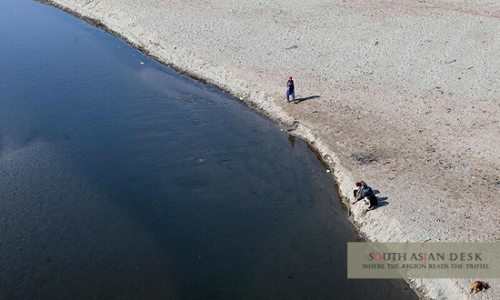
The Punjab water crisis is no longer a distant projection but a measurable reality, according to a detailed assessment by the Food and Agriculture Organisation (FAO) of the United Nations. The agency has warned that water demand in the province already exceeds supply across all sectors, while underground reserves are being drawn down faster than they can be replenished.
The findings appear in a report titled Water and Land Accounting in Punjab, which draws on annual water accounts covering five water years from 2012 to 2017. To assess the scale of the problem, the FAO sought advice from water specialists, including Shamsul Mulk, a former chairman of the Water and Power Development Authority (Wapda), and Rao Irshad Ali Khan, a former chairman of the Indus River System Authority (Irsa).
Groundwater Depletion Drives the Punjab Water Crisis
At the centre of the FAO report is the steady loss of aquifer storage. Groundwater was being depleted by about 5.5 billion cubic metres annually over the five-year period examined, while surface water resources were also coming under growing pressure. The report observed that sources of groundwater recharge have diminished, which in turn has reduced the net renewable water resources available to the province.
The rivers that flow through Punjab have also weakened. According to the report, river flows have declined by about 30 billion cubic metres following the 1960 Indus Waters Treaty with India, and freshwater bodies across the province have diminished significantly. Wetlands cover only 1.7 per cent of the province, and its natural landscape has shrunk considerably. Outside canal command areas and urban centres, rainfall remains the only source of water.
The canal network faces its own limits. Punjab’s canal system operates as a run-of-the-river system for half the year and therefore cannot draw its full authorised share of river water. The report noted that the reduction in drainage flows points to a consistent gap between water supply and demand.
Urban Centres and Farms Face Mounting Water Stress
The gap has become particularly acute in the province’s cities, where access to freshwater is limited and groundwater reserves continue to decline. Agriculture is not spared either. The report said farm output is increasingly at risk because of water stress and the depletion of aquifer storage. Freshwater shortages have pushed users towards greater reliance on recycled water of lower quality, even as pollution from agro-chemicals and urban wastewater has intensified.
Why the Punjab Water Crisis Matters Nationally
Punjab makes a major contribution to the national economy, which makes the management of its water resources especially critical. The report stressed that Pakistan’s overall water supply is already considered insecure, so pressure in its most productive province carries consequences well beyond provincial borders.
The analysis estimated that Punjab needs an additional 10 billion cubic metres of usable water every year to close the gap between supply and demand and to sustain its groundwater aquifer. It urged timely intervention, including ways to increase surface water resources, improve groundwater recharge and develop provincial mechanisms for the transfer of water between seasons.
A Commission to Review Water Policy
To address these pressures, the FAO strongly recommended setting up a commission to conduct a one-time review of provincial water resources, water-related policies, institutional mandates and existing strategies. Its tasks would include ensuring coherence between national and inter-provincial policies and water initiatives, and establishing an integrated mechanism to assess the impact of transboundary water projects and other interventions.
The commission would also identify overlapping responsibilities and the changes needed in institutional mandates. It would assess water and land resources along with current demand and projections until 2050. The report further proposed a provincial coordination cell within the Planning and Development Department to handle day-to-day operations.
Data Gaps Complicate the Response
A technical diagnosis of the water accounts identified four main challenges. These are growing scarcity across both space and time, continuous groundwater depletion, competition among sectors for water along with unaccounted transfers between them, and the need to protect annual renewable water resources, wetlands and the natural landscape.
The FAO report also pointed to shortcomings in data collection and the consolidation of information, which make planning harder. To remedy this, it recommended expanding the land-use classification system to cover the entire province. Reliable and consistent data, the report suggested, is a precondition for any serious attempt to manage a resource that is already stretched beyond its limits.
For policymakers, the message is clear. The Punjab water crisis cannot be treated as a seasonal inconvenience or a problem for a single sector. It calls for coordinated planning, better measurement and early action before the gap between demand and supply widens further.
Follow SouthAsianDesk on X, Instagram and Facebook for insights on business and current affairs from across South Asia.
Read More: