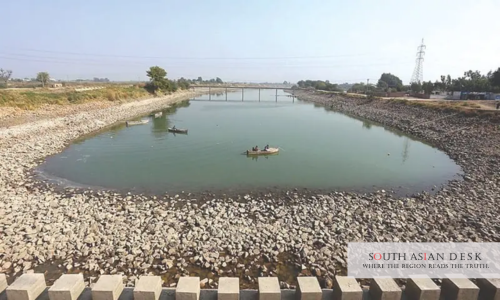
Sindh water shortage has reached alarming levels in the Right Bank Canal System of Sukkur Barrage, where reduced downstream releases and reported excess upstream withdrawals are affecting farmers during the peak Kharif crop season, according to irrigation records reviewed on Saturday, June 6, 2026.
Sindh water shortage hits Sukkur Barrage canals
Irrigation supplies in Sindh’s Right Bank Canal System have dropped sharply, creating serious concern for command areas fed through Sukkur Barrage, including Larkana, Qambar-Shahdadkot, Dadu, Sukkur and adjoining areas of Balochistan.
According to irrigation data cited in field reports, the North West Canal is facing a shortfall of 64.1 percent, the Rice Canal 38 percent and the Dadu Canal 82 percent.
The shortage comes during the Kharif season, when water demand rises for crops including rice, cotton, sugarcane and other summer crops. Farmers in the affected belt depend heavily on canal irrigation, particularly in areas where groundwater quality is poor or unsuitable for sustained cultivation.
The reported shortfall is also affecting canals serving Sukkur district and parts of Balochistan through the North West Canal system. Officials and growers have warned that prolonged shortages could damage standing crops and disrupt rural incomes if flows are not restored.
Sindh water shortage linked to upstream withdrawals
Field records cited in the report say Punjab was drawing 53,394 cusecs against an allocated share of 44,000 cusecs, suggesting an excess withdrawal of about 21.35 percent. The same records said Taunsa Barrage was drawing 25,694 cusecs against an entitlement of 24,000 cusecs, an excess of about 9.3 percent.
The report also said Sindh had submitted an indent of 130,000 cusecs but was receiving 100,000 cusecs, leaving the province with a large shortfall.
Concerns have also been raised over the Chashma-Jhelum Link Canal, which was reported to be operating at about 16,500 cusecs while downstream scarcity intensified. Sindh has historically objected to link canal operations during shortage periods, arguing that lower riparian flows should be protected under the water-sharing framework.
The pond level at Chashma Barrage was reported to have risen from 644.9 feet on Friday to 646.4 feet on Saturday, indicating accumulation upstream while downstream areas continued to report shortages.
Water Accord sets provincial shares
The Water Apportionment Accord of 1991 remains the main framework for distributing Indus River system water among Pakistan’s provinces. The accord allocated annual shares of 55.94 million acre-feet to Punjab, 48.76 million acre-feet to Sindh, 5.78 million acre-feet to the then NWFP, now Khyber Pakhtunkhwa, and 3.87 million acre-feet to Balochistan.
For Kharif, the accord lists Punjab’s share at 37.07 million acre-feet and Sindh’s at 33.94 million acre-feet. It also provides that shortages and surpluses should be shared on an all-Pakistan basis according to agreed principles.
Sindh’s position has long been that water shortages should be distributed fairly and that downstream requirements should not be undermined by upstream withdrawals or link canal operations. Punjab and federal water authorities have often maintained that releases are managed according to availability, allocations and system requirements.
Background
Sindh’s irrigation system relies heavily on the Indus River and its barrages. Sukkur Barrage, completed in the early 20th century, remains one of the central structures in Pakistan’s irrigation network and feeds several major canals.
The Sindh Irrigation Department describes Sukkur Barrage as a backbone of the country’s irrigation system, with its canal network providing supplies to millions of acres. Its right bank canals include systems that serve Larkana, Qambar-Shahdadkot, Dadu, Shikarpur and parts of Balochistan.
Water disputes between Sindh and Punjab usually intensify during shortage periods, especially when river flows are low, reservoirs are being managed for seasonal demand, and link canals become politically sensitive.
Agricultural representatives in Sindh have warned that water cuts during Kharif can have a direct impact on rice cultivation, rural employment and export-linked output. Former Sindh Abadgar Board district president Ishaq Mugheri said the current shortages in the North West Canal, Rice Canal and Dadu Canal had reached critical levels.
Pakistan Peoples Party Sindh President Nisar Ahmed Khuhro has also criticised cuts to Sindh’s water share during Kharif, saying the province plays a major role in national agricultural production and rice exports.
What’s next
Sindh irrigation officials and growers are expected to continue pressing federal authorities and IRSA to ensure releases in line with provincial shares and to review upstream withdrawals during the shortage period.
Immediate monitoring of Sukkur Barrage, Taunsa Barrage and Chashma-Jhelum Link Canal operations will be central to determining whether the current shortfall eases or worsens in the coming days.
The Sindh water shortage now requires urgent official clarification, transparent release data and coordinated action to protect crops, farmers and downstream water rights during the Kharif season.
Published in SouthAsianDesk, June 7, 2026
Follow SouthAsianDesk on X, Instagram and Facebook for insights on business and current affairs from across South Asia.