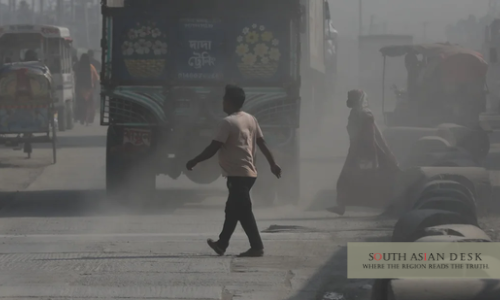
Dhaka air quality remained “very unhealthy” on Monday morning, with an Air Quality Index (AQI) score of 208 recorded at 9:10am, according to Dhaka Tribune. The reading placed the Bangladeshi capital third on the list of the world’s most polluted cities, behind Lahore in Pakistan and Kolkata in India. The ranking continues a pattern that residents of the city have come to expect as the winter season begins.
Dhaka Air Quality Stays Among the Worst Globally
On the morning in question, Lahore topped the list with an AQI score of 306, while Kolkata followed with 255. Dhaka’s score of 208 placed it clearly behind these two cities but well within the category that health authorities consider a serious concern for the general population.
The result was not an isolated one. At 8:30am on Sunday, Dhaka also ranked third among the world’s most polluted cities, with an AQI score of 206. Two consecutive mornings of very similar readings suggest that conditions in the city have remained broadly unchanged over the weekend. Air quality readings can vary from one monitoring platform to another and shift through the day, and another outlet reported a score of 203 at 8:40am on Monday, which still ranked Dhaka third.
What the Air Quality Index Measures
The Air Quality Index is a tool used to report daily air quality, showing how clean or polluted the air in a city is and what health effects may follow. In Bangladesh, the index is based on five pollutants, namely particulate matter (PM10 and PM2.5), nitrogen dioxide, carbon monoxide, sulphur dioxide and ozone.
Under the scale cited by Dhaka Tribune, a reading between 101 and 150 is considered unhealthy for sensitive groups, while a score between 151 and 200 is classified as unhealthy. Readings from 201 to 300 are described as very unhealthy, and anything above 300 is considered hazardous, posing serious health risks. Monday’s reading of 208 therefore sits at the lower end of the very unhealthy band.
What a Very Unhealthy Rating Means for Residents
A very unhealthy rating means that people may experience more serious health effects from air pollution regardless of their health condition. This is a stronger warning than the one attached to the unhealthy category, which is primarily aimed at sensitive individuals. Children, older people and those with respiratory or heart conditions are generally regarded as being at particular risk when levels reach this range.
The World Health Organization (WHO) has long identified air pollution as one of the leading risk factors for death and disability worldwide. The organisation estimates that it kills about seven million people every year, largely through stroke, heart disease, chronic obstructive pulmonary disease, lung cancer and acute respiratory infections. Health professionals commonly advise vulnerable groups to limit time outdoors on days when readings are high, although the Dhaka Tribune report did not include any official guidance for the public.
A Seasonal Problem With Long Roots
Dhaka has long struggled with air pollution, and its air quality usually turns unhealthy in winter before improving during the monsoon. The latest readings fit that seasonal pattern, with the city appearing repeatedly near the top of global rankings in the colder months. The report did not examine the specific causes behind this week’s readings, and no official explanation from the authorities was cited.
The position of Dhaka among the world’s most polluted cities alongside Lahore and Kolkata also highlights how widely the problem is shared across South Asia. Cities in the region regularly appear together at the top of such rankings during the winter season, which points to a challenge that extends beyond national borders.
Outlook for the Coming Days
Air quality can change quickly depending on weather conditions, so the rankings may shift in the days ahead. For the moment, however, Dhaka air quality remains in a range that the AQI scale associates with serious health effects for everyone, not only for those who are already vulnerable.
Residents will be watching whether the readings ease or worsen as winter deepens. Without sustained measures to reduce emissions, the capital is likely to continue appearing on lists of the world’s most polluted cities for as long as the cold season lasts, and the health burden of that exposure will continue to fall on its residents.
Follow SouthAsianDesk on X, Instagram and Facebook for insights on business and current affairs from across South Asia.
Read More: