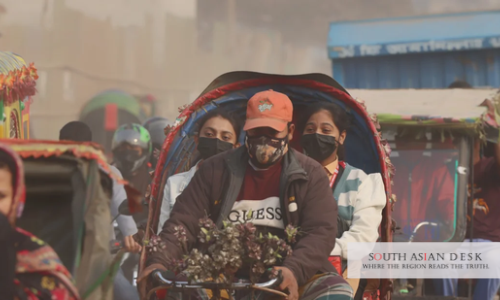
Dhaka air quality was classified as unhealthy on Sunday morning, placing the Bangladeshi capital fourth among the world’s most polluted cities. The Dhaka Tribune reported that the city recorded an Air Quality Index (AQI) score of 166 at 8:42am, a reading that, according to the AQI scale, indicates that airborne pollutants have reached a concentration capable of posing health risks to the general public.
What the Dhaka Air Quality Reading Means
The AQI is an index that tracks daily air quality and conveys how polluted the air is and what effects it may have on residents. Under the scale cited by Bangladeshi news agencies, a reading between 101 and 150 is considered unhealthy for sensitive groups, while a score from 151 to 200 is classed as unhealthy. Readings between 201 and 300 are termed very unhealthy, and anything above 301 is deemed hazardous. At 166, Dhaka therefore sits in the middle of the unhealthy band, short of the very unhealthy category the city has entered on worse days.
In Bangladesh, the AQI is calculated on the basis of five key pollutants, namely particulate matter (PM10 and PM2.5), nitrogen dioxide, carbon monoxide, sulphur dioxide and ozone. The rankings are drawn from IQAir, the Swiss air quality monitoring company whose real-time platform is the source most often cited in local reporting.
How Dhaka Air Quality Compares With Other Cities
According to the IQAir-based listing published by Probashir Diganta, which recorded Dhaka at 166 at 8:58am, Lahore topped the world’s most polluted cities with an AQI of 420. Tashkent in Uzbekistan followed with 196 and Karachi with 170, ahead of Dhaka in fourth place. Delhi stood fifth with 156, followed by Wuhan in China at 155. Lahore’s reading lies well beyond the 301 threshold at which air is considered hazardous, which underscores how severe conditions were elsewhere in the region that morning.
The ranking is not fixed, and Dhaka’s position moves from day to day. On Monday, October 26, Daily Sun, citing the United News of Bangladesh, reported that Dhaka also ranked fourth with an AQI score of 168 at 9:30am, behind Delhi at 200, Lahore at 199 and Karachi at 175. Earlier readings have been markedly worse. On one Tuesday morning in recent weeks, Dhaka topped the global list with a score of 213, a level classified as very unhealthy, according to reports by the Dhaka Tribune and UNB. The pattern shows a capital that repeatedly appears among the five most polluted cities in the world, with only its exact rank and score changing.
A Seasonal and Chronic Problem
Dhaka has long struggled with air pollution. The Dhaka Tribune notes that air quality typically deteriorates in winter and improves during the monsoon season, a cycle that makes the arrival of November a period of heightened concern. The trend is not limited to occasional spikes. IQAir has reported that the average PM2.5 concentration in Dhaka in 2024 was 78 micrograms per cubic metre, equivalent to an AQI of 162 and about 15.6 times the World Health Organization’s annual guideline of 5 micrograms per cubic metre. In other words, the unhealthy readings seen on Sunday are close to the city’s yearly average rather than a sharp departure from it.
Why the Ranking Matters
A fourth-place ranking on a single morning does not capture the cumulative burden on a densely populated city, but it does illustrate the regional character of the problem. Dhaka now appears alongside Lahore, Karachi and Delhi in the upper reaches of daily lists, which suggests that South Asia’s largest urban centres are facing a shared seasonal challenge. For residents, the practical significance lies in the classification itself, since an unhealthy reading means that exposure over the course of a day could carry health consequences for the general population, not only for children, older people and those with existing respiratory conditions.
As winter approaches, daily AQI figures from IQAir and local monitors are likely to remain closely watched, and the fall or rise of Dhaka air quality in the coming weeks will indicate how heavily the season weighs on the capital.
Follow SouthAsianDesk on X, Instagram and Facebook for insights on business and current affairs from across South Asia.