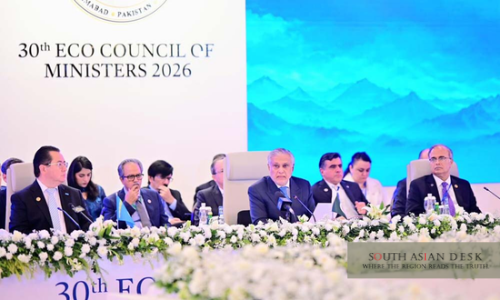
The ECO Council of Ministers meeting in Islamabad concluded on Monday with the adoption of a ten-year economic roadmap and with Pakistan assuming the organisation’s chair for 2026-27. The 30th meeting of the Economic Cooperation Organisation (ECO) was held on 15 and 16 November, and produced several outcomes touching on trade, investment, transport and regional diplomacy, according to Business Recorder.
What the ECO Council of Ministers Meeting Adopted
Member states adopted the Strategic Goals of Economic Cooperation 2026-2035, also known as ECO Vision 2035. The framework aims to strengthen regional economic integration through trade, investment, market access and regional value chains, and envisages closer cooperation in transport, energy, digital technology and climate resilience.
The ministers also issued the Islamabad Communiqué. Deputy Prime Minister and Foreign Minister Ishaq Dar told the concluding session that the roadmap and the communiqué together provide a common framework for pursuing regional priorities over the next decade. He added that meeting those objectives would require clearly defined priorities, realistic timelines and effective implementation and follow-up mechanisms.
Pakistan’s Chairmanship and Its Five Priorities
Pakistan took over the chair of the ECO Council of Ministers under the theme “Reviving Regionalism for a Resilient ECO”. Dar outlined five priorities for the chairmanship: expanding market access and investment, improving connectivity to Pakistan’s ports for landlocked member states, implementing the ECO Trade Agreement roadmap, strengthening cooperation on disaster preparedness and climate-resilient infrastructure, and investing in human capital through research and vocational training.
Dar said Pakistan would work with member countries and the organisation’s institutions to advance regional connectivity, facilitate trade within the region and promote mutually beneficial economic partnerships. He also announced that Pakistan will host the 19th ECO Summit in 2027 and the 31st Council of Ministers meeting that year, and expressed the hope that the next gathering would review concrete progress on the priorities agreed in Islamabad. Iran will host the 18th ECO Summit on 3 and 4 December 2026.
Diplomacy and Regional Connectivity Take Centre Stage
Beyond trade, the meeting also had a diplomatic dimension. According to Business Recorder, the Islamabad Communiqué acknowledged Pakistan’s diplomatic efforts to ease tensions between Iran and the United States and endorsed its mediation initiative. The report noted that the endorsement came amid heightened geopolitical tensions. The communiqué’s full text was not available at the time of writing, so the exact wording of that passage could not be checked.
Prime Minister Shehbaz Sharif reiterated Pakistan’s commitment to developing road, rail and multimodal transport corridors to improve regional connectivity. He pointed to the potential of the ports of Karachi, Port Qasim and Gwadar for landlocked ECO members, and said Pakistan favoured dialogue and diplomacy for the peaceful resolution of disputes. On the sidelines, Dar held talks with Iranian Foreign Minister Seyed Abbas Araghchi, Tajikistan’s Foreign Minister Sirojiddin Muhriddin and ECO Secretary General Dr Asad Majeed Khan.
Who Attended and Who Did Not
Senior officials from Turkiye, Azerbaijan, Kazakhstan, Iran, Kyrgyzstan, Tajikistan, Turkmenistan and Uzbekistan attended. Officials from Afghanistan, which is also a member, were not present, according to Business Recorder, which did not give a reason. The organisation has 10 member states and traces its origins to the Regional Cooperation for Development, set up in 1964 by Pakistan, Iran and Turkey, which was renamed ECO in 1985.
Afghanistan’s absence matters for the connectivity agenda, since several of the transit routes discussed by member states pass through its territory. The report did not say how the organisation plans to address it.
What Comes Next
The meeting’s immediate results are frameworks and commitments, rather than projects. ECO Vision 2035 sets objectives for a decade, but the practical test will be how quickly member states turn them into agreed corridors, trade measures and funding. Dar’s own call for realistic timelines and follow-up mechanisms suggests that implementation is the central challenge.
The next milestones are the 18th ECO Summit in Iran in December and the 19th summit and 31st ministerial meeting in Pakistan in 2027. They will show whether the priorities set out at the ECO Council of Ministers meeting in Islamabad lead to measurable progress, and whether the member states that were absent this time can be drawn into the process.
Follow SouthAsianDesk on X, Instagram and Facebook for insights on business and current affairs from across South Asia.
Read more: https://southasiandesk.com/gulf-de-escalation-pakistan-unsc/