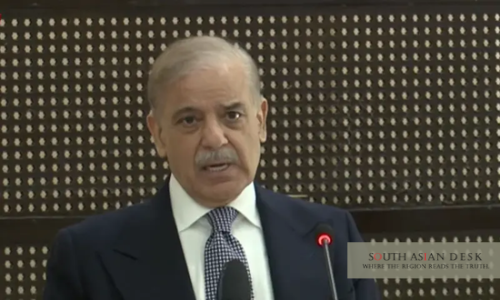
A civil-military partnership has been behind Pakistan’s recent economic achievements, Prime Minister Shehbaz Sharif said on Thursday, describing the cooperation between the country’s political and military leadership as unprecedented in its history. He made the remarks while addressing a ceremony organised by the American Business Council of Pakistan, where he spoke to members of the business community about the state of the economy and the government’s priorities.
Prime Minister Praises a Partnership Without Precedent
Prime Minister Shehbaz Sharif told the gathering that the achievements so far would not have been possible without teamwork at the top. He asked when the country had last seen such a productive arrangement between the military and political hierarchy, and answered that it had never happened before in Pakistan’s history. He said he wished such cooperation had existed in earlier decades, arguing that the country would have been transformed long ago had it done so.
The prime minister added that a civil-military partnership built on mutual understanding and flexibility in the national interest could have taken the country to great heights. He declined to take personal credit, saying instead that the recognition belonged to his team and to other partners in the field, including Chief of Defence Forces and Chief of Army Staff Field Marshal Asim Munir and his team.
Economic Stability Amid a Fragile Energy Situation
Recalling that Pakistan faced a serious threat of default in 2023, the prime minister pointed to a series of indicators that he said reflected macroeconomic recovery. He noted that the country had maintained economic stability even as the crisis in the Gulf unsettled some of the world’s most powerful economies. At the same time, he acknowledged that the position on energy remained very fragile.
Pakistan imports more than 90 per cent of its energy requirements, he said, yet there had been no panic or long queues at fuel stations. The government had also managed to put in place a subsidy programme, the Prime Minister’s Fuel Relief Scheme, to shelter the most vulnerable segments of society. He conceded, however, that these outcomes had come through hard work and at a cost borne by ordinary citizens.
On the situation in the Middle East, the prime minister said Pakistan was working tirelessly to help restore peace and was in contact with both Tehran and Washington with the support of friendly countries. He expressed confidence that the situation could be brought under control and suggested that a return to regional peace would allow the economy to rise to a level not seen before.
Tax Relief, Minerals and Concerns of Investors
Turning to domestic policy, the prime minister said his government wanted to hear directly from business leaders and to establish a mechanism for addressing their genuine grievances. He pledged to remove impediments and bottlenecks facing investors, and said transparency was the primary requirement of such a system. He also acknowledged that members of the American Business Council of Pakistan had contributed immensely to promoting the country’s economic interests, calling them great ambassadors for Pakistan.
He said that in the last budget the government provided tax breaks worth Rs400 billion, even though the country remains under an International Monetary Fund programme. According to the prime minister, the relief went to exporters, the manufacturing and corporate sectors, and salaried individuals, and was intended to act as a stimulus for the wider economy. He cautioned that a problem accumulated over seven decades could not be solved overnight, and urged all stakeholders to move forward together.
The prime minister also spoke about the country’s mineral wealth, saying Pakistan has deposits worth trillions of dollars and that work in the sector had been actively under way for the past two to three years. In remarks on the auto industry, he said the sector had received subsidies for years with little to show for them, and he argued that the present moment favoured electric vehicles as a way to reduce dependence on imported energy and limit the effects of climate disasters.
Focus on Export-Led Growth and Structural Reforms
Concluding his address, Prime Minister Shehbaz Sharif said the government had taken difficult decisions, exercised fiscal discipline and embarked on a programme of structural reforms. The task now, he said, was to consolidate those gains and place the country firmly on a path of sustained export-led growth, stressing that the growth had to be driven by exports.
His emphasis on a civil-military partnership comes at a time when the government is seeking to reassure investors that policy direction will remain steady. Whether the current economic stability can be turned into lasting expansion will depend on how effectively the government delivers on its reform agenda, secures the energy supply the economy needs and creates conditions in which exporters and investors can plan with confidence.
Follow SouthAsianDesk on X, Instagram and Facebook for insights on business and current affairs from across South Asia.
Read More: