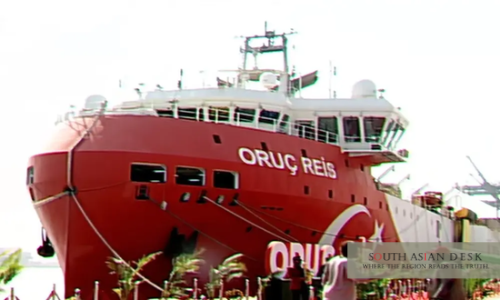
An offshore oil and gas survey in Pakistan’s waters is set to begin after the Turkish seismic vessel Orus Reis arrived at Karachi port on Friday, in what officials described as a new phase of energy cooperation between Pakistan and Turkiye. Turkish Energy Minister Alparslan Bayraktar, who reached Karachi a day earlier, joined Deputy Prime Minister Ishaq Dar, Federal Minister for Petroleum Ali Pervaiz Malik and other officials to receive the vessel, according to Business Recorder.
What the Turkish Survey Involves
Bayraktar said Turkish Petroleum would carry out 3D seismic data acquisition for approximately two months in an area of 670 kilometres in the Indus Sea block. Seismic surveys send sound waves into the seabed and record how they reflect, which allows geologists to map the rock layers below and identify structures that could hold hydrocarbons. The survey is a way of collecting data, and not of drilling for oil or gas.
He said Turkish Petroleum aims to launch operations in the identified fields in 2027, based on the data collected during the survey. He added that he hoped the work would lead to discoveries that would contribute to the development of both countries, and described the project as the beginning of a new era that could shape energy markets, bilateral trade and both economies.
Why the Offshore Oil and Gas Survey Matters
The survey is part of Pakistan’s effort to revive offshore exploration, which has stalled for years because of limited investment and technical capacity, according to the report. Dar said the vessel brings Turkish scientific expertise together with the experience of Pakistan’s national energy companies, and noted that the country’s coastline is connected to important international energy and commercial routes, with opportunities in energy, shipping and fisheries.
The timing is significant. Pakistan’s domestic gas output has fallen by about half over the past decade, according to the managing director of Sui Southern Gas Company, and imported liquefied natural gas has been hard to secure since April because of the Iran war. Officials say new exploration is intended to reduce the country’s reliance on imports, although any discovery would take years to translate into supply.
Background: The First Offshore Auction in Two Decades
The vessel will survey offshore blocks that Pakistan auctioned for oil and gas exploration for the first time in two decades, according to an official statement. Under the Pakistan Offshore Bid Round 2025, Pakistan Petroleum Limited (PPL) announced the provisional award of offshore blocks on 13 November 2025, and signed production sharing agreements and exploration licences for eight blocks on 20 May 2026, in the presence of the petroleum minister.
PPL operates two of the blocks, Gharo Creek and Kochi Creek, and participates in six partner-operated blocks: Bin Qasim South, Keti Bandar, Behr, Zarrar, Offshore Deep D and Sapat Bandar. The blocks lie in the Indus and Makran offshore basins, next to the territorial waters of Sindh and Balochistan. The report did not say which of these blocks the Turkish vessel will survey first, or whether the Indus Sea block it mentioned corresponds to any of them.
Caution From Officials and Industry
Dar was careful about expectations. He said a seismic survey cannot guarantee a commercial discovery, but that no discovery can be made without seismic work and exploration. Industry experts quoted by Business Recorder in May said offshore exploration carries significant long-term potential because parts of the Indus Basin resemble hydrocarbon-rich offshore regions elsewhere. They also noted that offshore drilling is capital-intensive and technically complex.
The history is also a factor. Pakistan’s offshore activity has been limited in recent years, and no major offshore discoveries have been made despite earlier drilling campaigns, according to BR’s reporting. The government has tried to revive investor interest through new bidding rounds and improved regulatory incentives.
What Comes Next
Over the next two months, the survey will generate data that geologists and the licence holders will need to interpret before deciding where, and whether, to drill. Bayraktar’s 2027 target for operations in identified fields suggests that drilling decisions would follow the data analysis, though no wells have been announced. Costs, financing arrangements and the split of any future output under the production sharing agreements were not discussed at the ceremony.
For now, the offshore oil and gas survey is an early step in a process that is expensive, technically demanding and uncertain, and its results will determine whether Pakistan’s offshore acreage moves from exploration to development.
Follow SouthAsianDesk on X, Instagram and Facebook for insights on business and current affairs from across South Asia.