The Sargodha entry ban imposed on Jamiat Ulema-i-Islam-Fazl (JUI-F) chief Maulana Fazlur Rehman and eight other party leaders has deepened an already strained relationship between the religious party and the federal government. A notification issued by the district’s deputy commissioner prohibits the nine leaders from entering, residing or remaining in Sargodha for 30 days. The restriction took effect on November 25, a day before the party was scheduled to hold a rally in the city.
What the Sargodha Entry Ban Notification Says
The order was issued under Section 7(1) of the West Pakistan Maintenance of Public Order Ordinance, 1960, read with the Punjab Maintenance of Public Order (Amendment) Ordinance, 2008. Besides Maulana Fazlur Rehman, whose district is listed as Dera Ismail Khan, the notification names Maulana Naseer Ahmad Abrar, Maulana Amjad Khan and Professor Ghazanfar Aziz of Lahore, Maulana Safi Ullah of Bhakkar, Maulana Muhammad Noor Khan Hans of Multan, Maulana Muhammad Zakria Shah of Faisalabad, Maulana Muhammad Yahya Abbasi of Muzaffargarh and Maulana Jamal Abdul Nasir of Dera Ghazi Khan.
According to the document, the deputy commissioner reached the decision after reviewing a report submitted by the Sargodha district police officer. The report raised concerns that the individuals had a history of delivering provocative and objectionable speeches that could threaten public order. The notification describes the leaders as “firebrand speakers” and states that they were likely to assemble crowds unlawfully and incite public sentiment against the state and its institutions. It adds that their presence could create a law and order situation and pose a potential threat to peace and security in the district.
Detentions and Defiance Ahead of the JUI-F Rally
The administrative action was accompanied by arrests on the ground. Police said several senior JUI-F leaders detained in Sargodha were served notices for allegedly violating Section 144, which restricts public gatherings. Local party leaders were also detained in neighbouring Khushab district under the Maintenance of Public Order Ordinance.
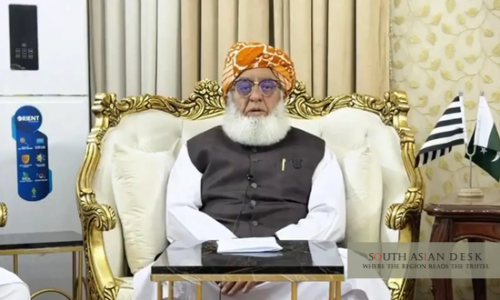
In a video message, the JUI-F chief said that he was leaving for Sargodha despite road restrictions and a blockade. He demanded that the government immediately remove all restrictions, release detained leaders and workers, and ensure that constitutional rights and civil liberties are protected. JUI-F Punjab spokesperson Hafiz Ghazanfar Aziz said the government was continuing its “high-handed tactics” against the party. He claimed that a large number of party workers had been stranded on the road and that arrests were being made across Punjab, with cases registered against JUI-F activists.
A Widening Rift Between the JUI-F and the Centre
The latest restrictions follow weeks of mounting friction. On Tuesday, Maulana Fazlur Rehman claimed that he had been placed under an hours-long “state siege” to restrict his movement. He had been due to attend a multiparty conference hosted by the Lahore High Court Bar Association, but he could not leave his residence in a private housing society on Multan Road because of the deployment of a heavy police contingent.
The tensions have their roots in the federal government’s imposition of governor’s rule in Khyber Pakhtunkhwa, which Fazl criticised. He also accused the Centre of reneging on its commitments despite his efforts to mediate between the PML-N and PTI governments, and he later accused it of depriving the provinces of their rights. The exchange led to harsh remarks between the veteran politician and key federal ministers.
Political support for the JUI-F chief has come from an unexpected quarter. Pakistan Peoples Party Chairman Bilawal Bhutto Zardari, a key ally of the ruling PML-N, has voiced his support for Fazl in recent weeks and condemned the government’s actions against him.
Last week, police and Federal Constabulary personnel deployed to protect Fazl and his family were withdrawn from their residences in Islamabad and Dera Ismail Khan. A JUI-F spokesman confirmed the withdrawal and alleged that the party’s Central Secretariat in Islamabad had been besieged by police. An Islamabad police official, however, said that only one police guard had been withdrawn.
The JUI-F chief’s son has also come under scrutiny from the National Accountability Bureau, which summoned former federal communications minister Asad Mahmood over alleged irregularities in 4,252 appointments at Pakistan Post during his 2022-23 tenure. According to a NAB source, Mahmood skipped two consecutive summonses issued for November 10 and 14. Separately, the JUI-F staged protests in parts of Sindh and Balochistan on November 7 against what it called a “coordinated character assassination campaign” targeting its chief. Party leaders and workers condemned the alleged drone surveillance of his residence and the circulation of footage on social media, and they demanded an impartial investigation.
Implications of the Sargodha Entry Ban
The Sargodha entry ban, together with the detentions and road blockades, has turned a planned JUI-F rally into a test of how far the authorities will go in restricting opposition politics in Punjab. The government has justified the measure on public order grounds, while the party insists that it is a violation of constitutional rights. With the restriction valid for 30 days from November 25, the dispute is likely to remain at the centre of the political debate between the JUI-F and the federal government.
Follow SouthAsianDesk on X, Instagram and Facebook for insights on business and current affairs from across South Asia.
Read More: