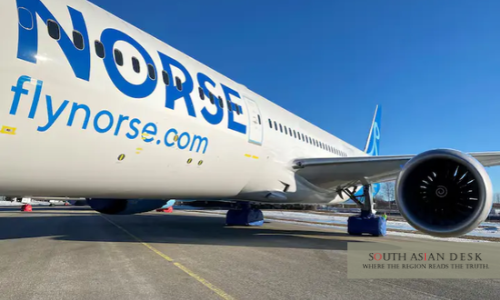
Norse Atlantic bankruptcy proceedings may follow after the Norwegian long-haul airline suspended flights on Thursday and said it intends to file for bankruptcy if a short-term financing solution is not secured urgently, leaving its lease agreement with Pakistan International Airlines (PIA) in doubt, according to Reuters. PIA said on Wednesday that Norse had abruptly suspended the arrangement, forcing it to cancel two flights between Pakistan and the United Kingdom.
What Happened to Norse Atlantic
Norse Atlantic had warned on Wednesday that its financial situation was critical and that it needed new financing for its short-term liquidity and operations, an announcement that sent its share price down 85 percent. In a statement on Thursday, the board said it would file for bankruptcy if no financing solution was found urgently. Its shares fell a further 10.2 percent by 0830 GMT, taking the decline for the year to 99.2 percent.
The airline has returned all its aircraft to bases in Norway, Sweden and Britain, Chief Executive Eivind Roald told the Norwegian business daily Finansavisen. Norse said it is considering options for short-term financing and is in discussions with investors about a possible takeover that would include a financing solution, but added that there can be no assurance a viable solution will be found.
How the Norse Atlantic Bankruptcy Risk Reached PIA
In October, Norse signed an agreement covering aircraft, crew, maintenance and insurance under which PIA would lease two jets, Reuters reported. PIA described the arrangement as a wet-lease, a type of contract in which the lessor supplies the aircraft together with its crew, maintenance and insurance, and the operator sells the seats.
According to Business Recorder, PIA said Norse suspended operations without prior notice just as passenger check-in was about to begin at London and Manchester airports. As a result, PIA cancelled its London-Islamabad flight PK-786 and its Manchester-Lahore flight PK-710. The carrier expressed regret to affected passengers and said it was contacting them to rebook them on later flights.
PIA Shifts to Its Own Boeing 777 Aircraft
PIA said it has taken decisive measures to eliminate dependence on third-party operators, and that it will operate all its UK flights with its own Boeing 777 aircraft from 26 November. A spokesperson said alternative arrangements had been finalised to restore normal flight schedules. The statement did not say how many aircraft would be used, how the change would affect other routes or what costs PIA might face from the failed lease. PIA is now majority-owned by a private consortium after its privatisation, according to earlier reporting.
Reuters described the Pakistani deal as being in limbo, while PIA’s statement indicates that the carrier has already moved away from the lease for its UK operations. Whether the agreement could be revived under a new owner of Norse is not known, and neither company has addressed the question publicly.
Jet Fuel Costs and the Wider Airline Crisis
The collapse reflects pressure across the industry. Reuters described the global aviation sector as suffering its worst crisis since the COVID-19 pandemic, as the conflict involving Iran, which began at the end of February, disrupts operations and raises costs. European jet fuel costs more than doubled in March after supply disruptions linked to the war and have stayed volatile at elevated levels since. Fuel typically accounts for about a fifth of an airline’s costs.
Norse is not the only carrier in difficulty. Latvia’s airBaltic announced earlier that it was entering Chapter 11 bankruptcy proceedings and restructuring as it sought to secure new financing. Norse launched a formal process for a possible sale or merger in July.
Norse’s own business model also faced challenges before the war. It was founded in 2021 by entrepreneur Bjorn Tore Larsen after Norwegian Air abandoned long-haul operations during the pandemic, and flew 12 Boeing 787 Dreamliners with many former Norwegian staff. Analysts noted early on that, as a pure long-haul player, it lacked a feeder network of regional connections to fill its transatlantic flights. It later diversified into charter and aircraft leasing services as scheduled flying alone failed to generate profits.
What Comes Next
The immediate question for Norse is whether it can secure financing or a buyer before filing for bankruptcy. For PIA, the next steps are the rebooking of affected passengers and the performance of its own Boeing 777s on the UK routes, where it competes in a market that depends heavily on travellers between Pakistan and Britain.
The episode shows the risk of relying on a lessor under financial strain. Whether Norse Atlantic bankruptcy proceedings go ahead will determine whether any part of the October agreement survives, and PIA’s decision to use its own aircraft suggests it does not intend to wait.
Follow SouthAsianDesk on X, Instagram and Facebook for insights on business and current affairs from across South Asia.