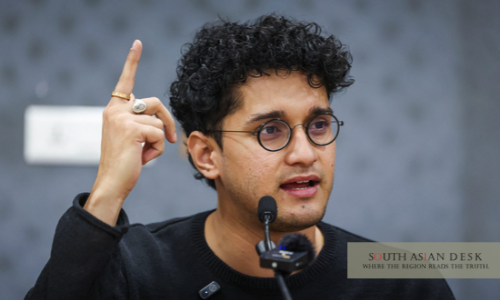
The Saurav Das passport notice has become the latest point of tension between the Indian government and one of the country’s most visible youth protest groups. India’s foreign ministry said on Wednesday that passport authorities had asked Das, a leader of the Cockroach movement, not to use his passport until he clarifies information about his place of birth. Das has challenged the move before the Delhi High Court, which is due to hear his petition on Thursday.
What the Foreign Ministry Said About the Saurav Das Passport Notice
Foreign ministry spokesperson Randhir Jaiswal told a regular media briefing that passport authorities issue a notice when a discrepancy is noted or reported. He said Das was also advised not to use the passport until he had submitted his response. Reports in Indian media said the notice was a show-cause notice issued by the Chennai Regional Passport Office, which issued the passport in 2019, and that Das was given seven days to reply.
The ministry has not publicly detailed the nature of the discrepancy beyond its reference to his place of birth. Its position is that issuing such notices is an established procedure applied to passport holders when questions about their details arise.
Airport Incident Ahead of a London Trip
The dispute came to public attention on Monday, when Das said he had been stopped at Delhi airport hours before he was due to fly to London. According to his account, he was scheduled to speak to students, and Indian media reported that one of the events was at the University of Oxford. Das accused Prime Minister Narendra Modi’s government of trying to silence dissent and stifle debate by blocking his travel to Britain.
The government has rejected that characterisation by presenting the matter as a routine administrative step linked to his passport details. The two accounts differ sharply, and the Delhi High Court is now expected to examine the legal basis for the restriction.
Who Is Saurav Das and What Is the Cockroach Movement?
Das is the chief spokesperson of the Cockroach Janta Party, which presents itself as a mock political party and uses satire to criticise the political establishment. The group was launched online in May and has since built a following of millions on social media. Its name plays on the ruling Bharatiya Janata Party, and it draws much of its support from young people.
The Cockroach movement first made national headlines earlier this year when a weeks-long sit-in by its supporters led to the resignation of Education Minister Dharmendra Pradhan over exam paper leaks. More recently, Das led thousands of young supporters in demanding the resignation of Chief Election Commissioner Gyanesh Kumar over voter list revisions that critics say favour the BJP. The Election Commission has not been reported to have accepted that characterisation.
Earlier Detention at Jantar Mantar
Das was also among 14 people who scaled barricades on 13 October to enter the Jantar Mantar observatory in central Delhi, a day after the site was removed from the list of designated protest sites. He was detained for a few days after that incident. His critics have pointed to the episode as evidence of the movement’s confrontational tactics, while his supporters see it as part of a wider pattern of pressure on protest activity.
The Delhi High Court Petition
Das told the court, according to the legal news website LiveLaw, that the government’s move should be set aside. The case is likely to turn on whether the passport authorities followed due process in issuing the notice and whether advising a passport holder not to travel pending a response is consistent with the law. Courts in India have previously recognised the right to travel abroad as part of personal liberty under Article 21 of the Constitution, which means that any restriction must follow a procedure established by law.
The foreign ministry has said that Das remains free to respond to the notice, and that clarifying his place of birth would resolve the matter. His response, and the court’s observations on Thursday, will therefore shape what happens next.
What Happens Next
The outcome of the hearing will determine whether Das can resume international travel in the near term and whether the passport authorities will need to justify the notice in greater detail. For the wider Cockroach movement, the case has already become a rallying point, drawing attention to how the state handles prominent critics. For the government, it tests whether an administrative process can withstand scrutiny when the person concerned is a public political figure. Either way, the Saurav Das passport notice is likely to remain in the headlines as the court proceedings unfold.
Follow SouthAsianDesk on X, Instagram and Facebook for insights on business and current affairs from across South Asia.