Sheikh Hasina’s return to Bangladesh is a matter distinct from Dhaka’s extradition request, India’s foreign ministry said on Wednesday, responding to the former prime minister’s announcement that she intends to fly home next month. Foreign ministry spokesperson Randhir Jaiswal told a regular media briefing that the extradition request is being examined in line with established procedures, while the case of a citizen who wishes to return voluntarily on a travel document is a separate question. He did not elaborate.
India Draws a Line Between Two Issues
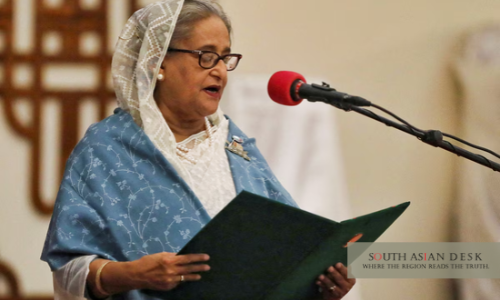
The statement is notable for what it leaves unsaid. New Delhi has not indicated whether it will act on Dhaka’s request or whether it would assist or obstruct a voluntary return by the 79-year-old former leader. By treating the two matters as separate, India has kept both options open while avoiding any commitment on the central demand made by the Bangladesh government. Hasina has lived in India since 5 August 2024, when she fled Dhaka after a student-led uprising ended her 15-year rule.
Why Sheikh Hasina’s Return to Bangladesh Has Drawn Attention
The question gained urgency this week after Hasina’s spokesperson, Syed Mozammel Ali, told Reuters that she plans to return on 16 December. The date is Victory Day in Bangladesh, which marks the end of the 1971 Liberation War with Pakistan. In a statement, the spokesperson said that because Hasina was flown to India on a Bangladeshi aircraft in 2024, the government should now arrange her air transport from Delhi back to Dhaka. She has also asked for a new passport, her previous one having been cancelled months after she left the country. Dhaka has rejected that request.
Bangladeshi officials have responded firmly. A minister told Reuters on Sunday that Hasina would be arrested and jailed on arrival and that there had been no official discussions with India about sending an aircraft for her. Bangladesh’s state minister for foreign affairs, Humayun Kabir, has said she could return only through extradition and under strict surveillance.
The Death Sentence and Dhaka’s Extradition Request
The legal background explains why the Bangladesh government is insisting on a formal process. In November 2025, Bangladesh’s International Crimes Tribunal sentenced Hasina to death in absentia after convicting her of crimes against humanity over the crackdown on protesters during the 2024 uprising. The government says that, given the death sentence, she must be returned under the extradition treaty between the two countries.
Dhaka first formally sought her extradition in December 2024, and it has repeated the demand since the verdict. India said in April this year that it was examining the request and wanted to engage constructively with the new government in Dhaka. A Bangladesh government adviser, Zahed Ur Rahman, said this week that the issue would be discussed with India, and that extradition and voluntary return were different matters. On that narrow point, the positions in Dhaka and New Delhi are close, although they draw very different conclusions from it. Bangladesh argues that Hasina can come back only by extradition, while India has said that a voluntary return is a separate question that does not depend on the pending request.
What a Voluntary Return Would Involve
A voluntary return would raise several practical difficulties. Hasina would need valid travel documents, and the Bangladesh government has ruled out issuing a fresh passport. She would also need transport, and the authorities in Dhaka have said no arrangements are under discussion. Even if she were to travel by some other means, she would face arrest on arrival. These obstacles suggest that the announced date of 16 December may be as much a political statement as a travel plan, though her camp has described the date as deeply symbolic.
Wider Implications for India and Bangladesh
The episode comes at a delicate moment for relations between the two neighbours. In the same briefing, India expressed concern over attacks on religious minorities in Bangladesh and urged the authorities there to investigate the incidents and bring those responsible to justice. The pairing of those remarks with the statement on Hasina underlines how many unresolved issues now sit between the two governments.
For New Delhi, the challenge is to respond to the extradition request without appearing to give up its long-standing ties with Hasina or to disregard Dhaka’s legal process. For Dhaka, the priority is to ensure that the death sentence imposed by its tribunal is not seen to be undermined. Much will depend on whether Hasina follows through with her stated plan, and on how India chooses to treat the travel document she is seeking. Until then, Sheikh Hasina’s return to Bangladesh remains uncertain, and the legal and diplomatic questions surrounding it are unlikely to be settled before 16 December.
Follow SouthAsianDesk on X, Instagram and Facebook for insights on business and current affairs from across South Asia.